How do you read the forex market before you trade?
The framework behind every ForexCommand roundup — six layers, read top-down, that turn a wall of charts into one question: is now a good time?

Open a forex platform and you drown in it: dozens of pairs, a news feed, three indicators fighting for your attention — and none of them answers the only question that matters before you click buy. Is right now a good time to trade?
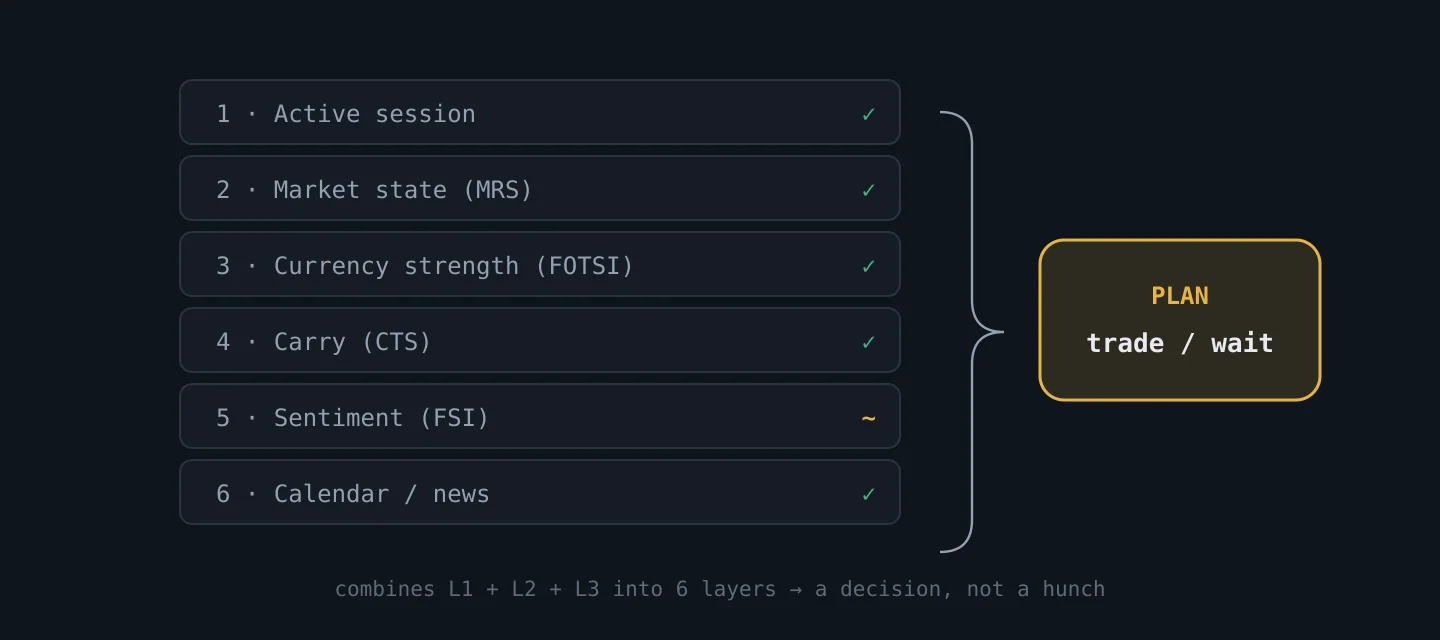
We built ForexCommand around that question. Here is the framework we use to answer it — the same one behind every daily roundup and every score in the tool. It reads the market in six layers, top-down. Each layer narrows the picture.
First — is the market even awake?
Price moves when money is at the desk. The forex day is a relay of three sessions — Tokyo, London, New York — and each has its own temperament. Trading sessions decide when the market is alive and when it's asleep; the real energy shows up where two of them overlap. Trading a dead hour is the most common unforced error there is.
How much room does the day have?
An awake market can still be going nowhere. Before anything else, we ask how much room conditions leave for a move — volatility, the active session, the news load, the macro backdrop, positioning. That is exactly what the Market Readiness Score (MRS) rolls into a single 0–100 read. It is not a signal — it is a green light versus a red one for conditions.
Which currency is actually strong?
A pair is a tug-of-war between two currencies, and the chart hides which one is pulling. Splitting the pair into its two halves — measuring each currency's strength on its own — usually shows the winner before the candles do. The FOTSI oscillator is how we read that.
What does the trade pay — or cost — to hold?
Some positions pay you every night just for being in them; others bleed you quietly. That is carry, driven by the interest-rate gap between the two currencies. The Carry Trade Score (CTS) measures it, so a swing trade isn't fighting the overnight math. (Here is the carry trade from scratch if it's new to you.)
What is the market's mood?
Markets run on fear and greed, and sentiment turns before price does. We fold institutional positioning (COT), volatility, the VIX, and retail bias into one fear-and-greed read: the Forex Strength Index (FSI). Extreme readings are a warning, not a trigger.
What could blow it all up today?
Finally, the calendar. A single data release can erase a clean setup in seconds — but only if it surprises. What matters is the gap between forecast, previous, and actual, and knowing how to trade around a release without getting stop-hunted.
So — is now a good time to trade?
That is the whole point. No single score decides it; the sequence does. An awake session with room to move, a clearly strong currency, carry on your side, sentiment that isn't stretched, and no landmine on the calendar — that is a good time. Miss two or three of those and the cleanest-looking chart is a trap.
None of this is a signal service, and none of it tells you what to buy. It is a lens — a way to turn a wall of charts into one honest answer. That is the daily forex analysis behind every roundup we publish, and it is what the tool puts on your screen so you don't have to assemble it by hand.