
What is ICT (Inner Circle Trader)?
ICT refers to the educational material of Michael J. Huddleston ('The Inner Circle Trader'), a specific school within the broader SMC / price-action world that popularised terms…

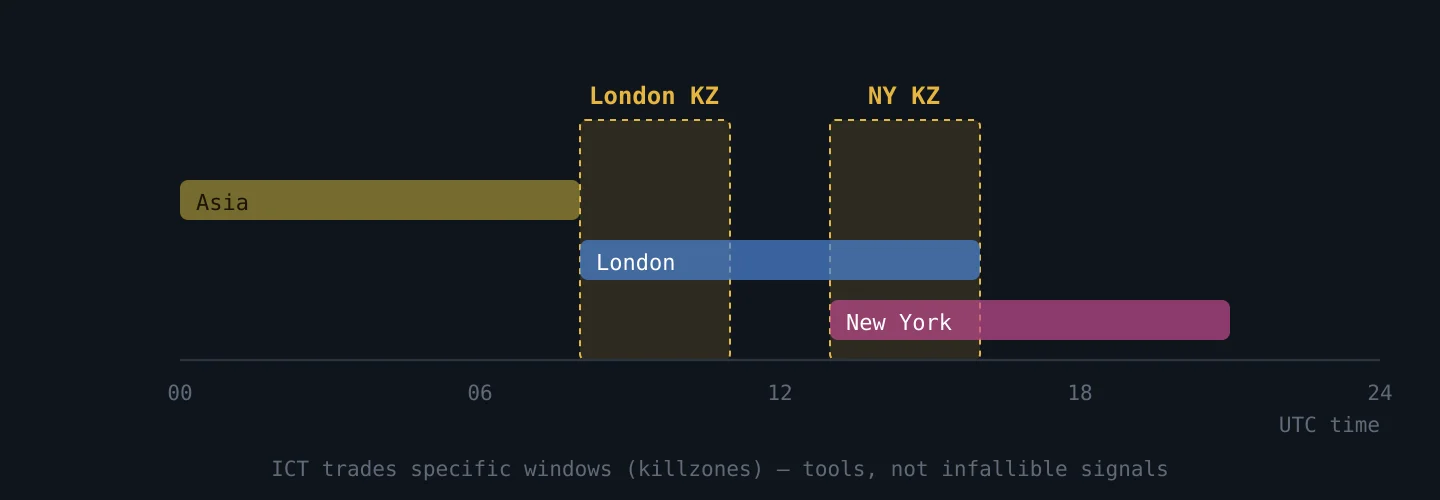
ICT refers to the educational material of Michael J. Huddleston ('The Inner Circle Trader'), a specific school within the broader SMC / price-action world that popularised terms like fair value gap, liquidity pools, order blocks, inducement, the 'silver bullet', and 'killzone' session windows, offering one influential teacher’s version of these heavily overlapping concepts.
What is ICT, and what does it aim to show on a chart?
ICT is a specific trading methodology developed by Michael J. Huddleston. It is one specific school within the broader SMC / price-action world, focusing on interpreting price movements through the lens of institutional ('smart money') activity.
It popularised terms such as fair value gap (FVG), liquidity pools, order blocks (OB), and specific trading times like the 'silver bullet' and 'killzone' session windows. On a chart, ICT concepts aim to pinpoint areas where institutional participants are likely to have left their footprint, indicating potential future price reactions.
How does ICT relate to Smart Money Concepts (SMC)?
SMC and ICT overlap heavily: SMC is the umbrella of concepts that analyse market structure, order flow, and liquidity from an institutional perspective. ICT is one influential teacher’s version of them, providing a structured curriculum and specific frameworks for applying these ideas.
The core idea shared is that understanding how large institutions operate in the market can offer an edge, rather than relying solely on retail technical analysis tools.
How can a trader practically use ICT concepts?
Traders using ICT methodologies often look for specific patterns or market conditions. For instance, after observing a market structure shift (BOS or CHoCH), a trader might identify a newly formed Fair Value Gap (FVG) or Order Block (OB). These areas are then treated as potential zones where price might retrace before continuing its previous direction, offering opportunities for entry confirmation.
For example, if price breaks higher, indicating a bullish shift, an ICT trader might look for a subsequent retracement into a clean FVG or a prior bullish OB, anticipating a reaction from these "institutional footprints." Combining this analysis with broader market context, perhaps informed by ForexCommand's MRS (Market Readiness Score), can provide a more comprehensive view.
What is a common mistake beginners make with ICT?
A common mistake beginners make is treating ICT concepts as infallible signals rather than discretionary tools. The methodology is complex and requires significant practice to identify concepts accurately and understand their context within the overall market flow, including considering areas of existing liquidity.
Simply spotting an FVG or OB does not guarantee a trade will work out; successful application requires understanding market structure, timing, and often, confluence with other factors. It is a discretionary framework, not a set of rigid, automated rules.