Can AI genuinely predict future forex prices?
Artificial intelligence (AI) and Large Language Models (LLMs) can analyze vast amounts of forex market data, news, and sentiment to identify complex patterns and generate…

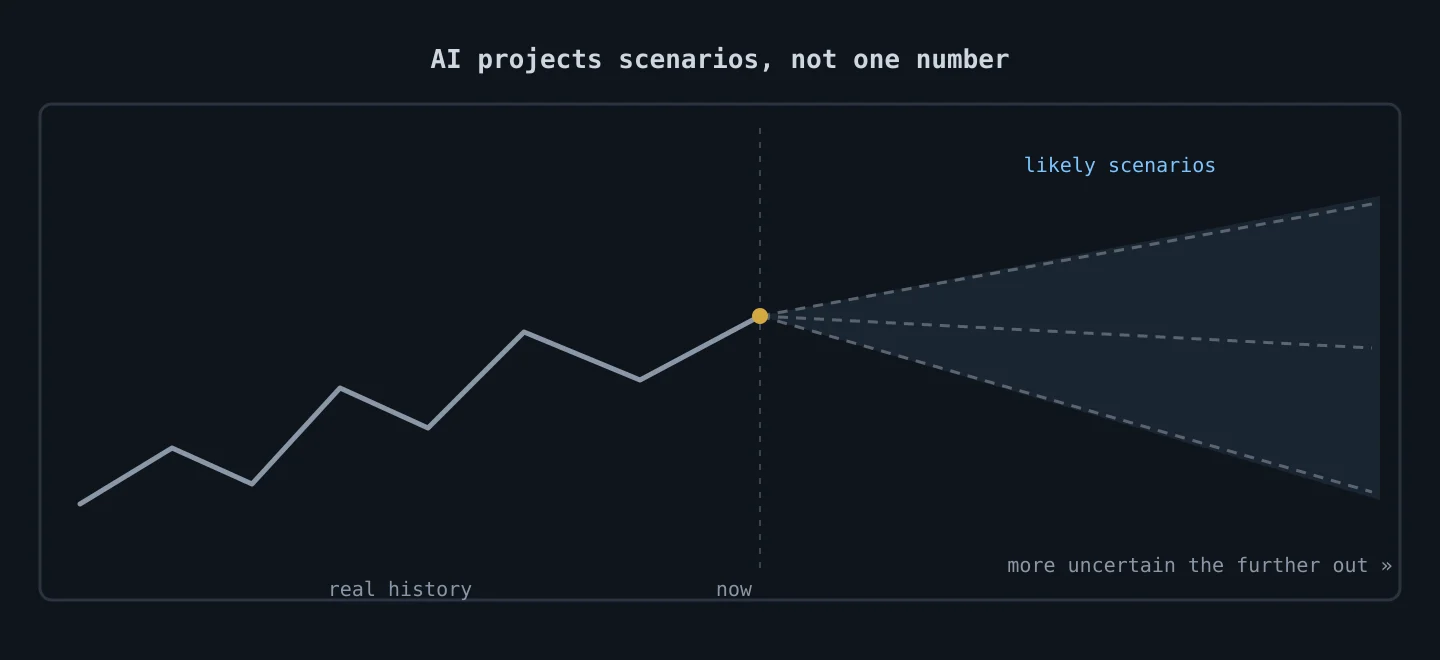
Artificial intelligence (AI) and Large Language Models (LLMs) can analyze vast amounts of forex market data, news, and sentiment to identify complex patterns and generate insights, but they cannot reliably predict future currency prices with consistent accuracy or certainty due to the market's inherent complexity, serving instead as powerful analytical co-pilots for human traders.
Why does it matter for a forex trader?
For any beginner forex trader, understanding AI's true capabilities is crucial to avoid unrealistic expectations and potential financial losses. Many hope AI offers a shortcut to profitable trading by accurately forecasting market movements. However, relying on AI for definitive price predictions can lead to poor decision-making and neglect of essential trading skills like risk management and independent analysis.
Recognizing AI as a co-pilot, rather than a pilot, allows traders to leverage its power for enhancing their research and analytical processes. This perspective helps in developing more robust trading strategies, freeing up time for critical thinking and learning.
How does it actually work?
AI in trading primarily works by processing and analyzing vast datasets to uncover patterns that humans might miss. This involves machine learning, a type of AI that allows systems to learn from data without explicit programming. These algorithms can sift through historical price charts, economic indicators, news headlines, and even social media sentiment.
Large Language Models (LLMs), which are advanced AI programs capable of understanding and generating human-like text, can summarize complex economic reports or identify sentiment trends from numerous news sources. Traders might use them to quickly gauge market sentiment by prompting an LLM to analyze recent financial news. This analysis helps identify potential correlations or anomalies, which can then be tested using backtesting – applying a strategy to past data to see how it would have performed.
What are the limits you must respect?
The most critical limit to respect is that AI cannot predict the future. While AI excels at pattern recognition in historical data, forex markets are dynamic and influenced by countless unpredictable factors, including geopolitical events, sudden policy changes, and human psychology. These "black swan" events often defy historical patterns.
AI acts as a powerful information, research, and analysis layer, but it is not a magical crystal ball. Over-reliance on AI for trading decisions can be dangerous, as its models are only as good as the data they are trained on, and past performance does not guarantee future results. Always remember that AI is a co-pilot; it assists by providing data-driven insights and helping manage information overload. The ultimate decision-making, risk management, and responsibility for any trade remain firmly with the human trader.
Can forex be predicted at all?
No method — human or AI — predicts forex prices with consistent accuracy. Currency markets react to unscheduled news, policy shifts, and human emotion that no historical pattern fully captures. You can read conditions and probabilities, never certainties. Even Jim Simons, the mathematician who came closest to 'solving' the market, won on edges that paid off on average — never on predicting the next price.
Does AI forex prediction actually work?
AI is strong at pattern recognition and summarising data, but any "AI forex prediction" that promises a reliable forecast is selling a certainty the market cannot deliver. Treat a tool that claims to predict price as a red flag, and use AI to inform your own analysis instead.