AI and LLMs in forex trading: use them as a co-pilot, not a pilot
An LLM does not trade for you — it is an information layer. What is it genuinely good for? The line you cannot cross and the question that actually matters.

A quiet shift has shown up lately: a lot of people no longer come to forex asking "which strategy should I learn?" but "which AI can just handle it for me?"
There are actually two different questions hiding in there. One is "can a bot trade for me?" — and we already answered that in our look at what trading bots can and can't do. The other, the one this article is about, is more interesting: how does an LLM change the way you learn and decide?
An LLM is not a trading bot
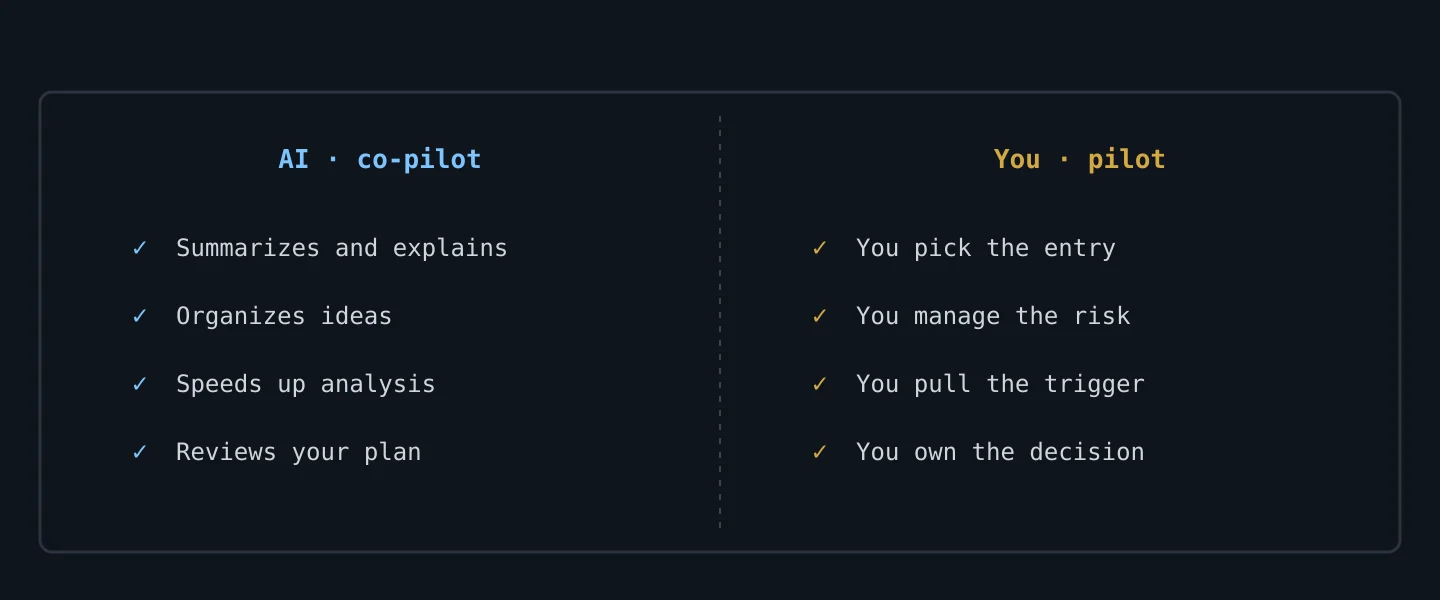
Worth separating clearly. A bot executes orders; a language model (ChatGPT, Claude, Gemini) generates text. It doesn't trade for you or "see" the market: it completes the most likely sentence. That makes it useless as an entry oracle, but powerful as an information layer:
- It explains concepts at your own pace, like an infinite tutor.
- It summarizes central-bank statements or macro news in seconds.
- It tidies your plan and journal, and helps you spot your own patterns (that you overtrade on Fridays, that you move your stop when you're underwater).
If you want the sharper distinction between a rules-based AI trading bot and this kind of assistant, that's its own topic — here we stay on the assistant.
Where does a co-pilot actually earn its keep?
Concrete, boring, and genuinely useful — that's the tell of real value. A few places an LLM pays for itself:
- Reading the news wall. Paste three central-bank headlines and ask for the net tone. That's lightweight AI sentiment analysis: not a signal, but a fast read on which way the room is leaning before you form your own view.
- The pre-trade checklist. Have it turn your rules into a five-question gate you must pass before clicking buy. It won't enforce discipline — it just makes skipping it harder.
- The journal post-mortem. Feed it last month's trades and ask what you keep repeating. An honest mirror beats a flattering memory.
- The infinite tutor. Any term you don't fully own — order block, carry, real yields — gets explained until it clicks, at your pace, without judgement.
Notice the pattern: every one of these hands you better information. None of them pulls the trigger.
Garbage prompt, garbage answer
The single biggest variable isn't which model you pick — it's how you ask. "Is EUR/USD bullish?" earns you a vague horoscope. "Summarize the last ECB statement in five bullets, flag anything hawkish, and cite the line" earns you something you can actually check. The skill that separates a useful co-pilot from a confident liar is your ability to frame the request and verify the answer — which is why good AI prompts for trading are worth learning as their own craft.
The line you can't cross
People get burned asking it for what it can't give:
| What can't it give you? | What happens if you ask? |
|---|---|
| Predicting price | "Will EUR/USD go up tomorrow?" gets you a convincing, worthless answer. |
| Real-time data | When it doesn't know, it makes up levels and figures. Always verify against a real source before trading. |
| Managing your risk | That's yours, always: how much to risk per trade is something you learn, not something you delegate. |
And be suspicious of the trendy label: that "AI" with a guaranteed 95% win rate is the same old magic bot in new clothes. The honest version of this — where the real risks of AI in trading live — is the boring truth: it helps you think, it does not think for you.
The question that actually matters
It isn't "will AI trade for me?" but "am I using it to learn faster, or to skip learning altogether?"
The automation worth having isn't the one that decides for you, but the one that gives you better information so you decide better. As a co-pilot, AI makes you faster and more disciplined. As an autopilot, it just helps you lose money with better presentation.
Learn the craft first. Then let AI amplify you.