Petrocurrencies: why does the Canadian dollar rise and fall with oil?
Crude ticks up and the Canadian dollar tends to follow, almost like a reflex. It is not a coincidence — it is what makes a currency a petrocurrency. Here is the mechanism.

Watch crude climb and, more often than not, the Canadian dollar climbs with it — almost like a reflex. Watch oil crash and the loonie usually sags. That link is not a coincidence or a superstition. It is what makes a currency a petrocurrency, and understanding it turns a confusing chart into an obvious one.
What is a petrocurrency?
A petrocurrency is the currency of a country whose economy leans heavily on selling oil and gas. When a huge slice of your national income arrives in exchange for crude, the health of your economy — and the demand for your money — rises and falls with the price of that crude. The clearest examples are the Canadian dollar (CAD), the Norwegian krone (NOK) and the Russian rouble (RUB).
Why does oil pull the currency up?
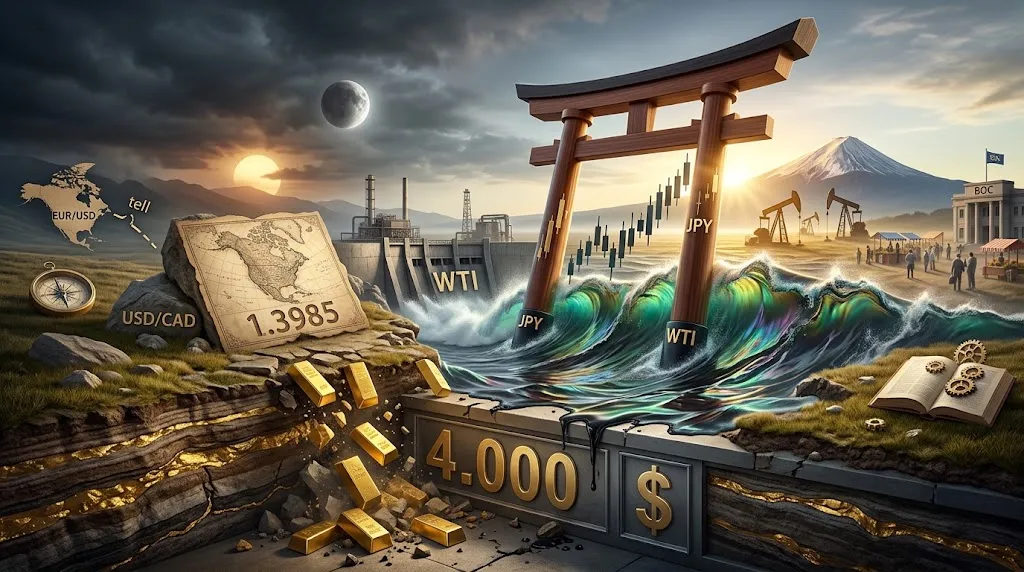
Follow the money. When oil prices rise, an exporting country earns more foreign currency for the same barrels. That improves its trade balance, lifts government revenue, and — crucially for a trader — increases the demand for its currency: buyers of its oil need its money, or the export proceeds get converted home. More demand for the currency pushes it up, which is why USD/CAD often falls as crude rises. It is a fairly direct chain from the commodity to the exchange rate.
What about the countries that buy oil?
The mirror image. A big oil importer like Japan (JPY) or India (INR) has to spend more foreign currency to buy the same energy when crude is expensive. That worsens its trade balance and tends to weigh on its currency. So a single move in oil can push two currencies in opposite directions at once — lifting the exporter, pressuring the importer — which is exactly why an oil shock ripples so widely across the forex board.
Is the oil-currency link ever broken?
Yes, and it is worth respecting. The correlation is strong but not a law. Interest-rate decisions, a broad risk-off wave, or a country’s own politics can overpower the oil signal for a while. The rouble is the sharpest reminder: sanctions can sever the normal link entirely, so a petrocurrency stops trading on oil and starts trading on politics. Treat the correlation as a powerful tendency, not a guarantee.
From concept to trade
Once you see the petrocurrency link, the CAD and NOK stop being random tickers and become, in part, a leveraged bet on crude. When oil moves on a geopolitical headline — a choke-point scare, a supply cut — you already know which currencies sit at the end of that chain, and why they lean the way they do.
We started with fear, then the trigger, now the commodity itself. Next we give the fear a price tag: the geopolitical risk premium — why uncertainty alone, before anything actually happens, already moves markets.