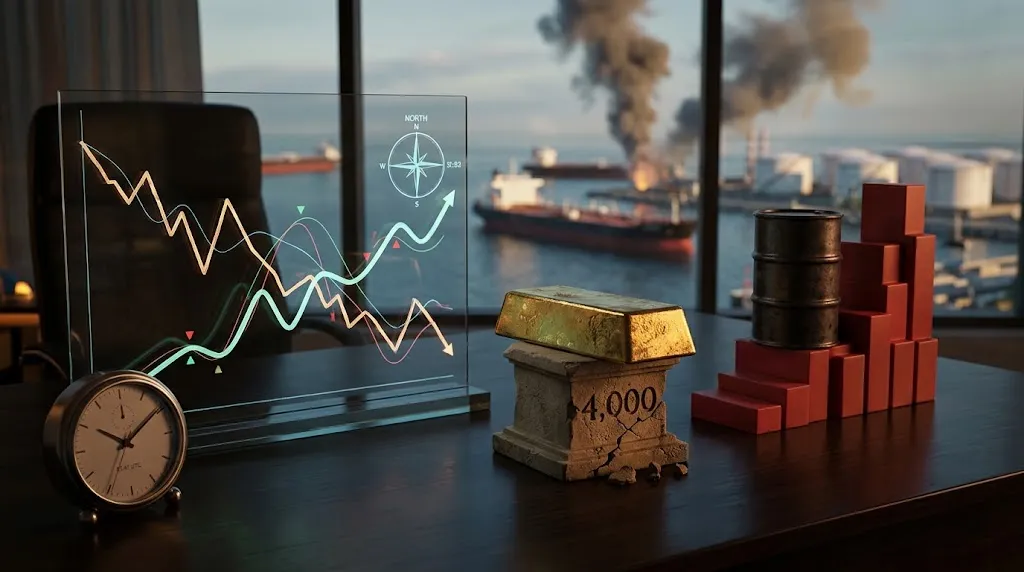
Safe havens: why does the dollar rise when fear hits the market?
A war headline hits and the dollar jumps while your AUD/USD sinks. That reflex has a name — the flight to safe havens. Here is the mechanism, not just the news.

A missile lands in a shipping lane, a central bank warns of recession, an election result shocks investors — and within minutes the same thing happens: the US dollar climbs, gold climbs, and risk-sensitive pairs like AUD/USD slide. It looks like magic. It isn’t. It’s one of the most reliable reflexes in all of finance, and it has a name: the flight to safe havens.
What is a safe-haven asset?
A safe haven is an asset investors buy when fear rises, because they expect it to hold its value while riskier things fall. It is not about earning the highest return — it is about not losing. When uncertainty spikes, money doesn’t disappear; it moves. It leaves anything that depends on growth and optimism, and it parks somewhere it can wait out the storm. The classic havens are the US dollar (USD), the Swiss franc (CHF), the Japanese yen (JPY) and gold.
Why is the dollar the number-one haven?
Three reasons stack on top of each other. First, liquidity: the dollar is the most traded currency on earth, so you can move billions in and out without pushing the price against yourself. Second, backing: US Treasury bonds are the deepest, most trusted “park your cash here” market in the world. Third, and biggest, the dollar is the global reserve currency — a huge share of world trade and debt is priced in dollars. In a crisis, companies and governments everywhere suddenly need dollars to cover dollar-denominated obligations, and that scramble alone lifts demand.
How does this show up on the chart?
This is the part that matters for a trader. The market flips into what’s called “risk-off” mode. Capital flees the currencies tied to growth and appetite — the Australian dollar (AUD), the New Zealand dollar (NZD), most emerging-market currencies — and flows toward the havens. The concrete result: AUD/USD and NZD/USD tend to fall, because the “risk” side of the pair is being sold and the “safe” side bought at the same time. Two forces push in the same direction, which is why safe-haven moves can be fast and violent rather than gentle.
Do all safe havens move together?
No — and this is where beginners get caught. Havens are a spectrum, not a team. The franc and the yen sometimes rise even harder than the dollar, because Swiss and Japanese investors repatriate money home in a panic. Gold is trickier still: it’s priced in dollars, so when the same fear that drives people into gold also drives them into the dollar, a stronger dollar compresses gold’s price even as demand for it rises. That’s why you’ll sometimes read “gold up on war fears” and “gold capped by a strong dollar” in the same week — both are true.
From concept to trade
Here’s the shift this gives you. When the next geopolitical headline drops, the useful question isn’t “is this bad?” — plenty of bad news barely moves markets. The question is “does this flip the market into risk-off?” If it does, the safe-haven playbook is already in motion before the details are clear. Reading that switch is exactly what a market-readiness read is built to weigh, and it’s the thread that ties this whole series together.
This is only the first piece. A safe haven explains why the dollar rises — but not what pulls the trigger. In the next explainer we’ll zoom into a single narrow stretch of sea, the Strait of Hormuz, and watch how one choke point can set this entire chain in motion.