
Priced in: why does the market's reaction beat the number?
Good data, falling price? Markets trade the surprise, not the number. How 'priced in', 'buy the rumor' and the reaction itself reveal what a release really means.

A jobs report beats forecasts and the dollar falls. An inflation print cools and yields rise. If that has ever confused you, this is the lesson that fixes it.
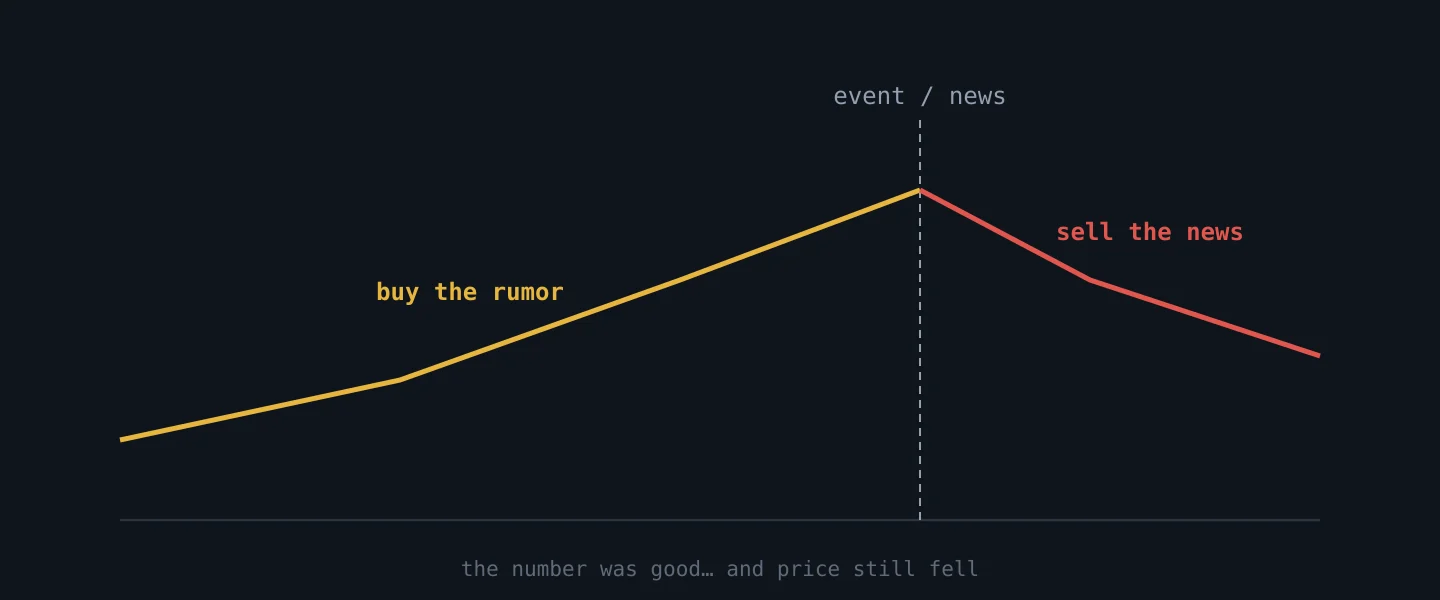
Markets trade the surprise, not the number
A data release has three numbers: the previous reading, the forecast (what the market expected) and the actual. Price doesn't react to the actual in isolation — it reacts to the gap between actual and forecast. That gap is "the surprise". A strong number that merely matches expectations is, to the market, a non-event; a weak number that beats a worse forecast can rally.
So the first question is never "was the data good?" It's "was it better or worse than what was already expected?"
"Buy the rumor, sell the fact"
Markets are forward-looking. By the time a widely anticipated release prints, traders have already positioned for it — the expectation is in the price. When the news merely confirms what everyone expected, those positions get closed for profit, and price can move against the data. That's the old floor adage: buy the rumor, sell the fact.
This is why a hawkish report can fail to lift a currency: the hike it implies was already bought. The data confirmed the story; it didn't add anything new.
Read the reaction, not just the release
Because expectations are invisible and reaction is not, the cleanest read is price itself. A simple test:
| Data | Price | What does it mean? |
|---|---|---|
| Good | Up | The surprise was real and not fully priced. Trend intact. |
| Good | Down or flat | It was already priced — positioning is stretched, and a reversal may be brewing. |
| Bad | Up | The market expected even worse, or had positioned for a disaster that didn't come. |
The reaction tells you how the data landed against positioning — information the headline number alone never gives you.
A worked example
Picture a strong US jobs report. If the dollar jumps, the market wasn't fully positioned for strength and the move has fuel. If the dollar sells off on a strong number, the hike it implies was already in the price, and the smart read is that the good news is exhausted. Same data, opposite trades — decided entirely by what was priced in.
The takeaway
Stop grading data as simply good or bad. Grade it against expectations, then let the market's reaction confirm how it actually landed. The number is the input; the reaction is the answer. Learn to read the second and the first stops fooling you.