
What is a mitigation block?
A mitigation block is an order block that failed without a liquidity sweep: price fell short of the previous extreme, then broke structure the other way. How to spot it.

A mitigation block is an order block that failed without a liquidity sweep. Price tried to extend the move, fell short of the previous high or low in what is called a failure swing, and then broke market structure the other way. The block left behind becomes a zone traders expect to act in the new direction when price comes back.
What does a mitigation block look like on a chart?
Take the bullish case. Price makes a swing low, rallies to a swing high, and turns down; the last up-close candle before that turn is a bearish order block (OB). Price then falls but stops short of the earlier swing low, turns, and closes above the swing high. The bearish block has failed, and it is now a bullish mitigation block, expected to act as support when price returns. The bearish case is the mirror image.
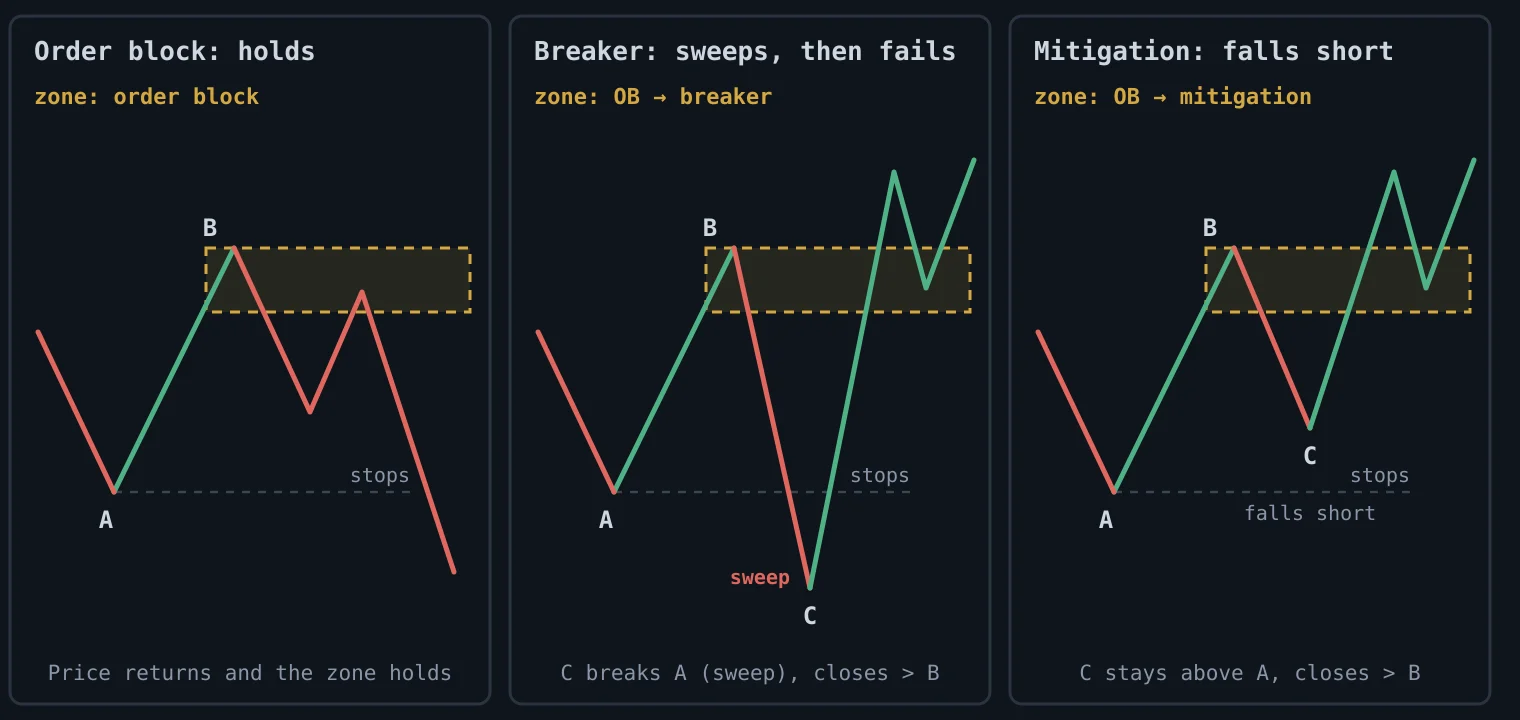
Had the fall first run below the earlier swing low, taking out the stops resting there, the same failed block would be called a breaker block. That sweep is the only thing separating the two. We compare them side by side, with five years of hourly data, in our post on order blocks, breaker blocks and mitigation blocks.
Why is it called "mitigation"?
The name comes from a story about the traders on the wrong side. In the bullish case, those who sold the failed swing are trapped once price closes above the swing high, and when price comes back to their entry they buy to close out near break-even, mitigating the loss. That buying is what is supposed to push price away from the zone again.
It is a story, not something a retail chart can show: you see the candles, never who is trapped. It is also a different use of the word from "mitigated", which only means that price has returned to an order block and, under the framework's own logic, used it up. Smart Money Concepts (SMC) frameworks such as ICT (Inner Circle Trader) and the Market Maker Model (AMD) use both meanings. Context from ForexCommand's MRS (Market Readiness Score) or CTS (Carry Trade Score) can add market context to an SMC read.
How do traders use mitigation blocks?
Once structure has broken, traders mark the block and wait for price to return to it, looking for a reaction in the direction of the new structure: in the bullish case, a rejection inside the zone, with the stop below it. Arriving at the zone proves nothing; the reaction is the evidence.
Some ICT tutorials rank the mitigation block below the breaker block, because the breaker has swept liquidity first. On our hourly data for ten forex pairs, that ranking did not hold up: once the width of the zone and its distance from price were matched, the two held about equally often, and neither held more often than an ordinary band of the same size.
What is a common beginner mistake with mitigation blocks?
The most common one is calling any order block a mitigation block. A mitigation block only exists after an order block has failed: no failure swing and no break of structure against the block, no mitigation block. The second is mixing up "mitigated", a state of any order block, with "mitigation block", a pattern.
Focusing solely on the mitigation block in isolation, without considering the overall market trend, liquidity dynamics, or higher timeframe analysis, also leads to poor outcomes. SMC is a comprehensive framework; a mitigation block is one tool, not a standalone strategy.
Updated October 2026: an earlier version of this page described the mitigation block as little more than another name for an order block. That is not the standard definition, and we have corrected it.