
What is a Fair Value Gap (FVG)?
A Fair Value Gap (FVG) is one type of imbalance: a three-candle pattern where rapid price movement leaves an unfilled space on the chart. This gap, between the wick of…

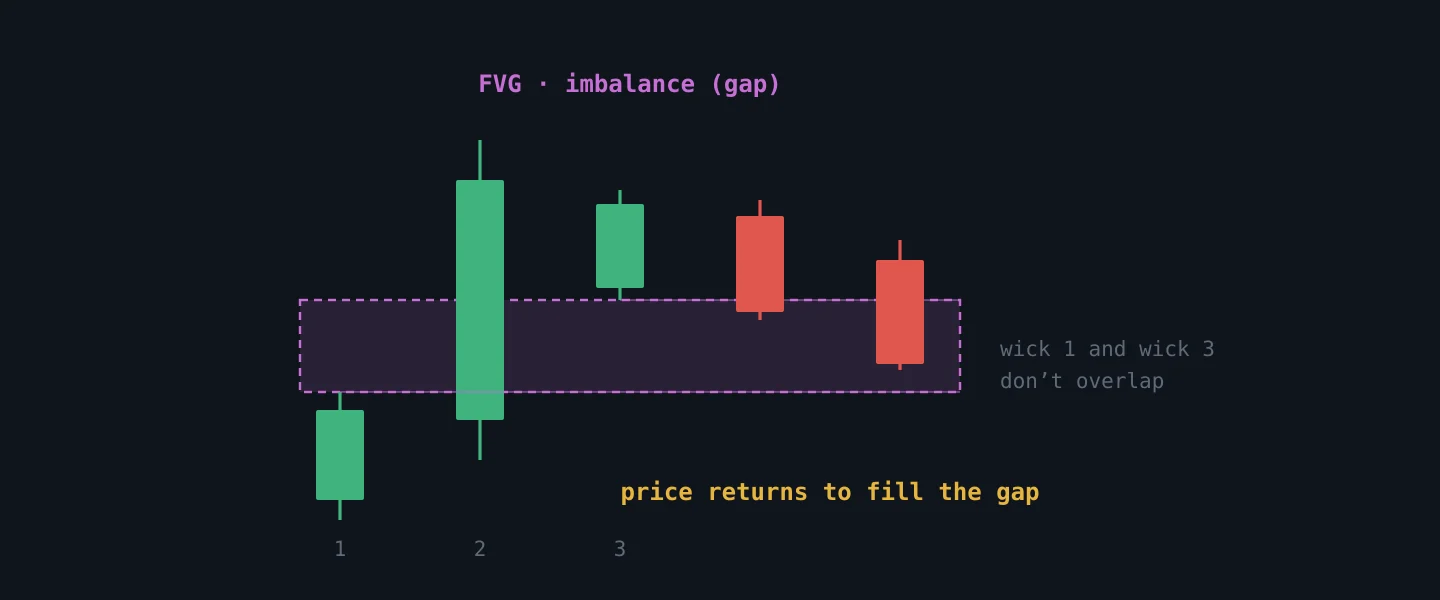
A Fair Value Gap (FVG) is one type of imbalance: a three-candle pattern where rapid price movement leaves an unfilled space on the chart. This gap, between the wick of candle 1 and candle 3, signifies a temporary imbalance between buyers and sellers, which price frequently revisits to rebalance, acting as a potential zone of interest for traders.
What does an FVG look like on your chart?
An FVG is a three-candle pattern. The middle candle is a large, impulsive move; the gap is the space between the wick of candle 1 and the wick of candle 3, which the middle candle travelled straight through without trading back into.
Drawn precisely, in a bullish FVG: candle 2 pushes up hard, and if the high of candle 1 sits below the low of candle 3, the space between those two levels never traded in both directions. That space is the gap. A bearish FVG is the mirror image — the low of candle 1 above the high of candle 3.
Three practical points that decide whether you have marked it correctly:
- You measure wick to wick, not body to body. The bodies belong to the impulse; the wicks define the untraded space.
- The middle candle must be genuinely impulsive. Three ordinary candles that happen not to overlap are noise, not an imbalance.
- The gap is a zone, not a line. Its top and bottom are both meaningful, and price reacting at the near edge is a different event from price filling it entirely.
Why are FVGs important to traders?
FVGs are popular within the Smart Money Concept (SMC) framework — the term was popularised by ICT — and are seen as footprints left by large institutional players. These "smart money" entities often leave inefficiencies as they execute large orders, pushing price quickly. Traders analyze these gaps as potential areas where institutions might need to return to fill orders, often after a BOS or CHoCH. Price will often sweep a nearby inducement level, collecting stops, on its way back to fill the gap.
The underlying idea does not actually require any belief about institutions. A gap marks a price range where one side had no opposition — everyone who wanted to transact there was skipped over. Unfinished business tends to get finished, and that is as far as the claim needs to go.
ForexCommand's desktop app can highlight these zones, drawing Order Block (OB) and Fair Value Gap overlays directly on your TPO / Market Profile chart.
Is an FVG the same as an order block?
No — although they often appear together and are easily confused. An FVG is an imbalance: the gap left when a move is so fast that price skipped a range. An order block (OB) is something different: the last opposing candle before that push, the footprint of where institutions placed their orders. Put simply, the order block is usually the cause of the move, and the FVG is the trail it leaves behind.
That's why many traders use them in confluence. An FVG that overlaps an order block marks a stronger zone of interest than either on its own: you get both the likely origin of the institutional orders and the inefficiency price tends to return to fill. What you shouldn't do is treat them as synonyms — they measure different ideas.
How do you trade a fair value gap?
The gap gives you a zone; structure tells you whether to trust it. Walked through on GBP/USD.
Price breaks upward out of a range and closes above the prior swing high — a bullish break of structure, so the bias is long. The impulse that did it ran from 1.2680 to 1.2790 in three candles. Marking the gap: candle 1's high sits at 1.2705, candle 3's low at 1.2735. That untraded band, 1.2705 to 1.2735, is the FVG.
You do not chase the breakout. You wait for the retrace into that band. Entry near the top edge of the gap, say 1.2733, gives you the tightest invalidation; entry at the midpoint, 1.2720, gives you a better fill but risks missing the move entirely if price only taps the edge. Either way the stop belongs below the bottom of the gap — under 1.2700 — because price trading fully through the imbalance means it was rebalanced and the read is spent.
Notice what the gap did and did not do. It did not predict the retrace. It gave you a defined zone to act in and a level that says plainly when you are wrong.
Do all fair value gaps get filled?
No. On five years of our hourly forex data, 87% of FVGs of 3 pips or more were completely filled within 120 candles, so about one in eight was still open by then. Some stay open for good, and a genuine repricing, such as a central bank surprise, is the obvious case: the market's opinion of fair value changed and there is no reason to go back.
What a high fill rate does not tell you is that the gap pulls price back. In the same data, which we break down in our comparison of FVGs, imbalances and liquidity voids, an FVG got filled about as often as any band of the same width at a similar distance from price, so the fill rate is mostly what a wandering price does anyway.
The practical consequence is that "price fills gaps" cannot be a strategy on its own. It is a tendency, and a tendency needs structure and invalidation around it before it becomes a trade.
What is a common pitfall for beginners using FVGs?
A common mistake is treating FVGs as definitive signals or guaranteed support/resistance levels. Traders often enter solely based on price touching an FVG, without additional confirmation or understanding of broader market structure. Not every FVG will be rebalanced, and not every rebalance leads to a predictable reaction.
Three more that cost money regularly:
- Marking gaps on every timeframe at once. Drop to the 1-minute chart and the screen fills with imbalances, none of which mean anything. Read gaps on the timeframe your decisions live on.
- Trading a gap against the structure. A bullish FVG in a market that just printed a CHoCH downward is a zone price is passing through, not one it is coming back to respect.
- Treating a partial fill as a failure. Price often reacts from the near edge without filling the whole zone. That is the normal case, not a broken one.
The takeaway
A fair value gap is a three-candle imbalance: a band of price the market moved through so fast that one side never got filled. Use it as a zone of interest rather than a signal — mark it wick to wick, let structure decide the direction, place invalidation beyond the far edge, and remember that a filled gap is no proof of a pull: price reaches most bands of that size anyway. It tells you where a reaction is plausible, not that one is coming.