What is backtesting and how do you validate a strategy with data?
Backtesting is testing your strategy against historical data before you risk real money. What is it? The hindsight bias that ruins home-made backtests, and how to do it honestly.

Backtesting is testing your strategy against historical data before you risk real money. It's the difference between "I think this works" and "I know this had an edge over 200 trades". Without it, every losing streak will make you doubt and jump to the next trendy strategy.
Why isn't it enough for a strategy to just "look good"?
An idea can sound flawless and still lose money consistently. The chart is full of patterns that look obvious after the fact, but the market doesn't pay you for what looks pretty in hindsight — it pays you for what holds a real statistical edge. Backtesting is how you separate a hunch from an edge: you put a number on it.
What exactly is a backtest?
It's applying your strategy's exact rules — entry, stop, target, size — to a stretch of price history, trade by trade, and recording the outcome of each one. At the end you don't have an opinion: you have a sample. How many won, how many lost, how much you made when you won and how much you lost when you lost. That data is the foundation for everything else.
What's the trap? Hindsight bias
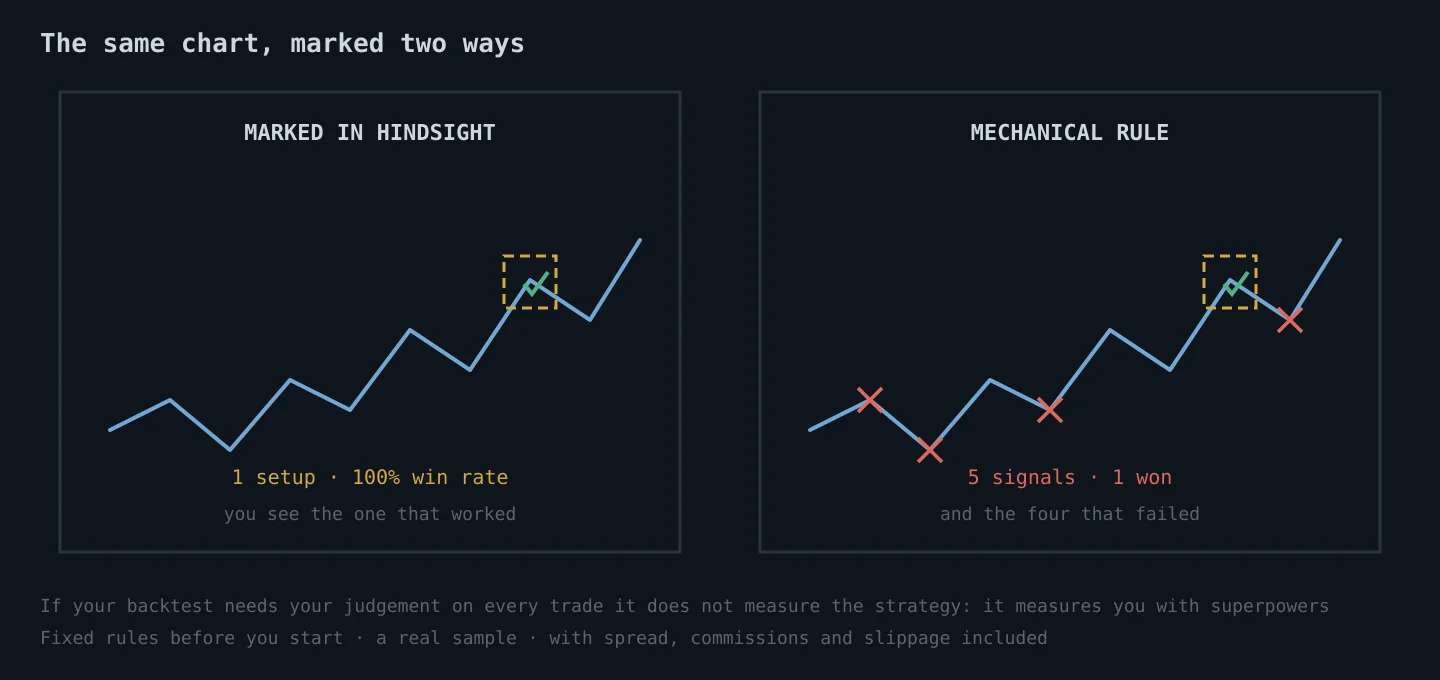
It's the error that ruins almost every home-made backtest: looking at the chart already knowing what happened next. You see a candle and think "I'd have entered here", but in real time, without knowing the future, maybe you wouldn't have. To avoid it, your rules must be so mechanical that another person, looking at the same thing, would make the same decision. If your backtest needs your "judgment" on every trade, you're not measuring the strategy — you're measuring yourself with superpowers.
How do you run an honest backtest?
- Written, fixed rules before you start. No adjusting on the fly.
- A large enough sample — dozens or hundreds of trades, not five lucky ones.
- Include real costs: spread, commissions, slippage. A strategy profitable in theory can die from friction. In MT5, the Strategy Tester takes the spread from history and can fill every order with no delay — cleaner conditions than your live account.
- Don't optimize until it shines. A perfect curve over the past is usually a strategy fitted to noise, not a repeatable edge.
What does backtesting give you that intuition doesn't?
Well-founded confidence. When the losing streak arrives — and it will —, the difference between holding the plan and abandoning it is knowing your edge is backed by data, not by hope. The strategy is only part of the result; backtesting is how you build the confidence to execute it when it hurts.