Oil went from a shipping story to a rate hike in five sessions
Tankers on Monday, a ten-year yield touching 5% on Friday, a European Central Bank hike in between and a core inflation print above forecast - and the dollar never once topped our basket. What actually drove the week, and what is the tell for the next one?

On Monday the week's news was tankers. By Friday afternoon the ten-year Treasury yield had briefly touched 5% for the first time since 2024 and the market was pricing a Federal Reserve hike. Those are the same story, and the chain that joins them was built one session at a time.
The chain, session by session
It opened with tanker attacks lifting crude near $90 into a thin holiday market. From there Brent cleared $100 on Tuesday, passed $105 and $106 on Thursday as Houthi militants seized key ports, and touched about $110 on Thursday night — its highest since mid-May, per a weekly strategy note published by Action Forex.
The American benchmark never went with it. West Texas Intermediate settled just above $94.00 on Wednesday, its own best level since 22 May, and was back around $93.20 by Thursday morning as traders booked profit. By Friday our own roundup had Brent above $100 and West Texas Intermediate below $93.50 — the same session, seven dollars apart.
That gap is the reason the two names matter. They are different grades, the shock arrived by sea, and one "oil" figure covering both would have been wrong in one direction or the other all week.
The reason given for the climb is not the same everywhere. InvestingLive attributed it to the Iran war, calling oil the main driver of the rise in long-term yields. A weekly strategy note published by Action Forex pointed instead to news that Yemeni Houthis had taken control of key ports. Both are wire attributions, and neither is ours.
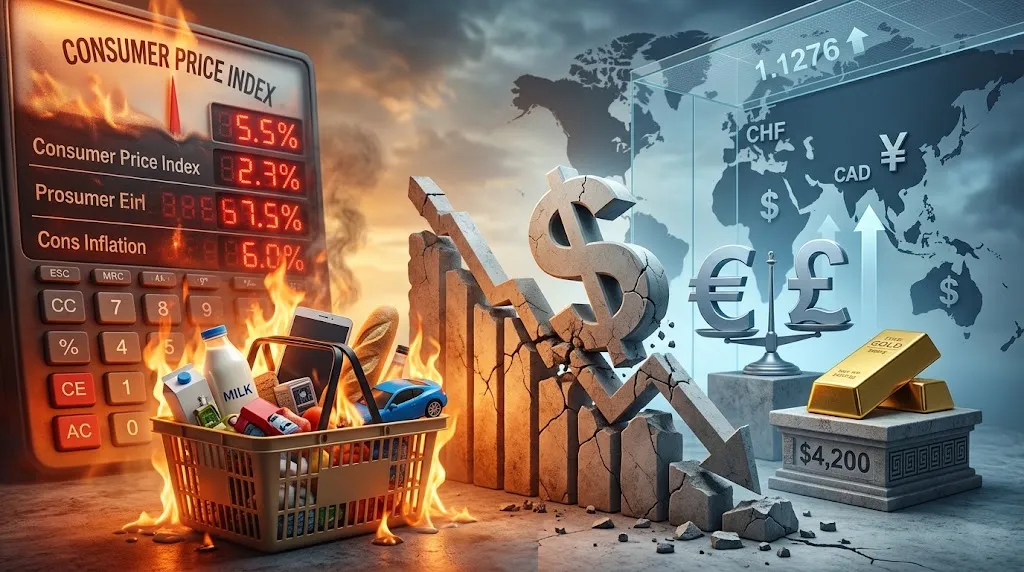
What is not in dispute is where the energy price went next. It went into inflation expectations, and from there into the bond market. European debt extended a five-week decline on rate hikes and surging oil. Gold, which is supposed to like inflation, fell for three sessions to $4,350 precisely because higher oil was pushing yields up — the metal pays no coupon, so a rising yield is a rising cost of holding it.
On Thursday the European Central Bank raised its main refinancing rate to 2.65% from 2.40%, exactly the forecast we had published the day before. The decision went out on the bank's own wire at 12:15 UTC, with Christine Lagarde presenting the statement forty-five minutes later.
Friday: the print that landed after everything we published
The August consumer price index arrived at 12:30 UTC, after that morning's roundup had already gone out. Four readings, and they do not say the same thing:
| Reading | Actual | Expected | Previous |
|---|---|---|---|
| Consumer prices, year over year | 3.4% | 3.4% | 3.4% |
| Consumer prices, month over month | 0.4% | 0.4% | 0.1% |
| Core, month over month | 0.3% | 0.2% | 0.2% |
| Core, year over year | 2.4% | 2.4% | 2.5% |
The headline looks calm: 3.4%, unchanged, in line. The monthly pace is not calm — it quadrupled, from 0.1% to 0.4%. And core, the reading that strips out energy and food, came in above forecast.
That last row is the one that moved money. The ten-year yield briefly broke 5% for the first time since 2024. Market-implied odds of a Fed hike climbed above 85%. The dollar firmed, and Action Forex headlined the session as nothing resolved: the print had lifted the odds of a hike while the dollar, yields and oil all faded off their highs.
An hour and a half later the University of Michigan's preliminary consumer sentiment index came in at 47.8 against 51 expected, with consumer inflation expectations jumping to 4.6%. Households are not reading the calm headline either.
What our own gauges saw
| Reading | MRS | CTS | Strongest | Weakest |
|---|---|---|---|---|
| Mon 7 | 63 | 80 | NZD | CAD |
| Tue 8 | 63 | 76 | NZD | EUR |
| Wed 9 | 65 | 75 | JPY | GBP |
| Thu 10 | 45 | 76 | AUD | CHF |
| Fri 11 | 64 | 76 | CAD | NZD |
These are readings taken around 01:00 UTC, in the Asian session — a snapshot of that instant, not a verdict on the day before it. Measured across the whole session instead, three of these five rows name a different currency — which is why the paragraph below counts sessions, not snapshots. The Thursday drop to 45 is the clearest example: it is the Market Readiness Score pricing the risk of the day ahead, which was European Central Bank day.
One number is worth more than the rest of the table. No currency led our basket twice this week, two of the five sessions had no leader at all, and the dollar never led one — not once, in the week the market started pricing a hike. Measured across each session's minutes rather than at a single instant, the yen led Monday, the kiwi Tuesday and the franc Friday; on Wednesday and Thursday the top two were too close to separate. The yen was also the most-trailing currency in four of the five sessions. That is a basket with no anchor, which is what a market looks like when it is being moved by something outside the currency block. This week that something was a barrel.
The New Zealand dollar bookends the week in the strangest way: it led Tuesday outright and came second on Monday, then led the fewest minutes of any currency on Friday — 5%, last of eight — with manufacturing slowing to 53.1 from 54.3 in between — still expanding, just less.
What stays open
Next week three central banks decide: the Federal Reserve, the Bank of Japan and the Bank of England. A week-ahead note published by Action Forex frames it as an inflation dilemma and reports investors split on whether the Fed hikes at all, while the Bank of Japan looks poised to raise by 25 basis points on 18 September and the Bank of England is expected to hold. Japan's own producer prices ran at 7.6% against 7.4% expected, which does not argue for patience.
The yen closes the week with its first two-week winning streak since May, even after Friday's rally stalled. Sterling has a figure behind it again: British output grew 0.4% in the month when the forecast was flat.
The tell to watch. The dollar did not top our basket on a single session this week. If it takes the top on any session next week, the market has decided the hike is real and is buying it rather than the barrel. If it still cannot — with three central banks meeting — then the story driving this market is still energy, and the Fed is following it rather than leading it.
Update (19 September 2026). Neither branch of that test survived the week. The Federal Reserve did hike — 25 basis points to 3.75–4.00%, its first increase in three years — and the dollar still led none of the five sessions. By the test above that pointed at energy; but the barrel spiked and handed the whole move back, with WTI finishing Friday at $95.60, within 34 cents of where it had closed the previous week. The Fed hiked and the dollar led none of the week's five sessions.