What is inflation?
Inflation is the rate at which prices rise and money loses value — and the single biggest driver of the central bank decisions that move every currency pair.

Inflation is the rate at which prices across an economy rise over time, which means each unit of a currency buys a little less than it did before. A steady 2% a year is the target most central banks aim for; when inflation runs hot or collapses, it reshapes interest rates, currencies, and every trade you have open.
Why does inflation matter to a forex trader?
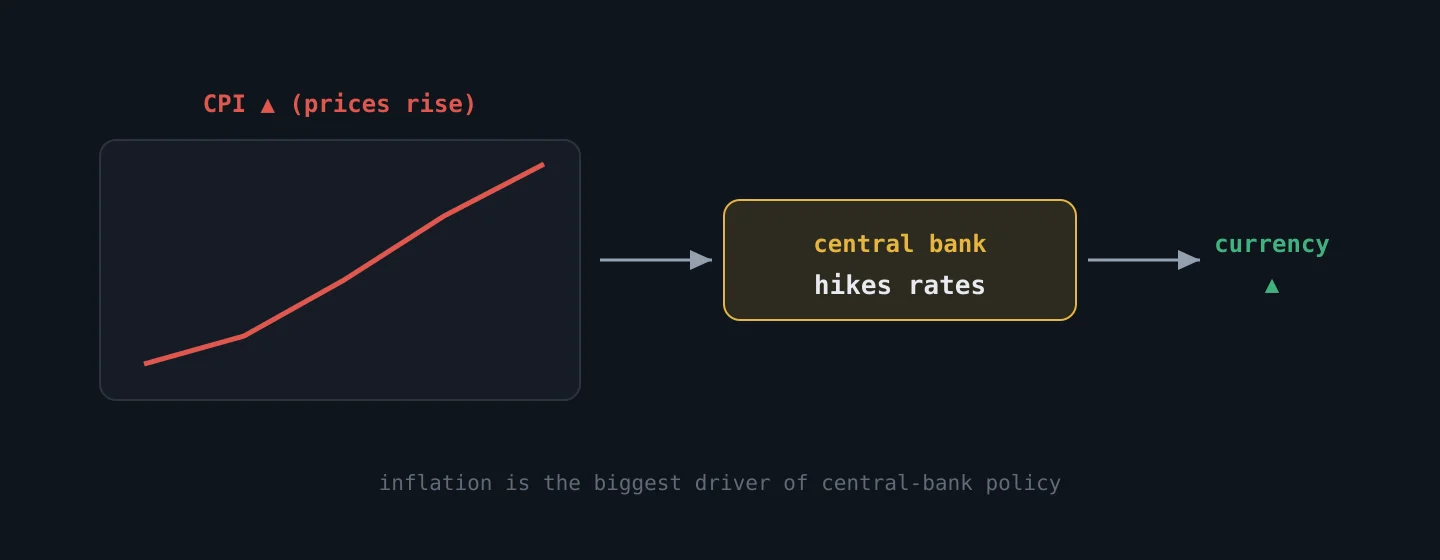
Inflation is the single biggest driver of central bank policy, and central bank policy is the single biggest driver of currency value. When inflation rises above target, central banks raise interest rates to cool the economy. Higher rates draw in foreign capital chasing better returns, which tends to strengthen the currency. When inflation falls too low, banks cut rates to stimulate growth, and the currency usually weakens. Trade the currency and you are, indirectly, trading the market's expectations for inflation.
This is why an inflation surprise can move a pair harder than almost any other release: it forces traders to re-price how aggressive the central bank will be at its next meeting.
How is inflation measured?
You never see "inflation" directly — you see the gauges that track it. The most-watched is the Consumer Price Index (CPI), which measures the change in a basket of everyday goods and services. Others include the Producer Price Index (PPI) and, in the US, the Fed's preferred measure, Core PCE. "Core" versions strip out volatile food and energy prices to reveal the underlying trend.
Headline vs core — and why traders watch core
Headline inflation includes everything; core inflation excludes food and energy. Because energy and food prices swing wildly from month to month, central banks — and the traders front-running them — pay closest attention to core. A hot headline number driven by a one-off oil spike may not change policy; a hot core number almost certainly will.
What causes inflation?
Economists split the causes in two. Demand-pull inflation happens when demand outstrips supply — too much money chasing too few goods. Cost-push inflation happens when the cost of producing goods rises — an oil shock, a supply-chain snarl, higher wages — and firms pass it on. Most real-world inflation is a mix of both.
The extremes: deflation and hyperinflation
Falling prices (deflation) sound good but are dangerous: consumers delay spending, growth stalls, and debt gets heavier. At the other end, hyperinflation — prices spiralling out of control — can destroy a currency entirely, from Weimar Germany to more recent cases. Central banks aim for a small, stable, positive rate precisely to avoid both extremes.
The takeaway
Watch the inflation calendar the way you watch price. A CPI or PCE release that beats or misses expectations is really a message about the central bank's next move — and the currency reacts to the message, not just the number. Know whether inflation is running above or below target, and you already know which way the policy pressure — and often the currency — is leaning.