
The carry trade: what is it and how does the CTS measure it?
The carry trade earns the interest-rate gap between two currencies — and the CTS gauges when that environment is supportive and when it is a trap.

The carry trade earns the interest-rate gap between two currencies — but the same gap that pays you can reverse violently, which is exactly what our CTS is built to gauge.
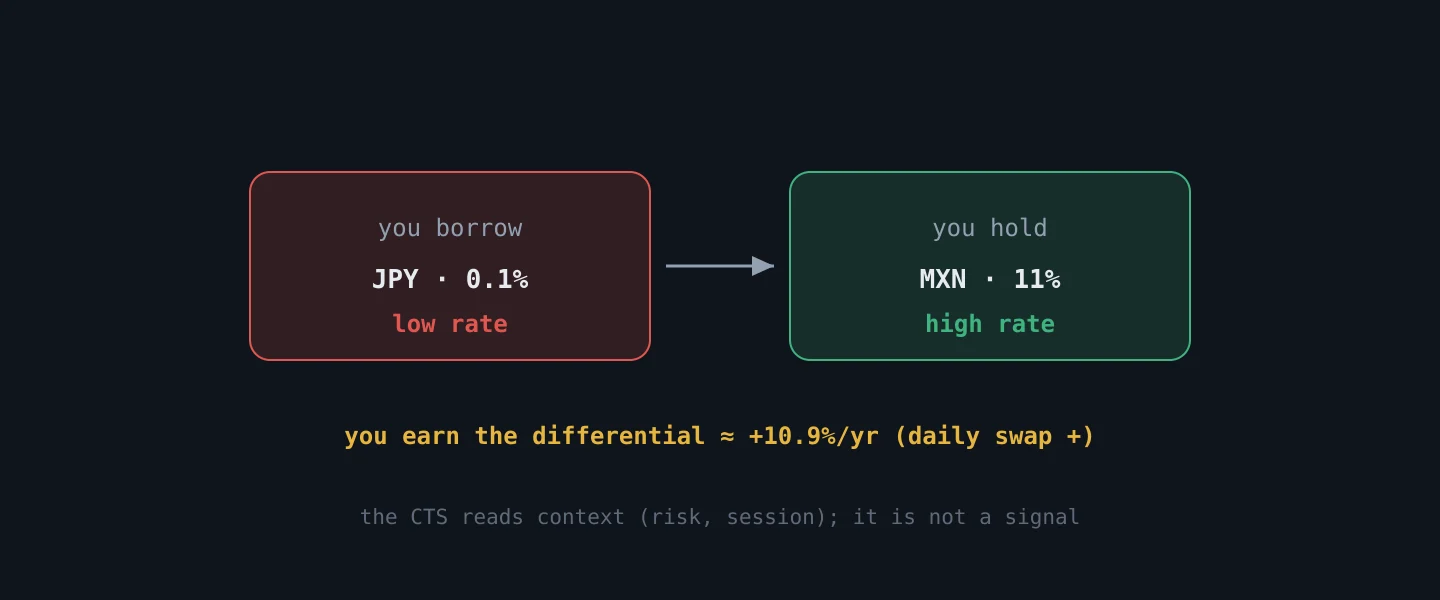
You Are Already Doing It
Hold a position open past the daily rollover and your broker either credits or debits a small amount — the swap. That swap is the carry trade in miniature: the cost or reward of holding one currency against another overnight. Every trader who leaves a trade open sees it, whether they think about it or not.
What Is a Carry Trade?
A carry trade borrows in a currency with a low interest rate and holds one with a higher rate, pocketing the difference — the interest-rate differential.

The classic example, used here only to illustrate the mechanic, is funding in a low-yield currency such as the Japanese Yen to hold a higher-yielding one; while both sit still, the rate gap accrues in your favor.
The wider the differential, the more the position pays simply for being held.
Why Is It Not Free Money?
Carry works beautifully in calm markets and unwinds brutally when they turn. The saying captures it: the carry trade goes up the stairs and down the elevator.
In a risk-off shock, crowded carry positions are closed all at once, and the high-yield currency can hand back months of accrued interest in days. The differential is real, but it is compensation for a risk — not a guarantee.
That is why a raw rate gap is not enough on its own. Context — timing, conviction, and event risk — decides whether the carry is worth holding.
How Does the CTS Score It (0-100)?
ForexCommand's Carry Trade Score (CTS, shown as PCT in the app) condenses that context into a single 0-100 reading, built from four parts:
| Component | Weight | What does it add? |
|---|---|---|
| Spread | /50 | The interest-rate differential of the strongest carry pair. The bigger the gap, the more points. |
| Session | /30 | How well the current trading session aligns with that pair. |
| Clarity | /20 | The gap between the #1 and #2 ranked pairs. A clear leader scores higher than a near-tie. |
| News Risk | Penalty | When a high- or medium-impact event for the pair is imminent. |
How Do You Read It?
The CTS lands in tiers — No Carry, Weak, Moderate, Strong — so you read the environment at a glance.
A high score says the conditions that favor carry are lined up; a low one says they are not. What it never says is "buy". The CTS is a reading of context, not a signal to enter. It tells you whether the carry environment is supportive — the decision, and the risk, stay yours.
The CTS is one of ForexCommand's three proprietary indicators: read it alongside the MRS, which measures whether the market is ready to move, and the FSI, which measures fear-versus-greed sentiment.