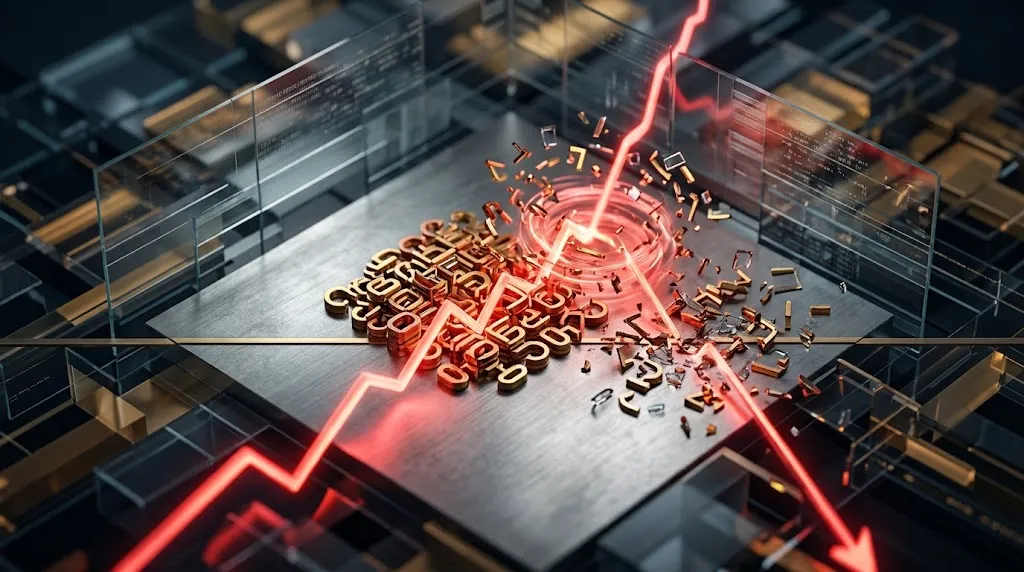
Synthetic indices are not the market
Its issuer writes that a random number generator produces them and that news does not affect the price. What is left of technical analysis, why is the arithmetic negative-sum, and why does "Volatility 75" have nothing to do with the VIX?

A synthetic index is traded with the same tools as a currency pair: the same candles, the same indicators, the same platform. It resembles the market closely enough that treating it as one feels natural.
It is not one, and its issuer says so in writing. Deriv, the platform that made these products popular, puts it like this on the synthetic-indices page of its own website, under its derived-markets section:
"These instruments are generated by a cryptographically secure random number generator."
Nothing there needs interpreting. The price does not come from buyers and sellers: it is generated. Everything else in this article follows from that sentence.
What the issuer says about its own product
The same page adds two clarifications worth having in front of you before trading one of these:
- External news events do not affect how the price evolves.
- Any short-term correlation with a real market is purely coincidental.
To that it adds continuous availability — 24 hours, seven days, holidays included — and a range of volatilities running, in the company's own words, "from a serene 10% to a stormy 250%".
None of those three things is possible in a real market. Markets close because there are people on the other side. They react to news because news changes what those people will pay. And their volatility is not chosen from a menu.
Why does technical analysis lose its subject?
Support is collective memory. It is a price where, in the past, enough people were willing to buy to stop a fall, and where some of those people are still watching. The same goes for resistance, for a round number, for a gap waiting to be filled.
In a generated sequence, nobody remembers anything. There are no resting orders, no participant who defended a position down there, no treasurer with a month-end need.
You will still see patterns, and that is the problem. Randomness produces patterns: streaks, double bottoms, impossibly clean channels. What it does not produce is the reason a pattern anticipates anything. In a real market a pattern sometimes works because it describes repeated human behaviour; here it describes a previous roll that has no bearing on the next one.
On what you actually can measure in a real market — and why timing matters more than direction — there is the piece on volatility, ATR and timing.
The arithmetic, which is the uncomfortable part
A random walk with no trend has zero expectancy. It rises and falls and, on average, goes nowhere over time.
On top of that base sit the costs: the spread between bid and ask, the commission, and on positions held overnight, financing. All of them subtract. None adds.
The result is direct. Zero minus something is negative. This is not a hard market where some win and others lose: it is a driftless series with a toll charged on every trade.
Here is the real difference from forex, and it deserves stating precisely. The currency market is a zero-sum game before costs: one participant's gain is another's loss, and there are participants with other motives — companies hedging risk, central banks, tourists — who are not there to beat you. A synthetic index is negative-sum from the first tick, and there is nobody else at the table.
"Volatility 75" is not the VIX
This is the most widespread confusion and it deserves its own paragraph.
The VIX is an index computed from the prices of options on the S&P 500. It measures how much volatility real participants are paying to hedge against, which is why it is called the fear index. A stock exchange publishes it, and anyone can reconstruct it.
A synthetic index called "Volatility 75" computes none of that. The 75 is a generation parameter: the annualised volatility the algorithm is configured with. They share a number and nothing else.
If what interests you is how real volatility reaches the currency market, that is in our explainer on the VIX and forex.
The regulation, and why it matters more here
Deriv operates through several companies holding different licences: in Malta with the MFSA, in Labuan, in Vanuatu with the VFSC and in the British Virgin Islands. Which one serves you depends on the country you open the account from.
That structure is common in the industry and is not in itself an alarm signal. But it does change what you can claim and from whom, so for this product the question "which entity am I signing with?" carries more weight than usual. What a licence protects and what it does not is worked through in the case for a regulated broker.
What this article does not tell you
It does not say synthetic indices are a fraud. A cryptographically secure generator can be provably fair, and we have no evidence that these are not. The objection is not that they cheat: it is that there is no price discovery, no second opinion available, and that on top of zero drift any cost is a guaranteed bleed.
It also does not say they are illegal, because they are not where they are offered. And it does not assess specific platforms or compare their terms.
Nor does it claim nobody makes money on them. In a negative-expectancy game there are always winners; what there is not is a structural reason to be among them for long. That distinction is worked through in risk of ruin.
What it does give you is the right question to ask before opening one of these charts: if the price is generated by the party on the other side of your trade, what exactly are you analysing?