How do US midterm elections move the dollar?
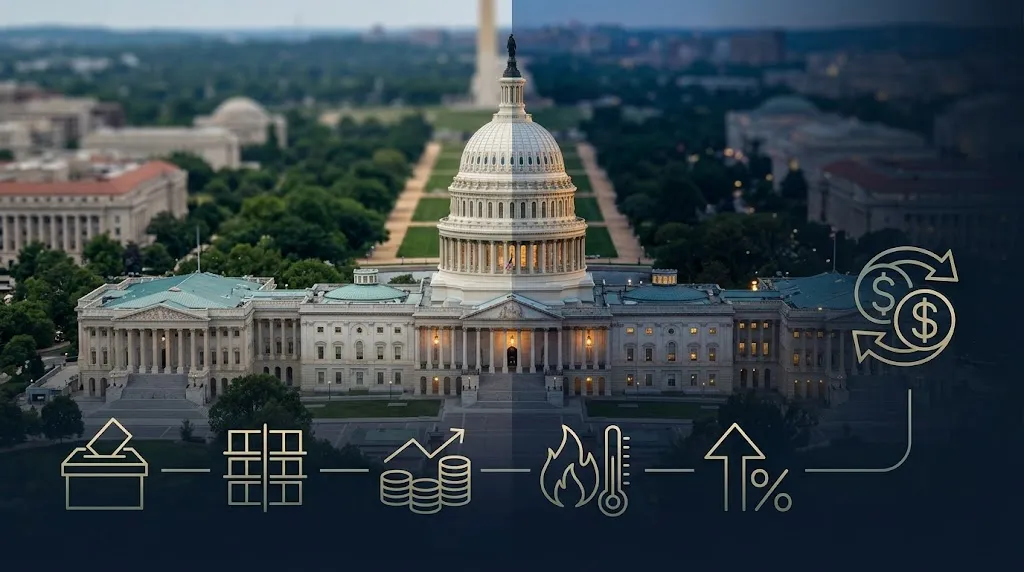
A worked example of how geopolitics affects forex: midterm elections do not move the dollar because of who wins, but because of whether government ends up divided. The chain runs from spending to inflation, then to rates, and only then to the exchange rate.
Every two years, the United States renews its entire House of Representatives and a third of the Senate at the midpoint of a presidential term. And every two years, the currency market spends a few weeks on edge over something that, deep down, has little to do with who wins.
If you trade the dollar, the useful question is not which party comes out on top. It is this one: will the government still be able to pass spending? That is the variable that reaches the exchange rate, and the path it travels from a ballot box to your chart is more mechanical than it looks.
It is not who wins: it is whether government ends up divided
A "unified" government is one where the president's party also controls both chambers of Congress. A "divided" government is any other combination: the opposition only needs to take a single chamber.
The difference matters because in the United States the budget is passed by Congress, not by the White House. With the chambers split, large spending packages, tax cuts and stimulus get stuck. They do not disappear: they get negotiated, trimmed and delayed.
For a trader that translates into a concrete, measurable expectation: less fiscal impulse over the next two years.
| Government composition | Ability to pass spending | Fiscal expectation |
|---|---|---|
| Unified (president + both chambers) | High | More stimulus, wider deficit |
| Divided (opposition holds one chamber) | Low | Less stimulus, budget gridlock |
| Divided (opposition holds both chambers) | Very low | Recurring spending-ceiling standoffs |
Notice that no party name appears anywhere in that table. None is needed: the mechanism is identical with the colours swapped.
The transmission chain, step by step
Here is the full route, and it is worth memorising because it repeats every cycle:
1. Election result → the market learns how much spending can be passed.
2. Fiscal expectation → less stimulus means less aggregate demand pushing the economy along.
3. Inflation expectation → with less fiscal fuel, pressure on prices eases at the margin.
4. Rate expectation → if inflation cools, the central bank has less reason to keep rates high.
5. Rate differential → the appeal of holding dollars against other currencies changes.
6. The dollar.
Step 5 is the one that actually moves price. A currency appreciates, in essence, when being paid to hold it beats the alternative. Everything before that is just the chain of reasoning that leads the market to revise that expectation. We unpack it in more detail in our explainer on central bank rate decisions and currencies.
Why does the rate channel outweigh the headline?
This is where a lot of people go wrong. Election night produces spectacular headlines and long candles, but that move usually unwinds within days. What persists is the repricing of the yield curve.
The reason is one of time horizon. A headline reports a fact that lasts a night; an election result changes fiscal policy for the following two years, and therefore reprices the whole stretch of the curve covering that period. A move fuelled by emotion runs out when the buyers run out; one fuelled by a rate differential holds up for as long as the differential is there.
Hence the practical rule: if an election-driven move is not accompanied by a move in bond yields, distrust it.
The 2026 case: the mechanism collides with a hiking Fed
The current cycle has a twist that makes it an unusually good case study, and it is worth understanding because it breaks the easy intuition.
At the time of writing, Republicans hold the House by 220 seats to 215, the narrowest margin since 1930 — the last time the minority held 215 or more seats was after that year's elections, when Republicans won 218, Democrats 216 and the Farmer-Labor Party one. Democrats need a net gain of just three seats to flip the chamber. Translated: the odds of divided government are high, and with them the odds of fiscal gridlock.
Intuition would say "less spending, lower rates, weaker dollar". But that chain is colliding with a Federal Reserve (Fed) heading the other way. Under Chair Kevin Warsh, the market is not pricing cuts: it is pricing hikes, with inflation proving stubborn above the 2% target. We cover it in the Warsh Fed: why markets are pricing rate hikes, not cuts.
When the fiscal channel pushes down and the monetary channel pushes up, the monetary one wins. The central bank sets the interest rate directly; Congress only influences the conditions the central bank observes, and with months of delay. It is the same logic by which tensions over the Fed's independence move the dollar more than almost any political headline: what matters is who controls the rate, not who controls the budget.
What does a trader watch, and when?
The most common timing error is getting ready for election night. Informed money does not wait for the count.
- Weeks ahead: watch the repricing of expectations. If polling moves consistently towards one outcome, the yield curve starts building it in well before the vote. That is the tradeable move, and it is gradual.
- Count night: wide spreads, thin liquidity and expensive execution. It is the worst moment to enter and a reasonable moment to hold no position at all.
- The days after: this is where you find out whether the move has substance. Compare the dollar's shift against the two-year yield. If they travel together, the repricing is real. If the dollar moves alone, it is probably noise that will correct.
Two mistakes that cost money
Assuming direction from the party. There is no stable relationship between the colour of a government and the direction of the dollar. What does exist is a relationship between fiscal capacity and rate expectations. Across different cycles, the same party has coincided with both a strong dollar and a weak one, because the monetary backdrop was different.
Trading the news instead of the expectation. By the time the result is published, it is already in the price — at least in its most likely scenario. What gets traded afterwards is not the result, but the gap between what was expected and what came out. If you do not know what was priced in, you cannot know whether there is a surprise.
In short
Midterm elections move the dollar by an indirect and fairly predictable route: they change the government's ability to spend, that changes the inflation expectation, and that expectation changes the rate expectation. The exchange rate responds to the last link, not the first.
That is why the winning party is the least informative part of the result. The useful part is whether government ends up divided, how much of that was already in the price, and — above all — whether the central bank is looking in the same direction or the opposite one. In 2026 it is looking in the opposite one, and that is worth more than any seat count.