What is the VIX and why does it move forex?
The VIX measures the movement the options market expects in US stocks. It is not a currency indicator — and yet it is one of the cleanest early warnings that risk appetite is about to turn.

The VIX measures how much movement the options market expects in US stocks over the next 30 days. It is not a currency indicator at all — and yet it is one of the cleanest early warnings a forex trader has that risk appetite is about to turn.

What does the VIX actually measure?
The VIX is the CBOE Volatility Index. It is calculated from the prices of options on the S&P 500, and it expresses a single thing: how much movement traders are paying to protect themselves against over the coming 30 days, annualised and quoted in percentage points.
A VIX of 15 does not mean the market is about to fall. It means options are priced for roughly 15% annualised movement — in either direction. Like ATR, the VIX has no opinion on direction. It only has an opinion on size.
Why is it called the "fear gauge"?
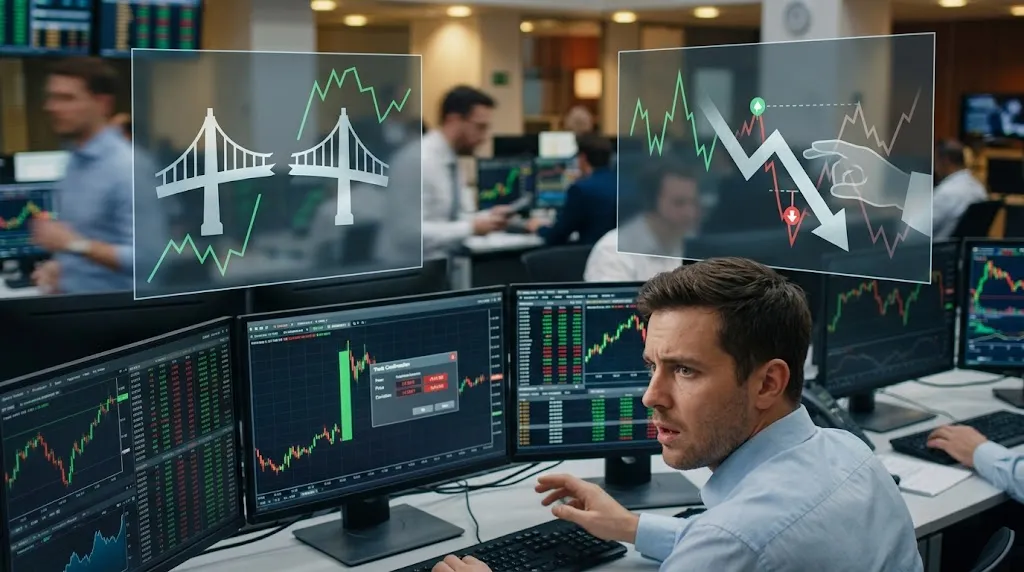
Because it usually rises when stocks fall. When the S&P 500 drops, demand for protection jumps, option premiums rise, and the VIX rises with them. That inverse relationship is not a law of nature, but it holds often enough that the VIX became shorthand for how nervous the market is.
Two things are worth remembering about how it behaves. It spikes far faster than it falls — fear arrives in hours and drains over weeks. And a low VIX is not the same as a safe market: it only tells you that nobody is paying up for protection right now, which is a very different statement.
Why does a US stock index move currencies?
This is the part that matters for a forex trader, and it has almost nothing to do with equities as such.
Volatility is the price of risk. When that price rises, capital does the same thing everywhere at once: it leaves what pays well but can fall, and moves to what is liquid and predictable. In FX that shows up as a pattern, not a single trade:
- Funding currencies strengthen. The yen and the franc — the ones borrowed to finance other positions — get bought back as those positions are closed.
- High-yielders weaken. The Aussie, the kiwi and emerging-market currencies tend to fall first and fall furthest.
- The dollar usually gains, because it is where liquidity goes when it stops wanting risk. That is the safe-haven reflex.
- Carry trades unwind. A rising VIX is the most reliable warning that a crowded carry position is about to be squeezed — which is exactly how the yen carry trade earned its 'widow-maker' nickname.
So the VIX is not telling you anything about the dollar directly. It is telling you the weather that every currency is trading in.
What do the different levels mean?
There are no official thresholds, and anyone who gives you exact ones is inventing them. What follows is the scale we use inside our own indicator, which maps the VIX onto a 0-100 risk-appetite score:
- 12 or below — complacency, scores 90
- 15 — calm, scores 75
- 20 — neutral, scores 50
- 25 — caution, scores 30
- 30 — stress, scores 15
- 40 or above — extreme fear, scores 0
Two deliberate choices in there. Complacency caps at 90 rather than 100, because no single input should be allowed to max out a composite score. And extreme fear floors at 0 at a VIX of 40, so a crisis print of 60 or 80 does not distort everything else. Between the anchors the score interpolates smoothly — there are no cliff edges where one hundredth of a point flips the reading.
The VIX inside ForexCommand
The VIX is 20% of our Forex Strength Index (FSI) — the "global fear" pillar, sitting alongside positioning, volatility, retail sentiment, carry and news risk. When you read "FSI 65, greed" in a daily roundup, a fifth of that number is the VIX.
One honest limitation, because it changes how you should use it: we take the VIX from the Federal Reserve's FRED (Federal Reserve Economic Data) database (the `VIXCLS` series), and FRED publishes it once per trading day, at around 17:15 New York time. A reading taken mid-session is therefore yesterday's close, not a live quote. That is fine for what it is used for — gauging the regime you are trading in — but it is not a tool for reacting to a spike as it happens. For intraday conditions, the Market Readiness Score and ATR do that job.
The takeaway
Think of the VIX as the barometer rather than the forecast. It will not tell you which way the wind blows, and it is a day behind. What it does tell you — cheaply, and before most currency-specific signals do — is whether the market is calm enough for a carry position to survive, or nervous enough that the safe havens are about to be bid. When it moves sharply, the pattern that follows in FX is remarkably consistent: see how a risk-off wave actually travels through the market.