
What is the spread in forex?
The spread is the gap between the buy and sell price — the built-in cost of every trade, and the reason a position starts slightly in the red the moment you open it.

The spread is the difference between the price you can buy at (the ask) and the price you can sell at (the bid). It's the most basic cost of every trade — the broker's built-in fee — and it's why a position starts slightly in the red the instant you open it.
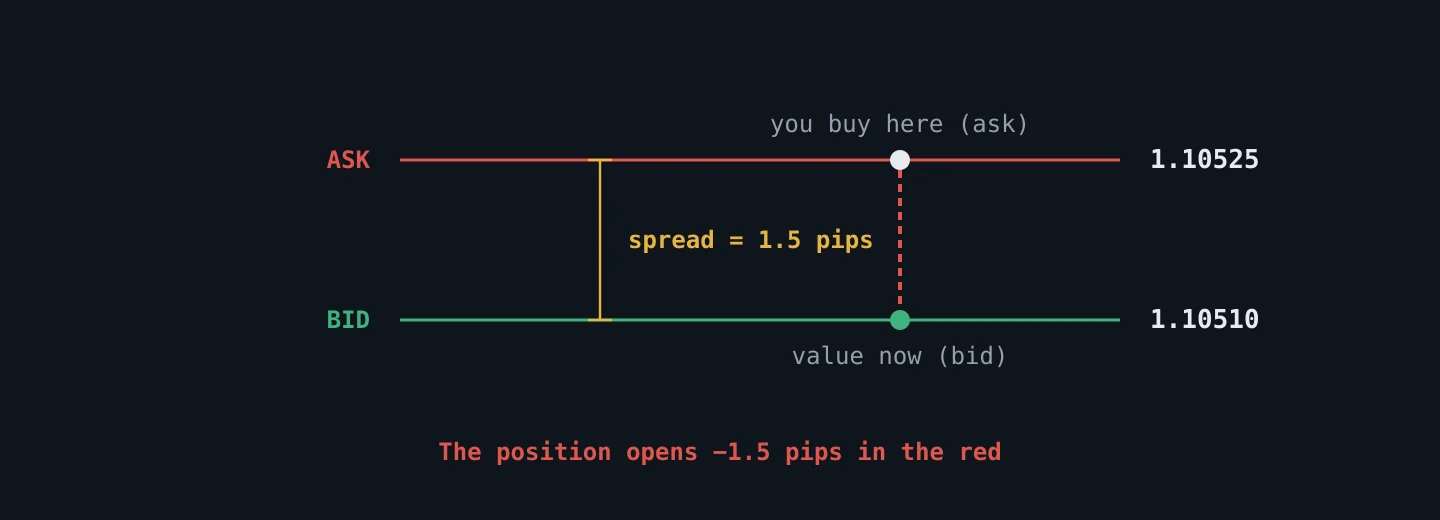
Bid, ask, and the gap between them
Every forex quote has two prices: the bid (where the market buys from you) and the ask (where it sells to you). The ask is always a little higher. That gap — measured in pips — is the spread. On EUR/USD it might be 0.8 pips; on an exotic pair it can be many times wider.
The direction of the two prices is what catches beginners out. You buy at the ask, but your open position is valued at the bid, so the moment you click you are down by the spread. Nothing has gone wrong — the market has to move in your favour by the width of the spread before you are level.
Why does the spread exist?
It's how many brokers get paid. Instead of charging a separate commission, they widen the quote a touch and keep the difference. Even on a commission-based account some spread remains, because it reflects the real supply and demand to trade that pair at that moment.
Underneath the broker's markup is a genuine cost. Someone has to stand ready to take the other side of your trade at any instant, and that willingness carries risk. The spread is what compensates the market maker for holding a position it did not choose until it can offload it. That is why the most heavily traded pairs, where offloading is easy, have the thinnest spreads.
Fixed vs variable spreads, and raw vs standard accounts
Two account distinctions are worth understanding before you compare brokers.
- Variable (floating) spreads move with market conditions — tight when the market is calm, wider when it is not. Most accounts work this way.
- Fixed spreads stay the same regardless of conditions. They look reassuring but are set wide enough to cover the broker in bad conditions, so you pay the average all the time.
- Standard accounts bundle everything into the spread. No separate commission line, and what you see quoted is what you pay.
- Raw or ECN accounts show the near-interbank spread and charge a commission on top.
The comparison people get wrong is the last one. A raw account advertising "spreads from 0.0 pips" is not free — the cost moved to the commission line. To compare honestly, add them together: a raw spread of 0.2 pips plus a commission worth roughly 0.7 pips is 0.9 pips all-in, which may be better or worse than a standard 0.8-pip account depending on the pair and the hour.
What makes a spread widen?
Two things above all: liquidity and volatility. In deep, active markets — the London–New York overlap on EUR/USD — spreads are tight. In thin conditions — the late Asian session, the seconds around a news release, weekend gaps — they blow out. A spread that's normally 1 pip can jump to 10 or more around a central-bank decision.
The predictable widenings are worth memorising, because they are avoidable rather than unlucky:
- The daily rollover, when liquidity providers change books and the spread can briefly balloon on every pair at once.
- Scheduled data releases. The widening starts seconds before the number, not after.
- Session gaps and market open. Sunday's first quotes are the widest of the week.
- Exotic pairs at any time. A pair with few natural buyers and sellers is permanently expensive to trade.
What does the spread actually cost you?
Turn it into money, because pips are misleading until you do. The spread is quoted in pips, so the cost depends on your position size — the same relationship covered in our guide to pips and their value.
On EUR/USD, one standard lot (100,000 units) has a pip value of about $10. A 0.8-pip spread therefore costs roughly $8 every time you open and close a position. Trade one standard lot a day and that is about $8; trade twenty a day as a scalper and it is $160 a day, or something near $3,200 over a twenty-day month — before a single losing trade.
Now scale it down. On a mini lot (10,000 units) the pip value is about $1, so the same spread costs 80 cents. The percentage is identical; what changes is whether the number is visible to you.
This is why the spread barely dents a swing trade held for days and can quietly decide whether a scalping strategy is viable at all. Always measure your target against it: risking 5 pips to make 5 while paying 1 pip of spread is a much worse deal than it looks, because you need to be right roughly 60% of the time just to break even.
The mistakes that cost money
Choosing a broker on the advertised spread alone. "From 0.0 pips" describes the best moment on the best pair. What matters is the typical spread on the pairs you actually trade, at the hours you actually trade them.
Trading through the news window. Entering in the seconds around a release means paying a spread several times wider than normal, and often getting slipped on top.
Placing tight stops in wide-spread hours. The spread can take out a close stop without the market ever reaching your level, because your stop is triggered on the opposite side of the quote.
Forgetting it is charged twice. The spread is a round-trip cost. You pay it on entry and again, implicitly, on exit.
The takeaway
Treat the spread as the entry fee on every trade. Trade liquid pairs in active hours to keep it tight, avoid trading through the spread-widening seconds around news, compare brokers on the all-in cost rather than the headline number, and size your targets so the spread is a rounding error — not a headwind you fight on every position.