What if you built your strategy backwards?
Five measurements from the series plus a new table: how many pips does each time window actually offer across ten pairs? Not the strategy — the floor.
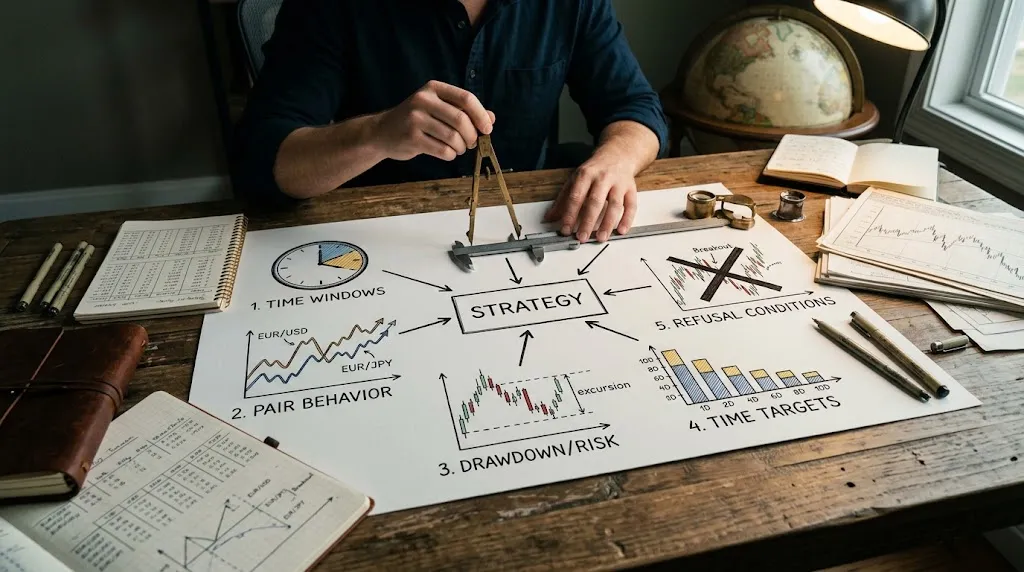
This series never handed you a strategy, because there is no single one that works for everyone: of 240 combinations we tested, only nine survived the cost of trading. What it did hand you is five measurements — and you build backwards from those, starting with what you cannot change.
The strategy is not the beginning, it is the last piece
Almost everyone builds forwards. You pick a technique you saw work for someone else, then try to fit it into your life: your hours, your account, your patience.
The anchor of this series measured what happens when you do that. One simple rule, ten pairs, all twenty-four hours: 240 combinations, and only nine are still standing once you subtract a single pip of cost.
Building backwards is the reverse. You start from the constraints you cannot negotiate and let them rule things out. It will not give you the perfect strategy, because there isn't one. It gives you a floor.
The five constraints already measured
Each one has a full study behind it. Here is only the number that decides.
1. Your hours rule, and they don't negotiate. Between midnight and 08:00 New York, the day has already covered a median 61.7% of its range. Sit down when New York opens and you arrive late to at least two thirds of the move.
2. Pick the pair by what moves in your hour, not by habit. The median one-minute candle on EUR/USD measures 1.30 pips, and 38.5% of minutes don't even reach one.
3. The stop is set by what you must sit through, not by your comfort. To collect the median three-month move, price first went against you by a median excursion of 62% of that move. Day to day, 50.8% of sessions close inside the previous day's range.
4. The target is set by the clock, not by your ambition. Holding ten days instead of one does not multiply the move by ten: it multiplies it by 3.3.
5. Some hours — and some signals — the answer is no. In the non-farm payrolls hour the candle widens by a median 2.35 times versus that same hour on an ordinary day. And a breakout on its own is a coin flip: 50.1% against 49.9% across 14,162 cases.
None of the five depends on your technique. All five come before it.
How much does your window actually offer you?
That was the missing measurement, and we ran it for this post. We took our own hourly candles — 5.7 years, January 2021 to September 2026, about 1,468 days per pair in the two daytime windows and about 1,169 in the evening one, Sundays excluded — and measured the median range of three four-hour windows: the three a person with a life can realistically have.
Hours are in coordinated universal time (UTC), so translate them to your own clock before reading the table.
| Pair | 06:00-10:00 (European morning) | 12:00-16:00 (London-NY overlap) | 20:00-00:00 (European evening) |
|---|---|---|---|
| EUR/GBP | 20.4 pips | 22.0 pips | 12.8 pips |
| EUR/CHF | 22.9 pips | 24.6 pips | 18.1 pips |
| NZD/USD | 22.9 pips | 30.4 pips | 17.5 pips |
| AUD/USD | 24.7 pips | 32.9 pips | 14.8 pips |
| USD/CHF | 26.8 pips | 35.7 pips | 16.9 pips |
| USD/CAD | 26.6 pips | 45.3 pips | 17.4 pips |
| EUR/USD | 30.5 pips | 40.3 pips | 12.5 pips |
| USD/JPY | 40.6 pips | 54.1 pips | 23.9 pips |
| GBP/USD | 41.2 pips | 51.7 pips | 18.3 pips |
| EUR/JPY | 51.1 pips | 56.3 pips | 31.5 pips |
Three readings, and the third one changes decisions.
First: the overlap window offers a median 38.0 pips and the evening one 17.4. Less than half. That is not an opinion about when to trade; it is how much material is on the table at each hour.
Second: EUR/USD is the worst pair in the table at night, at 12.5 pips, while ranking fifth of ten at midday, at 40.3. The pair everyone picks by default is precisely the one that treats an evening-only trader worst.
Third: EUR/JPY is the only one that doesn't collapse — 31.5 pips in the evening window, more than EUR/GBP manages in its own best window of the day. If night is your only window, there is your candidate before you open a single chart. With the warning the anchor already gave: five of its nine survivors were yen crosses, «where the real spread usually runs above one pip». EUR/JPY is the pair the assumption below hurts most.
So what is your floor?
Your window's median range is what one trade inside it can aspire to capture on an ordinary day. Half the days offer more and half offer less, and no single trade takes the whole window.
So the floor comes from a division. Assuming one pip of round-trip cost, trading EUR/USD at night pays 8% of what that window offers on an ordinary day before being right about anything. Trading EUR/JPY in the overlap pays 1.8%. Same cost, same technique: the only thing that changed is which cell of the table you live in.
That percentage is your floor. If it is high, your strategy has to be better than someone else's just to earn the same, and no technique fixes that — because it is not a technique problem.
And two cells are yours to choose today: the window, within what your life allows, and the pair. The rest of the table is the market's call.
What this post does not give you
- It does not give you the strategy. It gives you the floor to build one on, which is what was missing.
- It does not tell you whether it works. That isn't opinion, it's testing: that is where backtesting, the metrics that matter and logging your trades begin.
- The one-pip cost is an assumption, not a measurement. We don't store bid and ask. Substitute your broker's: at 1.5 pips every cell gets worse at once.
- The evening window has no Fridays. The market has already closed by then, so that column rests on 1,169 days instead of 1,468 — and the exclusion flatters it, because Friday night is among the deadest stretches of the week.
- Sunday doesn't count either. In UTC the market opens on Sunday at 21:00, so a Sunday can only show up in the evening window, and never whole: it contributes two or three hours, never the four. Excluding it works against us — those loose hours carry a higher median than weekday nights — but a half window doesn't measure what it claims to.
- These are 5.7-year medians. They describe the ordinary day, not next Tuesday.