
What is the Forex Strength Index (FSI)?
The Forex Strength Index (FSI) is ForexCommand's proprietary market-sentiment gauge, providing a single 0-100 score to measure the overall degree of fear or greed present in the…

The Forex Strength Index (FSI) is ForexCommand's proprietary market-sentiment gauge, providing a single 0-100 score to measure the overall degree of fear or greed present in the forex market, helping traders understand the prevailing psychological backdrop.
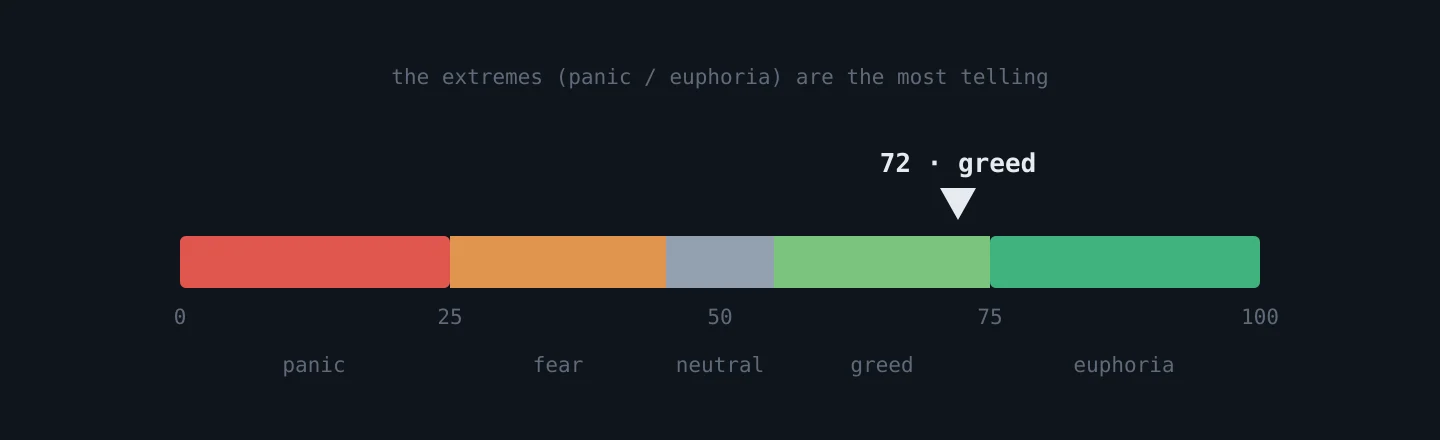
What do the FSI score and its tiers indicate?
The FSI is presented as a single 0-100 score, operating on a clear fear ↔ greed scale, much like a stock-market fear & greed index but specifically tailored for the forex market. This number offers an immediate snapshot of the collective emotional state driving currency trading.
The score is broken down into five distinct tiers, each indicating a different level of market sentiment. These tiers are:
| Score | Reading |
|---|---|
| 0–20 | Extreme Fear |
| 21–40 | Fear |
| 41–60 | Neutral |
| 61–80 | Greed |
| 81–100 | Extreme Greed |
Understanding which tier the market currently occupies helps traders gauge the dominant sentiment. This psychological context is crucial for making informed decisions and managing risk.
What are the components that make up the FSI?
The FSI is not based on a single metric but is rather a sophisticated, weighted blend of six distinct components. Each component contributes to the overall score, providing a holistic view of market sentiment.
Here are the components and their respective weights:
| Component | Weight | What does it measure? |
|---|---|---|
| Institutional positioning / COT | 25% | Measures the collective stance of large institutional traders, often indicative of "smart money" flows. |
| Volatility | 20% | Reflects the degree of price fluctuation, with higher volatility often signaling uncertainty or stress. |
| Global risk / VIX | 20% | Incorporates broader market risk indicators, as forex markets are sensitive to global economic sentiment. |
| Retail sentiment | 20% | Gauges the positioning and mood of individual traders, often contrasting with institutional activity. |
| Carry Trade / CTS | 10% | Assesses the attractiveness and prevalence of carry trades, which thrive in stable, risk-on environments. |
| News pressure | 5% | Accounts for the immediate impact and lingering effects of significant economic and geopolitical news. |
How should a trader practically use the Forex Strength Index?
The Forex Strength Index serves as a valuable CONTEXT and risk gauge, NOT a direct buy/sell signal. Its primary utility lies in understanding the prevailing market sentiment and identifying potential shifts in market psychology. Integrating the FSI with other tools, such as ForexCommand's MRS (Market Readiness Score) and CTS (Carry Trade Score), can provide a more comprehensive view of market conditions.
The extremes of the FSI are typically the most insightful. An FSI reading in the "Extreme Greed" range (81-100), for example, suggests a market that is crowded, potentially complacent, and therefore more prone to sharp reversals. Conversely, an FSI in the "Extreme Fear" range (0-20) signals a strong risk-off environment, often defensive in nature, which can sometimes present contrarian opportunities for those prepared to take on additional risk.
For instance, an FSI of 84 (Extreme Greed) tells you that the market sentiment is highly optimistic and potentially overextended. This warns you to exercise caution, avoid chasing stretched moves, and perhaps prepare for a potential pullback or reversal, rather than initiating new long positions.
One limit matters more than any of that, and it is worth stating flatly: an extreme FSI reading is not a reversal signal. Extreme sentiment can persist for weeks, and some of the strongest trends run with the gauge pinned at one end the whole way. "Crowded" tells you the risk of a sharp move has risen; it does not tell you the move is coming, and it never tells you when. Read it as a reason to size smaller and demand better entries — never as a reason to trade against the trend.
What is the most common mistake beginners make with the FSI?
The most common mistake beginners make is treating the FSI as a direct buy or sell signal. It is crucial to remember that the FSI provides contextual awareness of market sentiment, not specific trading entries or exits. Relying on it as a standalone signal can lead to poor trading decisions because sentiment alone does not dictate price action in isolation.
Another critical distinction often overlooked is the difference between the FSI and ForexCommand's FOTSI. The FSI measures overall market SENTIMENT, giving a single number to represent fear versus greed across the entire forex market. In contrast, the FOTSI is a different analytical tool designed to measure the relative STRENGTH of each individual currency. These are distinct tools with different purposes; confusing them can lead to misinterpretations of market dynamics.
See both live. The FOTSI oscillator gives you the per-currency strength ranking described above, updating with the market.