
Currency Strength, Explained: How Do You Read the FOTSI Oscillator?
Every pair is two currencies pulling against each other — the FOTSI oscillator isolates each one's momentum so you can see which side is driving the move.

Every pair is a tug-of-war between two currencies — the FOTSI oscillator isolates each one's momentum so you can see which side is actually driving the move.
A Pair Is Two Forces
When EUR/USD rises, the price alone never tells you why. Is the Euro strong, or is the Dollar weak? You are only seeing the net result of two currencies pulling against each other. To trade with the trend, you want to know which side is doing the work. And one currency shows up more than any other: the Dollar is on 89% of all forex trades, so its strength reading moves the whole board. The market's shared shorthand for that is the dollar index (DXY) — useful, but over half of it is a single pair.
What Does "Strength" Really Mean Here?
A currency strength meter answers that by stripping each currency out of its pairs and measuring its own momentum. FOTSI — the Forex Oscillator of True Strength Index — is one, and it does this for the eight majors: USD, EUR, GBP, JPY, CHF, AUD, CAD, and NZD.

Under the hood it takes seven quoted exchange rates, derives from them all 28 combinations of the eight major currencies, reads the momentum of each, attributes each move to the currencies involved, and smooths the result with the True Strength Index, a double-smoothed momentum measure. The output is eight lines on one chart — one per currency.
How Do You Read the Oscillator?
FOTSI oscillates around a zero line, with extreme zones marked at +50 and −50:
- Above +50 — the currency is in extreme positive momentum. Its recent strength is unusually extended, which makes chasing fresh longs on its pairs risky. Note what this does not say: momentum is not valuation, so an extended reading does not mean the currency is expensive or that a turn is due.
- Below −50 — extreme negative momentum, the mirror image.
- Zero-line cross — momentum has flipped sign. A new trend may be forming for that currency's pairs.
- Divergence between two lines — when one currency climbs while another falls, the pair built from them has the cleanest trend. That is the textbook setup the oscillator points to.
Strong vs Weak, Paired Up
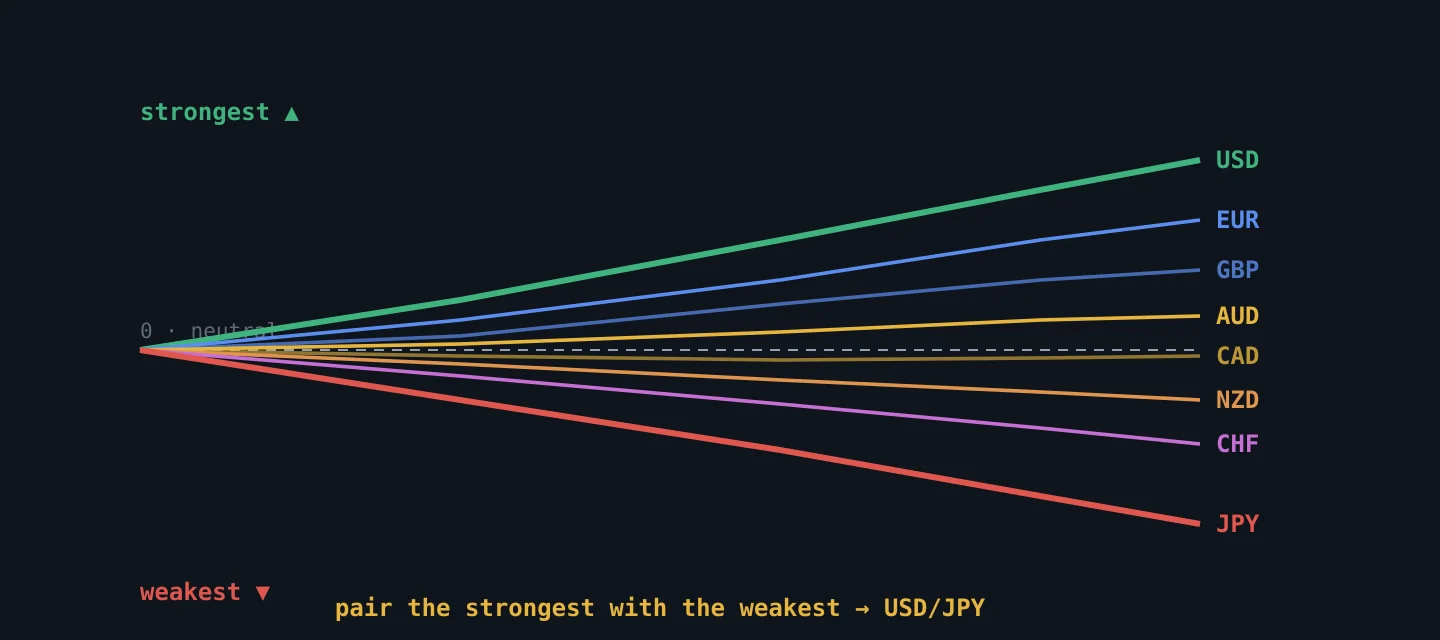
The practical edge is pairing the strongest currency against the weakest. If the Dollar sits near the top and the Yen near the bottom, USD/JPY is where the two momentum readings reinforce each other — a continuation setup rather than a fight against one strong side.
What Is FOTSI Not?
It is a momentum and strength gauge, not a buy or sell signal. Extended momentum can stay extended for a long time in a powerful trend, and a zero cross can fail. FOTSI tells you where the momentum sits and which pairs line up cleanly; confirmation, entries, and risk are still your job — and it reads best alongside the day's news and the calendar, never in isolation.
See it live. The FOTSI oscillator ranks the 8 major currencies from strongest to weakest and updates with the market — the reading this article teaches you to interpret.