The Fed hiked and the dollar led none of the week's five sessions
Three central banks decided in three consecutive sessions, the barrel climbed and gave the whole move back, and the dollar index closed at a late-July high — so how did the dollar finish in the bottom three of eight in all five sessions, and what does that leave open?
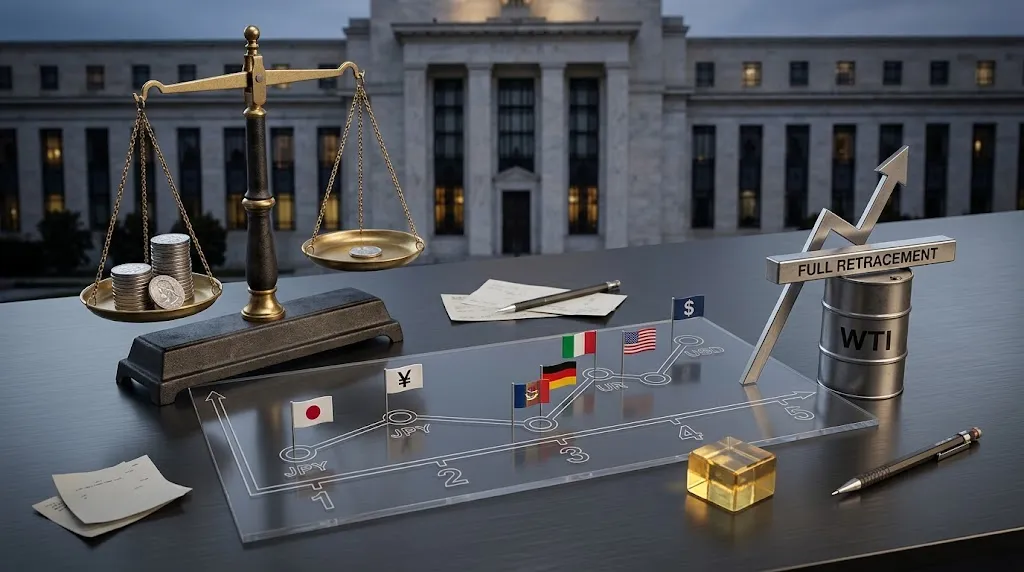
Last week's note closed on a test. If the dollar took the top of our basket on any session, the market had decided the Federal Reserve hike was real and was buying it. If it still could not, the story driving this market was energy, and the Fed was following it rather than leading it.
Neither branch survived. The dollar led none of the five sessions — which by that test pointed at energy. But energy spent the week climbing and then handing the whole move back, and finished where it started.
Three decisions in three consecutive sessions
The Federal Reserve raised its target range by 25 basis points to 3.75–4.00% on Wednesday, its first increase in three years. The median projection points to one further hike in 2026, and the committee lifted its 2026 rate forecast to 4.1%. Chair Warsh said inflation trends were not passing the test.
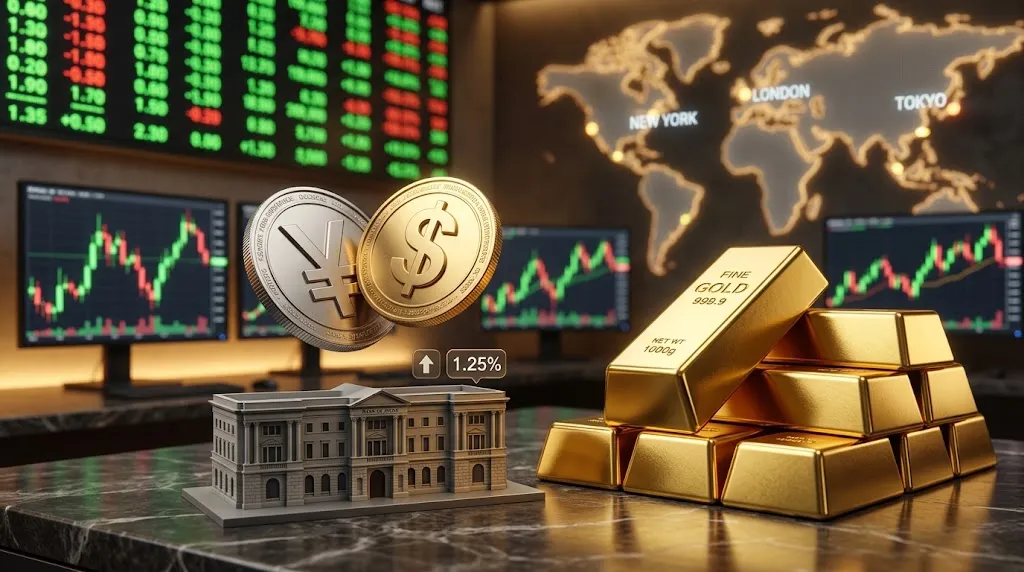
A day later the Bank of England held Bank Rate at 3.75% for a sixth meeting in a row. On Friday the Bank of Japan raised by 25 basis points from 1.00% to 1.25%, its highest policy rate since 1995, on a 7–2 vote whose two dissents were dovish.
The US Dollar Index cracked 100 on the Fed decision, tested its late-July high near 100.35 on Friday and settled just above 100.30.
The barrel climbed, then gave it all back
Monday set it up: Brent jumped to $107 and WTI topped $100 with a Saudi east-west pipeline out of service. The high-water mark came on Tuesday, not Monday: Brent held near $110 after Saudi Arabia's route around Hormuz shut, and US ten-year yields broke 5% in that session — their highest in more than nineteen years.
From Wednesday it unwound. A surprise build in US inventories, then a new Saudi route through Oman, pushed WTI back below $100 on the day of the Fed decision. Thursday was a round trip of its own: WTI fell to $94.50 and recovered the whole move to close near $97.50.
Then the number that reframes the week. The November contract finished Friday at $95.60, down $1.64 on the day — and within 34 cents of where it had finished the previous week. The spike was real and it was round-tripped in full. (Brent and WTI are different barrels; we have no Friday print for Brent, so WTI is the benchmark that can close the week.)
Gold ran the same shape. It broke below $4,300 on Monday and fell to near $4,250 after the Fed, then rallied more than 2% on Thursday as yields slid, closing Friday at $4,381 and stalling just under $4,400.
What our own gauges saw
| Session | MRS | FSI | Led the session | Dollar's place |
|---|---|---|---|---|
| Mon 14 | 69 | 62 | no clear leader | 6th of 8 |
| Tue 15 | 62 | 63 | yen, 22.2% of minutes | 7th |
| Wed 16 | 69 | 61 | no clear leader | 8th |
| Thu 17 | 62 | 61 | no clear leader | 7th |
| Fri 18 | 62 | 64 | yen, 25.4% of minutes | 6th |
These are readings at each session's close, not snapshots taken in the Asian hours, and the leader column counts every minute of the session rather than sampling one.
The number that names the week
Our strength measure ranks the eight majors minute by minute across 28 pairs. Read that way, the dollar finished sixth of eight on Monday, seventh on Tuesday, eighth on Wednesday, seventh on Thursday and sixth on Friday. Bottom three of eight, five times out of five — and on the session that contained the Fed's decision, no currency in the basket led fewer minutes than the dollar.
That is not a contradiction with an index at a late-July high, and the reason is not that the dollar was secretly weak. The two measures ask different questions. The Dollar Index records a level against six currencies, with more than half its weight in the euro. Our leader column records who moved fastest, minute by minute, across eight equally weighted majors — including the Australian and New Zealand dollars, which the index does not contain at all.
A currency can grind higher all week and never once be the quickest mover in a given minute. That is what the dollar did. What tops a minute count is movement in bursts — the yen around the Bank of Japan, the kiwi, the franc — and bursts are exactly what the dollar did not produce.
Only two of the five sessions had a leader clear enough to name, and both were the yen: 22.2% of Tuesday's minutes and 25.4% of Friday's. That same yen ended the week with USD/JPY at 156.95, up 0.63% on Friday, in what the wires called its worst week since October 2025. Both are true, because the two things being measured are different: ours ranks momentum across 28 pairs, not the yen against the dollar. On the other three sessions the top two were too close to separate, so there was no leader to name at all.
What stays open
The front end moved and the path did not. Action Forex reports that Chair Warsh's description of the hike as removing a dose of accommodation drove the two-year Treasury yield and the Dollar Index sharply higher, while Fed funds futures barely shifted the expected destination of the tightening cycle. The same note puts Brent's $100 test upstream of everything else.
Japan reopened a thread on Friday. InvestingLive reported an FX rate check during the session — the first rung on the ladder that ends in intervention, and a reminder that a central bank which has just raised rates can still be unhappy with its currency.
One date has a named source behind it, and a caveat attached: InvestingLive reports a Xi–Trump summit set for 24 September, with a Taiwan arms sale threat hanging over it.
The tell to watch. For a second consecutive week the dollar has not led a single session, and this week it never climbed out of the bottom three of eight. "Leads a session" has proved too high a bar to be useful, so the sharper test is this: can the dollar reach the top half of the table on any session? If it does, the market has started trading the Fed's path rather than the headlines around it. If it stays in the bottom three — with the barrel back where it started and the Fed still tightening — then neither of those is what moves this basket, and the place to look is the other end of the table, where the yen led the only two sessions that had a leader at all.