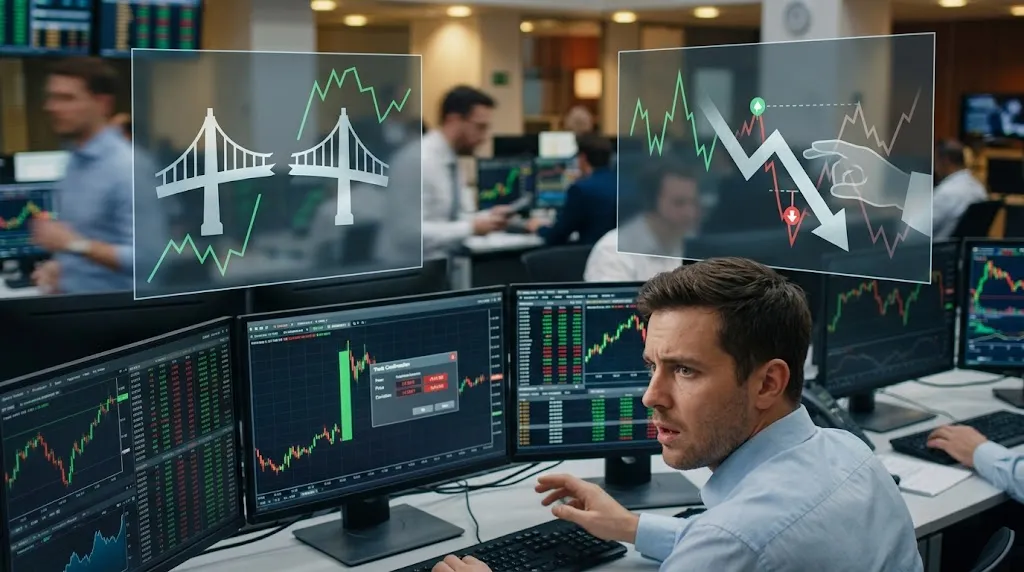
Order book and depth of market: why does forex not have one?
Forex has no central order book because it has no central exchange. That one structural fact explains tick volume, broker-specific spreads and why institutional orders cannot be verified.

Every stock trader can see a central order book. In forex there isn't one — not because it is hidden from retail, but because it does not exist. Understanding why explains more about spreads, slippage and "volume" than any indicator will.

What is an order book?
An order book is the live list of resting orders for an instrument: how much is bid at each price below the market, how much is offered at each price above it. Depth of market (DOM) is that list rendered as a ladder.
It tells you two things a chart cannot: how much size is waiting at each level, and how far price would travel if someone decided to buy or sell a given amount right now. That second one is liquidity, measured directly instead of inferred.
So why doesn't forex have one?
Because forex has no exchange. Stocks trade on a venue — the NYSE (New York Stock Exchange), Nasdaq — where every order lands in one book and every trade prints to one tape. Currencies trade over the counter: a decentralised network of banks, brokers and electronic venues dealing directly with each other.
There is no central place where all forex orders meet, so there is no book that contains them all. What exists instead is a set of partial books:
- Interbank platforms — EBS (Electronic Broking Services), Refinitiv — hold deep books, but only for their participants.
- Each ECN or broker sees its own flow and whatever its liquidity providers stream to it.
- CME (Chicago Mercantile Exchange) currency futures do have a real central book, because they are exchange-traded — which is why futures traders can see a DOM for the euro while spot traders cannot.
Your broker's DOM, if it offers one, is not "the" forex order book. It is that broker's window onto its own providers — a genuine view of a small slice.
What does this explain?
Once the structure is clear, several things stop being mysterious:
- Why is there no real volume? Volume on a forex chart is tick volume: the number of price updates, not the amount traded. It correlates with activity, which makes it useful as an activity proxy, but it is not size and should never be read as one.
- Why do spreads differ between brokers? Each is pricing off a different set of providers. There is no single "market" spread to converge on.
- Why does slippage spike on news? Providers widen or withdraw quotes simultaneously; the visible book thins out, and your order walks further to find a counterparty.
- Why can’t "institutional orders sitting at a level" be verified? Not because someone hides it — because no consolidated record of it exists anywhere. It is why the claims some frameworks make about institutional order flow cannot be checked with retail data.
What can you use instead?
The absence of a book is a real limitation, but not a blind one. Three substitutes carry most of the weight — and above them, the money you can actually follow in public sources:
- Session and hour. Liquidity in forex is far more predictable by time than by level: the London–New York overlap reliably has more depth than the Asian afternoon. That single fact replaces most of what a DOM would tell you.
- Spread as a live gauge. The spread widening is the book thinning, expressed in the one number every broker shows you. Watch it around news and rollover.
- CME futures depth, if you want an actual book. It is not the spot market, but for the majors it is a reasonable proxy for where size is resting.
The takeaway
Forex has no central order book because it has no central exchange. Everything downstream — tick volume instead of real volume, broker-specific spreads, unverifiable claims about institutional orders — follows from that one structural fact. Trade the hours when depth is genuinely there, and treat any tool that promises to show you "the real orders" with the scepticism its architecture deserves.