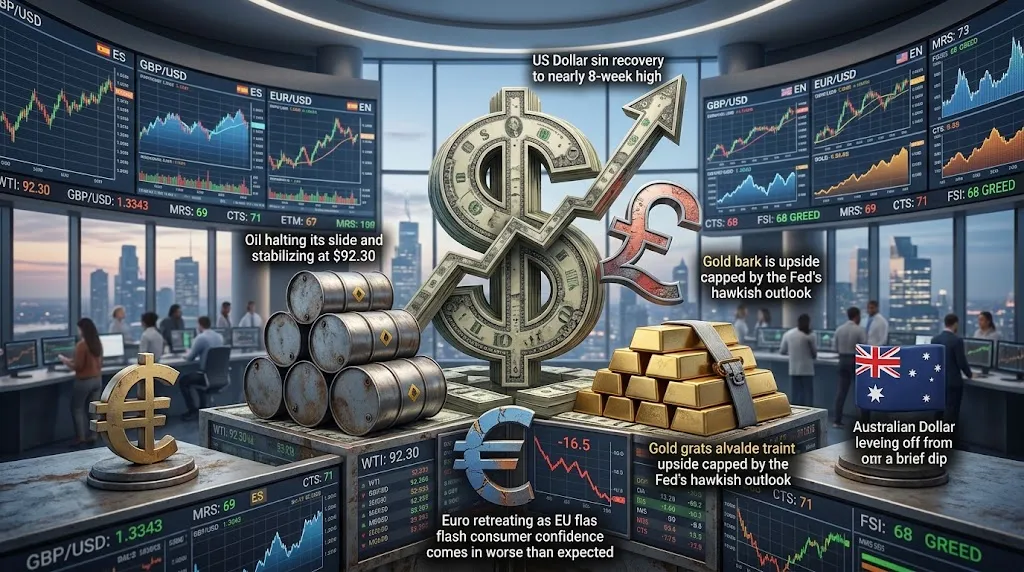
Dollar extends streak on Fed hawkishness; yen, Swiss franc weaken
The dollar rallied on hawkish Federal Reserve remarks, the yen and Swiss franc weakened, and the two levels the week watched both broke: Brent above $100, the 10-year above 5%.

The US dollar continued its rally, driven by hawkish Federal Reserve remarks, while the yen and Swiss franc weakened against it — the yen even as our own session gauge made it the day's strongest major.
Dollar strength and hawkish Fed signals
The US Dollar Index extended its winning streak, reaching 101.40, its highest level since late July, and marking its fourth straight gain. The dollar had recovered approximately 90% of its late-July to August losses.
- Fed officials lined up behind more tightening: Philadelphia’s Anna Paulson said further hikes might be needed to curb inflation, and Cleveland’s Beth Hammack warned that persistent price pressures could complicate the task.
- Yields were the session's engine. Investing.com reported US yields surging past 5% on the hot flash PMI and weak auctions, with the 10-year around 5.14%, its highest since 2007, and the 30-year at its highest since 2004. Action Forex put October rate-hike odds at 77.5%, up from roughly 53% a day earlier. New York Fed President John Williams called another 2026 hike “reasonable” without committing to October, and the wires credited his remarks with knocking the euro off 1.1400 and sending silver lower.
- The US Treasury sold $44 billion of 7-year notes at a high yield of 5.085%, and it was soft: a 0.7 basis point tail against a 0.2 average, bid-to-cover 2.42 against 2.49. Commerzbank said the Fed's unanimous hike had temporarily restored its credibility, and cut its EUR/USD year-end forecast to 1.15.
- InvestingLive had framed the week as two questions — could oil stay below $100, and could the 10-year stay below 5% — and by Thursday the answer to both was no, with Brent crude above $100: the level our weekly wrap had put upstream of everything else.
Key currency moves, data and metals
- The Japanese yen gave back most of its recovery, with USD/JPY extending its advance for a fifth consecutive day above 158.00, testing the 200-day moving average at 158.47. This weakness coincided with a slowdown in Japan’s private sector growth during September, as PMI Manufacturing fell to 54.1 and PMI Services to 51.6.
- Japan kept the intervention ladder in view: Finance Minister Satsuki Katayama said the principles set since the coordinated Japan-US intervention remain in effect, and with 10-year Japanese government bond yields surging the wires reported traders on high alert for further action.
- The Swiss franc weakened across the board following the Swiss National Bank’s decision to leave its policy rate unchanged at 0%. This pushed USD/CHF to its highest level since May 2025, while EUR/CHF gained 0.24% to around 0.9415 — Commerzbank expects franc weakness to slow near 0.95.
- The euro depreciated below 1.1400 to a two-month low, its weakest since 28 July. Rabobank, which places the pair near its yearly lows, flagged further downside risk against a consensus that had expected 1.18-1.20 in late 2026.
- Australia’s unemployment rate rose to 4.6% in August against a 4.5% forecast, its highest since 2021 — and AUD/USD barely moved. InvestingLive noted the report cut both ways, with strong headline hiring and a higher participation rate offsetting the jobless number; the pair held near its 7 August low around 0.7025.
- In Germany, the Ifo Business Climate index improved to 89.9 in September, beating expectations and extending its rebound.
- Gold fell below $4,300 in Asian hours and kept going, sliding to a one-week low near $4,250 and down about 0.85% on the day, as rising yields and a stronger dollar weighed on non-yielding bullion. Silver followed it down, off 1.23% at about $63.65.
- The pound fell for a fourth straight day against the dollar, down 0.21% at 1.3213 and heading for its lowest close since June.
Geopolitical developments
- Presidents Trump and Xi agreed to a two-month extension of their trade truce, avoiding a November tariff cliff but offering no long-term relief. The new January 10 deadline now marks the next risk event for trade-sensitive assets.
- Discussions were reported regarding a phased arrangement between the US and Iran to reopen the Strait of Hormuz and end the US blockade, with Iran signaling flexibility on fees but not control of the strait.
Market metrics and looking ahead
Our proprietary MRS registered 69, with the CTS at 71, and FSI indicating Greed at 67.
Our session gauge and the index disagree, and both readings are right. The Dollar Index posted a fourth straight gain, while the dollar ranked seventh of eight majors by time spent leading. The yen was the session’s only clear leader, at the top for 328 of its 1,433 minutes — weakest against the dollar, strongest across the basket. The dollar reached the top half of that table once this week, on Tuesday’s session, and has not held it: seventh on Wednesday, seventh again on Thursday. The index measures the dollar against a fixed basket; ours counts the minutes each major spent at the top of a momentum ranking built from 28 pairs.
Looking ahead, traders await scheduled remarks from Bank of England Governor Bailey and the revised University of Michigan Consumer Sentiment and Inflation Expectations from the US.