
Margin vs leverage: one is a ratio, the other is money
One is a permission your broker grants, the other is money a single trade locks and returns. The same position at four leverage settings, and the one number that never moves.
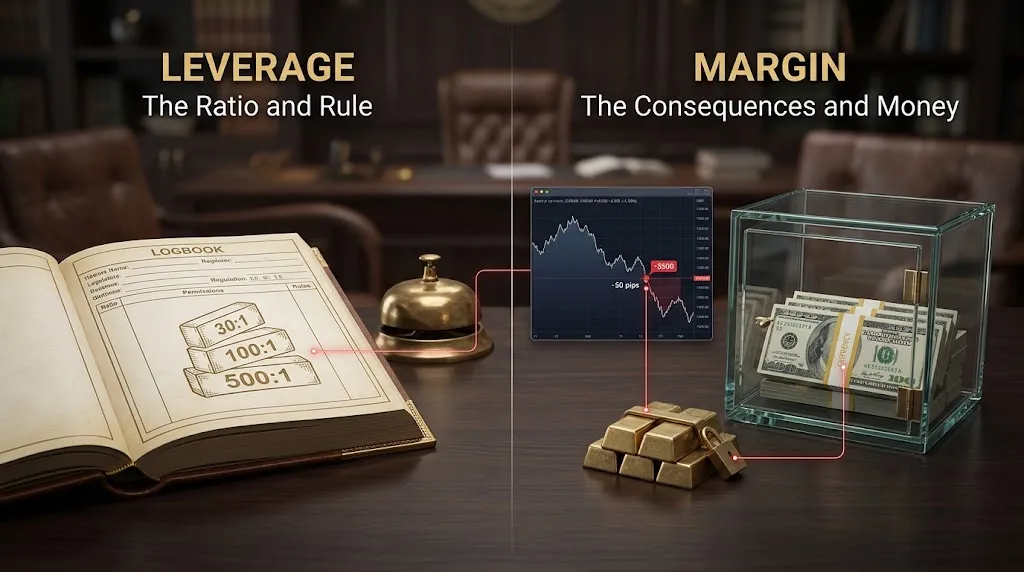
They are not two words for the same thing, and they are not even the same kind of thing. Leverage is a ratio your broker permits. Margin is an amount a particular trade takes out of your account. One is a rule that applies to everything you do; the other is a receipt for one position. The confusion is expensive because it lets a trader look at $228 of locked capital and believe $228 is what is at stake.
Our explainers already define each one on its own: leverage as the multiplier and its regulatory ceilings, margin as the collateral and how to calculate it. This is about what happens when you treat them as interchangeable.
The difference in one line each
- Leverage is a permission. A ratio — 30:1, 100:1, 500:1 — that your broker grants to the account. It is the same number whether you have one position open or none.
- Margin is a consequence. The money set aside when you open a specific trade, and returned when you close it. It changes with every position and is zero when you have none.
There is one more reason the two get fused: brokers also state margin as a percentage. A 2% margin requirement and 50:1 leverage are the same rule written twice — the percentage is 1 divided by the ratio — and neither of them is the dollar figure your position locks.
You do not choose your margin. You choose a position size, and the margin follows from it: notional divided by the leverage ratio. That direction of causation is the whole thing, and it is the part the word "synonym" destroys.
The same trade, four leverage settings
One standard lot of EUR/USD at 1.1411 — the European Central Bank's reference rate on 23 September 2026 — is a notional position of $114,110. Here is that identical trade under four ratios, on a $5,000 account.
| Leverage | Margin locked | Free margin | Margin level | Loss on a 50-pip move |
|---|---|---|---|---|
| 30:1 | $3,803.67 | $1,196.33 | 131% | −$500 |
| 50:1 | $2,282.20 | $2,717.80 | 219% | −$500 |
| 100:1 | $1,141.10 | $3,858.90 | 438% | −$500 |
| 500:1 | $228.22 | $4,771.78 | 2,191% | −$500 |
Not every row is on offer. A retail client in the European Union, the United Kingdom or Australia can only use the first one, and a client in the United States the first two: the caps on majors are 30:1 and 50:1 respectively, so 100:1 and 500:1 exist only outside those jurisdictions — the table in our leverage explainer has the detail.
Read the last column. It does not move. The market does not know what ratio your broker gave you; it moves the price of 100,000 euros, and 50 pips against you costs $500 in every row, on a dollar account.
Everything else in the table moves a lot. That is the point: leverage changes the collateral, not the exposure.
More leverage is not the risk — the bigger position it allows is
Our leverage explainer says leverage amplifies losses, and that is true measured against your margin: at 100:1 a 1% move is the whole of it. Measured in dollars at a fixed position size, which is the last column above, it does not move at all.
This is where the synonym does real damage. If margin and leverage were the same thing, then locking less money would mean risking less money, and the 500:1 row would be the dangerous one.
Look again. The 500:1 row is the one with $4,771.78 of free margin absorbing losses. The 30:1 row is the one sitting at a 131% margin level, about 120 pips from the 100% mark on a position it can barely hold. For one identical trade, the lower ratio is the account that gets closed out first — wherever your own broker sets its threshold, since that number is its to choose.
But read what each row pays for that. At that 100% mark the 30:1 account is out having lost $1,196, while the 500:1 account is still open until it has lost $4,772 — four times as much. Being stopped out early is what caps the loss, not the hazard — the ratio decides where you exit, and the position size decides how fast you get there. That cap holds in normal conditions: through a gap the close lands past the level, which is how a loss runs beyond the margin you put up.
That is not an argument for high leverage, and it is not permission to go looking for a 500:1 broker. It is a statement about what the ratio actually governs: how much room you have before the broker intervenes, not how much you lose when price moves.
What high leverage genuinely does is remove the obstacle. With $228 locked instead of $3,804, nothing stops you opening five more lots. The danger is in the position you take next, not in the ratio itself.
The leverage you are actually running
There is a second number, and almost nobody looks at it: effective leverage, which is your open notional divided by your equity.
That $114,110 position on a $5,000 account is 22.8:1, whatever the broker's paperwork says. A trader with a 500:1 account and one lot open is running 22.8:1. A trader with a 30:1 account and one lot open is also running 22.8:1. The permission is a ceiling; the effective figure is a description of what you are doing right now, and it is the one that behaves like risk.
Which also explains why "I trade with 500:1" says nothing at all about how aggressive someone is. It describes their broker, not their position sizing.
Where does the confusion cost money?
- Choosing a broker by its maximum ratio. You will use a fraction of it. The caps by jurisdiction are in our leverage explainer, and the important line there is that the cap is a ceiling rather than a target.
- Reading a small margin as a small position. Our margin explainer names this mistake with its own pair of figures; in ours, controlling $114,110 with $228 feels safe, and the risk lives in the notional either way.
- Treating margin level as a risk gauge. It is equity over used margin, so the same trade reads 131% or 2,191% depending only on the ratio. It tells you how close the broker is to closing you — nothing about how much you stand to lose. Our post on the five numbers in your terminal walks through how they move.
What this does not settle
- The caps are not universal and they change. Which ratios you can actually get depends on where your broker's entity is registered, and that belongs in the leverage explainer rather than here.
- Some platforms recalculate margin as the rate moves, so the locked figure drifts and the levels above shift with it. The arithmetic is identical; the trigger distances are not.
- Nothing here is about the cost of the trade. The spread, the commission and the swap are a separate bill, which we worked through in what a trade really costs.
The takeaway
Leverage is a ratio the broker sets for the account. Margin is money one trade sets aside from your balance and gives back. If you only remember one test: change your leverage and your potential loss does not move; change your position size and it moves immediately. That is how you know which of the two you are actually holding.