
What is BOS and CHoCH in trading? (market structure explained)
Market structure, in Smart Money Concepts (SMC), maps price's directional flow via swing highs and lows: an uptrend prints higher highs and higher lows; a downtrend, lower highs…

BOS and CHoCH are the two structure breaks that drive Smart Money trading. In trading, market structure — part of Smart Money Concepts (SMC) — maps price's directional flow via swing highs and lows: an uptrend prints higher highs and higher lows; a downtrend, lower highs and lower lows. A Break of Structure (BOS) signals trend continuation, while a Change of Character (CHoCH) hints at a potential reversal. These confirm past market events, offering insights into order flow.
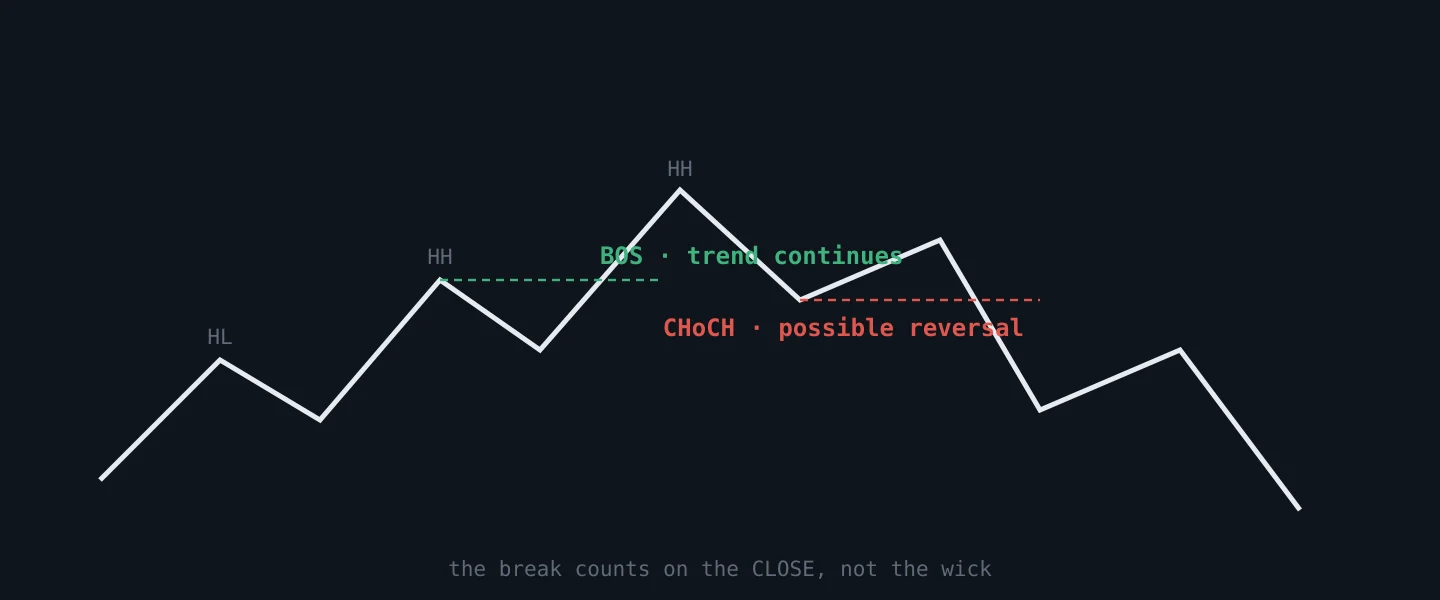
What is market structure and how do BOS and CHoCH show it?
Market structure is the sequence of swing highs and swing lows. An uptrend prints higher highs and higher lows; a downtrend prints lower highs and lower lows. Identifying these swings helps traders understand the prevailing trend.
A Break of Structure (BOS) is when price breaks the most recent swing in the SAME direction as the trend — read as continuation. Conversely, a Change of Character (CHoCH) is when price breaks the most recent swing AGAINST the trend — the first hint the trend may be shifting.
What is the difference between BOS and CHoCH?
Both are structural breaks, and both are confirmed by the same thing: price closing beyond a prior swing point. The difference is direction relative to the trend, and that single distinction changes what each one means for your bias.
- Direction — a BOS breaks WITH the trend; a CHoCH breaks AGAINST it.
- Message — a BOS says "the trend is still intact"; a CHoCH says "this trend may be ending".
- What it breaks — in an uptrend, a BOS takes out the last swing high; a CHoCH takes out the last higher low.
- Sequence — a trend usually prints several BOS events, then one CHoCH. The CHoCH is the first structural warning; another CHoCH in the opposite direction never confirms the old trend.
- How traders use it — a BOS is a continuation cue used to join an existing move; a CHoCH is a caution cue used to stand aside or hunt reversals.
The practical shorthand: BOS extends the story, CHoCH rewrites it.
Why do BOS and CHoCH matter in SMC?
In Smart Money Concepts (SMC) — and the ICT methodology built on it — BOS and CHoCH are crucial for understanding institutional order flow. They illustrate where "smart money" is likely extending a trend or initiating a reversal, providing a framework to interpret price action beyond basic support and resistance.
These events confirm what already happened; they are not predictions. By identifying clear BOS or CHoCH, traders can gain insight into the market's directional bias, aligning their analysis with the footsteps of larger participants.
What makes a break of structure valid?
This is where most charts get misread — not every poke past a swing point counts. Three filters separate a real structural break from noise.
- Close beyond the level, not just a wick. A candle that spikes through a swing high and closes back below it is a rejection, not a break. Wait for the close on your working timeframe.
- The swing has to matter. Structure is defined by the swings that shaped the trend, not by every micro-pivot inside a pullback. If a level did not produce a visible reaction when price left it, breaking it proves little.
- The timeframe has to be consistent. A break on the 5-minute chart says nothing about the 4-hour trend. Pick the timeframe your decisions live on and read structure there, then use lower timeframes only for entry timing. That is market fractality at work: the same structure repeats at every scale.
There is a fourth trap worth naming: price often runs a swing point deliberately to collect stop orders before reversing. That is inducement — the break that exists to trap breakout traders — and it is the single most common reason a "valid" BOS fails immediately.
How do you trade a BOS and CHoCH strategy?
A BOS and CHoCH strategy starts from one idea: structure is a read, not a signal. It tells you which side of the market to be on; the entry still comes from a zone. Here is the sequence traders actually follow, walked through on EUR/USD.
Say EUR/USD has been climbing: it prints a swing high at 1.1480, pulls back to a higher low at 1.1420, then pushes up and closes above 1.1480. That close is a BOS — the uptrend is confirmed intact, and the bias is long. You do not chase the break. You mark the demand zone the move originated from — say an order block or fair value gap around 1.1430 — and wait for price to retrace into it. Entry goes there, with invalidation below the higher low at 1.1420, because a close under that level would break the structure that justified the trade.
Now the other case. Price rallies to 1.1520, pulls back, and this time closes BELOW the 1.1420 higher low. That is a CHoCH: the uptrend's sequence is broken and the long bias is gone. The disciplined response is to stop looking for longs — not to flip short immediately. You wait for price to retrace up into a supply zone near the origin of the drop, and only then look for a short, using the most recent swing high as invalidation.
Two habits make the difference between a framework and a guess. First, decide your invalidation level before you enter — structure hands it to you for free. Second, weigh the wider context: a clean structural read in a dead session or into a high-impact release is still a low-quality trade, which is exactly what a market-readiness read is built to weigh.
What is a common beginner mistake with BOS and CHoCH?
A frequent error is mistaking minor internal price movements or liquidity sweeps for genuine structural breaks. Market structure applies to significant swing highs and lows that define the true trend, not every small fluctuation on the chart.
Traders often predict rather than confirm, forgetting BOS and CHoCH only tell us what has happened, not what will happen. Waiting for clear, established breaks on relevant timeframes prevents misinterpretations and premature entries.
The subtler mistake is treating a single CHoCH as a reversal already in progress. A CHoCH says the old trend lost control — it does not promise the opposite trend has taken over. Price frequently ranges for hours after one. Read it as permission to stop trading the old direction, and wait for a new structure to build before trading the new one.
Which comes first, a BOS or a CHoCH?
The sequence is fixed, and knowing it is most of what "reading structure" means.
A trend in progress prints a run of BOS events — each one a close beyond the previous swing in the direction of the trend, each one confirming the trend is intact. That run continues until, at some point, price closes beyond the most recent swing in the opposite direction. That first counter-break is the CHoCH, and it is the only one in the sequence that is not a continuation.
What happens next decides how you read it. If a new trend takes hold, the breaks that follow the CHoCH are BOS events again — now in the new direction. If they never come, the CHoCH was the start of a range rather than a reversal, which is the far more common outcome and the reason a single CHoCH is a warning rather than a signal.
So the pattern to expect is: BOS, BOS, BOS… CHoCH… then either BOS in the new direction, or nothing. A chart that shows CHoCH after CHoCH with no BOS in between is not reversing repeatedly — it is ranging, and structure has nothing useful to say about it.
The takeaway
BOS and CHoCH are two readings of the same event: a candle closing beyond a prior swing point. Direction relative to the trend is what separates them — with the trend it confirms, against it warns. Both describe what already happened, neither predicts, and both are only as reliable as the timeframe you read them on and the closes you insist on. Get the sequence right and structure stops being a set of labels and becomes a way of knowing which side of the market you belong on.