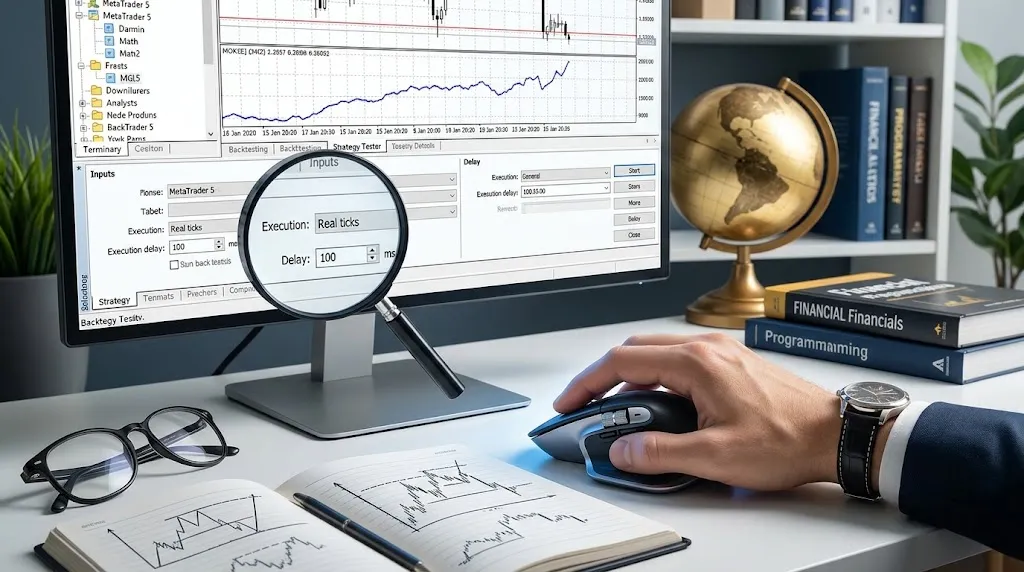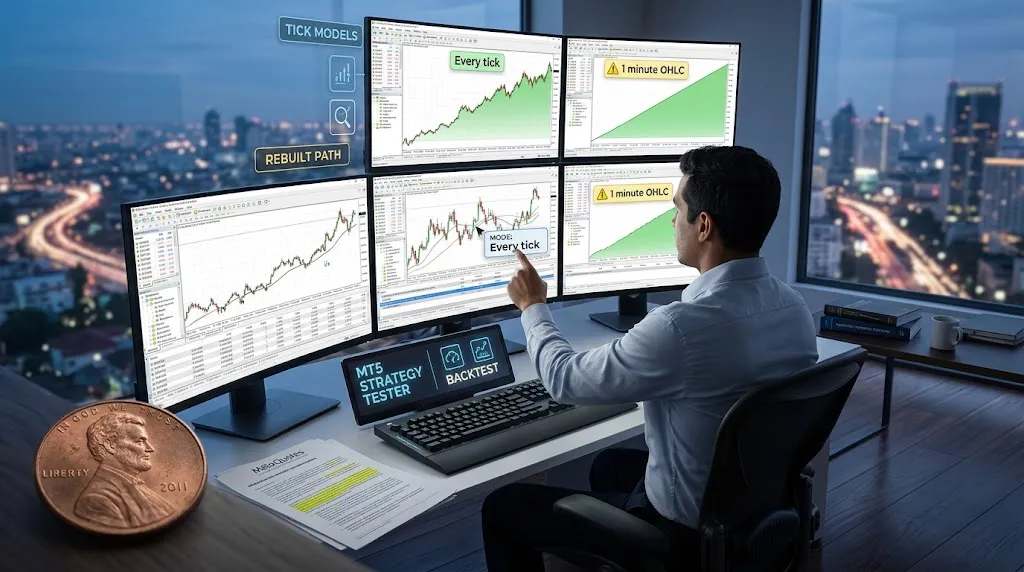
What does the MT5 Strategy Tester actually do when you hit Start?
Outside real-ticks mode, the MT5 simulator rebuilds ticks from each bar, takes the spread from history and can fill orders in "ideal" conditions. What does each report assume? The five questions to ask before you believe it.

The MetaTrader 5 (MT5) Strategy Tester runs a robot over the past, but outside its real-ticks mode it does not replay that past: it rebuilds it from the prices of each bar. It takes the spread from history and can fill every order with no delay at all, in what the platform itself calls "ideal" conditions. Every figure in the report depends on those assumptions, and it is worth knowing them before you treat it as proof.
Why is a simulator report not proof?
Anyone who has tested a robot, or thought about buying one, knows the results tab: dozens of statistics, a balance chart and the air of an official document. It comes from the Strategy Tester, the tool MT5 uses to run an Expert Advisor (EA: a program that trades on its own) over historical data.
The problem is not that the simulator is badly built. It is that every figure in the report depends on three choices that never show up in the curve: where the ticks come from, which spread is used and how orders are filled. Change any of the three and the result can change, with the same robot over the same period.
It is the tooling version of what we covered in what backtesting is: a test on the past is worth what its assumptions are worth.
Where do the ticks come from?
The official MT5 help offers five tick generation modes:
| Mode | Data it uses |
|---|---|
| Every tick | Ticks simulated from one-minute bars |
| Every tick based on real ticks | Real ticks accumulated by the broker |
| 1 minute OHLC | Only the four prices of each one-minute bar |
| Open prices only | OHLC of the chosen timeframe; the EA only acts at the open |
| Math calculations | No prices at all: calculation only |
The name of the first one is easy to misread. "Every tick" does not mean "every tick that happened". The help says so plainly:
All ticks are simulated in this mode.
The MQL5 technical documentation, MQL5 being the language MT5 robots are written in, explains how. For each one-minute bar four control points are known, the open, high, low and close (OHLC), and the simulator generates the rest of the path between them. What happened inside that minute is a plausible reconstruction, not a record.
The real-ticks mode is the closest to the market, and it still has small print. The help says that in it "no simulation is performed", but the technical documentation adds that each minute is checked against its bar, and if they do not match, those ticks are discarded and replaced with generated ones. The help gives the summary; the technical documentation gives the detail.
Each mode fools a different kind of strategy, and the difference deserves its own article. Here the rule is enough: before you read a report, find out which mode was used.
What does it do with the spread and with execution?
The spread. In MT5 it is not modelled: according to the documentation, it is taken from historical data and always treated as floating. That is a real difference from MetaTrader 4, where the test usually runs at a constant spread, as we explained in The robot is not sold for what it earns. A warning written for one platform does not carry over unchanged to the other.
Floating does not mean faithful. The historical spread depends on the broker that supplied the data, and it widens overnight in ways another broker's history need not reflect.
Execution. This is the most comfortable assumption. The simulator offers three delay options, and it describes the first like this:
The mode is used to check how an EA would perform in "ideal" conditions.
With no delay, every order fills at the requested price with no requotes. Random delay generates waits of 0 to 8 seconds with 90% probability and 9 to 18 seconds with 10%. Fixed delay can be taken from the real ping to the server. The help presents both as ways of bringing the test closer to real conditions.
There is also a mode that calculates profit in pips. The help warns that swaps and commissions are not calculated in it and margin is not controlled, and that it is only for a quick, rough estimate.
What does History Quality measure?
In MT5 the report does not carry MetaTrader 4's "modelling quality". It carries History Quality, which the report help defines as the percentage of correct versus incorrect one-minute data. A bar with a volume of 1 and different OHLC prices counts as incorrect, and so do gaps in the history. The period is split into between 1 and 199 intervals, and each one is scored separately.
It is a useful figure, and it measures exactly that: the quality of the data, not of the system. A 100% only vouches for the raw material; whether the strategy has an edge is a separate question, the same one we raised about MetaTrader 4's modelling quality.
How does the report read its own figures?
The report help pairs the Sharpe ratio with a scale. Below 0, "Bad". From 1, "Good". And from 3 upwards:
Sharpe Ratio ≥ 3.0 — a high value indicates that the probability of obtaining a loss in each particular deal is very low. Very good.
That scale is a generic reading, and the simulator computes Sharpe with a risk-free rate of zero. What it does not say is where the number was obtained. If the parameters were optimised on the same period being measured, a high Sharpe is not a sign of quality: it is what optimisation produces by construction. That is the mechanism we described in why a perfect backtest fails in live trading, and the reason Sharpe is for comparing, not for certifying.
What should you ask before you believe a report?
- Which tick mode was used? For most strategies, the reasonable answer is "Every tick based on real ticks"; anything else needs an explanation (for example, a strategy that only trades at the bar open, with no stops or pending orders).
- Which delay? If it is "no delay", the report describes ideal conditions, and the platform says so.
- What was the History Quality, and in which intervals does it drop?
- Does it include commissions and swaps? The pips mode does not calculate them.
- Is there a period outside the optimisation? Without one there is no way to separate edge from fit. Real-time forward testing comes after that, and it is a different test.
What this article does not tell you
It does not evaluate any particular robot, it has not run tests of its own in MT5, and it does not claim the Strategy Tester is a bad tool. It is a good tool, and its own documentation is franker about its limits than many of the product pages that use its reports.
What it does give you is the map of assumptions. A report without its settings is a curve without context, and the settings fit in five questions.