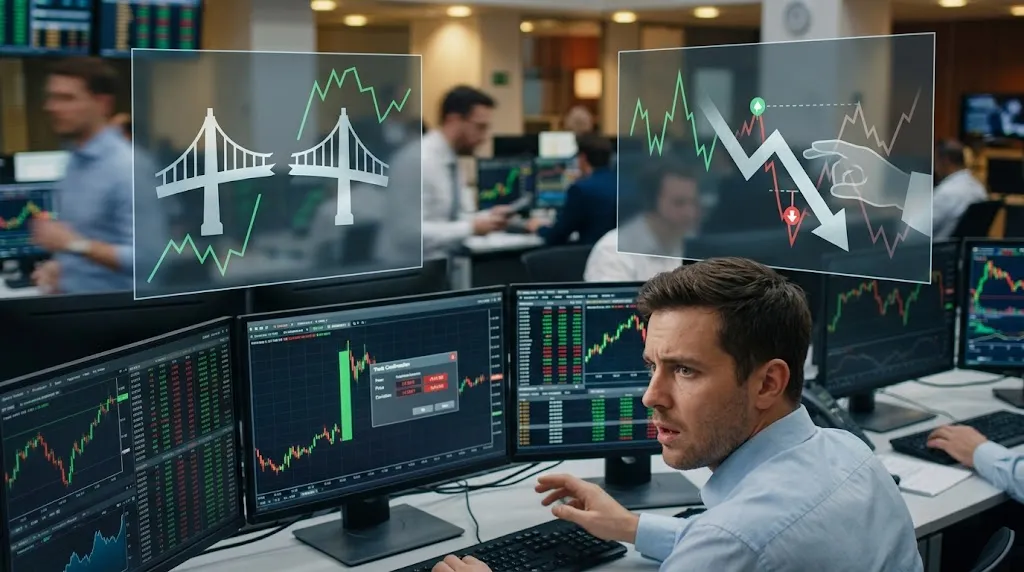
Why does a perfect backtest fail in live trading?
A backtest that looks flawless is often overfitted — the model memorised the noise of the past instead of a real edge. Here is how to spot curve-fitting before it costs you real money.

A backtest that looks flawless is usually a warning, not a green light. It often means the strategy is overfitted: it memorised the random noise of past data instead of a real, repeatable edge. On history it looks perfect; live, where tomorrow is not in the sample, it falls apart.

Why does it matter for a forex trader?
Overfitting (also called curve-fitting) is the single most common way traders — and the AI models they trust — fool themselves. It is seductive because the evidence looks so convincing: a smooth, rising equity curve with almost no losing trades. But that curve describes a past that will never repeat exactly. Chasing it wastes months and, worse, gives you false confidence to risk real money on a strategy that never had an edge to begin with.
How does it actually work?
Every price series is part signal (real, repeatable behaviour) and part noise (random wiggle that will never recur the same way). When you optimise a strategy — adding rules, tweaking parameters, letting a model try thousands of combinations — it will happily fit both. The more knobs you turn, the more of the noise it captures, and the more spectacular the backtest looks. That is the trap: a better-looking backtest can mean a worse strategy. The fix is discipline you already know from machine learning — hold out data. Test on a slice the strategy never saw (out-of-sample), or run it forward on new data with forward testing before you believe it.
What are the limits you must respect?
No backtest proves a strategy works — it only proves it did not fail on one specific slice of the past. Respect a few rules: prefer fewer parameters (each one is a chance to fit noise); be suspicious of any result that looks too clean (in MT5, a coarse tick model can manufacture one); judge a system on out-of-sample and forward results, not the curve it was built on; and lean on robust metrics rather than a single equity line. This is also why "AI predictions with 90% accuracy" are a red flag — that number almost always comes from testing on the same data the model learned, which is the definition of overfitting.
What is the difference between overfitting and a real edge?
A real edge survives contact with data it has never seen; an overfit does not. If a strategy performs on out-of-sample data, on a different pair, or on a later period roughly as well as it did in the backtest, that is evidence of a genuine pattern. If it only shines on the exact data it was tuned on, you have fitted the noise.
How can you avoid overfitting your strategy?
Keep it simple, keep data aside, and test out-of-sample and forward before risking a cent. Log every live trade in a journal and compare real results to the backtest — a large gap is overfitting showing its face. Remember that a strategy which is merely good but holds up live beats a perfect one that only ever existed in the past.