
How much should you risk per trade?
To safeguard your capital and ensure long-term survival in the forex market, the 1% rule is the right default: risk no more than 1% of your account on any single trade. This disciplined…

To safeguard your capital and ensure long-term survival in the forex market, risk no more than 1% of your total trading account balance on any single trade — the professional range runs to about 2%, and 1% is where you start. This disciplined approach protects against inevitable losing streaks, minimizes emotional trading, and allows your account to recover and grow steadily over time.
What exactly is the 1% rule for forex traders?
The 1% rule is a core principle of risk management: for every trade you place, the maximum amount of your account you are willing to lose, should your stop-loss be hit, is 1% of your total trading capital. It ensures that no single unexpected market move or a series of losses can wipe out your account.
How do you calculate your risk for a trade using this rule?
Let's use a clear example. Suppose you have a trading account with $10,000.
1. Calculate your maximum dollar risk: 1% of $10,000 is $100. This means on any single trade, your potential loss should not exceed $100.
2. Determine your position size: The $100 risk amount, combined with your chosen stop-loss distance, will dictate your maximum position size.
* Imagine you identify a trade setup on EUR/USD and decide on a 20-pip stop loss.
* To risk only $100 with a 20-pip stop, your position size must be such that 20 pips equals $100. This means each pip movement can be worth $100 / 20 pips = $5 per pip.
* Since a standard lot ($100,000) for most USD pairs is roughly $10 per pip, you would trade 0.5 standard lots (or 5 mini lots) for this specific trade.
Remember, these numbers are illustrative. Your actual pip value will vary based on the currency pair and your broker, but the principle of calculating your dollar risk first remains constant. If your analysis, perhaps informed by a high ForexCommand MRS (Market Readiness Score), suggests a strong setup, you still adhere to this strict risk limit.
So is 1% a law, or a starting point?
It is a starting point — a very good one, and the right default if you are still building a track record. But presenting it as an absolute is not honest: the professional range is roughly 1% to 2%, and plenty of experienced traders sit at the top of it while others deliberately sit below.
Four things decide where you belong in that range:
- Your edge. Risk is only justified by an edge you can measure. Until you have a real sample of trades with a known win rate and risk-reward, 1% is not conservative — it is simply prudent given what you do not yet know.
- How many positions you hold at once. This is the one most people miss. Risk per trade is not risk per portfolio: three correlated positions at 1% each are a single 3% bet on the same theme. Long EUR/USD and long GBP/USD is closer to one trade than two.
- Your drawdown tolerance. Not the number you can survive on a spreadsheet — the one you can survive without changing your plan mid-streak. Most people overestimate it.
- Rules imposed on you. On a funded account, the firm's daily and maximum drawdown limits often force well below 1%, whatever your own preference.
The useful way to hold it: 1% is the ceiling until your numbers earn you more, not the floor you start negotiating down from. Moving from 1% to 2% doubles your growth and doubles your drawdown — the arithmetic is symmetrical, and the second half of that sentence is the one that ends accounts.
What is the most common beginner mistake with this rule?
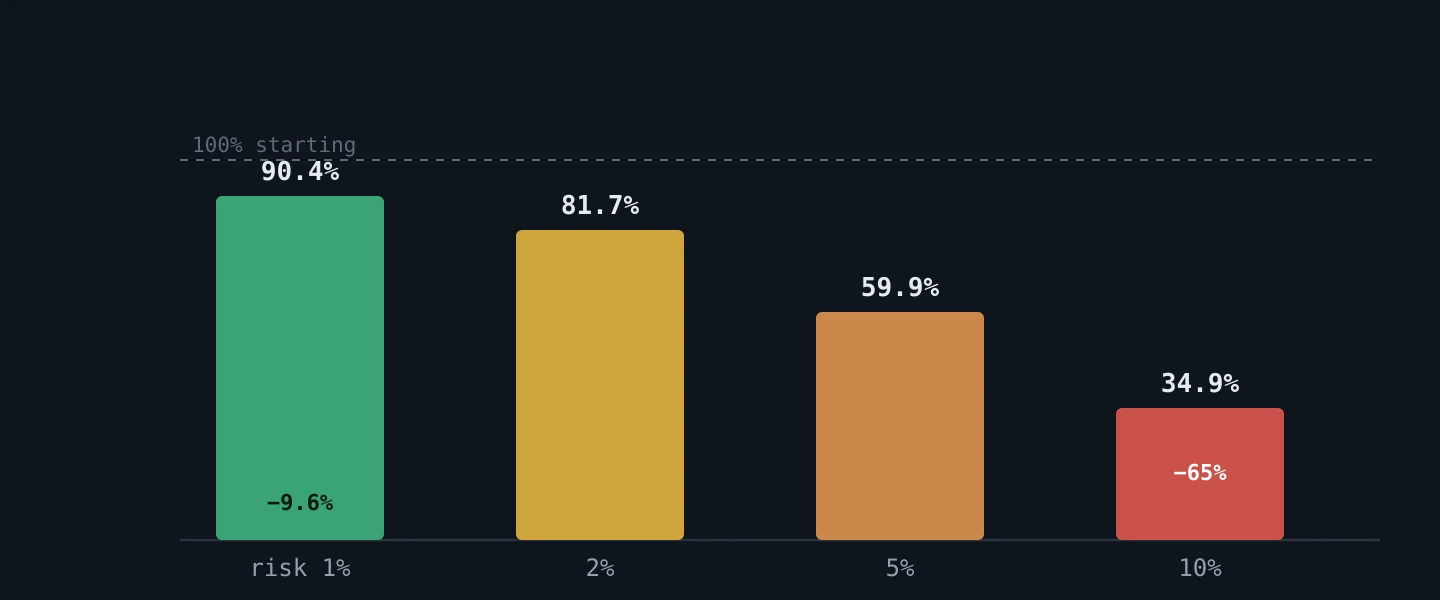
The biggest mistake beginners make is over-leveraging and risking too much per trade, often driven by the desire for quick, large profits. They might risk 5%, 10%, or even more of their account on a single position. This approach is incredibly dangerous. A string of just a few losing trades can quickly decimate a significant portion of their capital, making recovery extremely difficult. For example, losing 10 trades in a row at a 1% risk means your account is down 10%; at a 10% risk, it's down over 65%.