
What is a pip and how do you calculate pip value?
A pip (percentage in point) is the smallest standardized unit of price movement in a currency pair, typically the fourth decimal place (or second for JPY pairs). Calculating pip…

A pip is the smallest standard price move in a currency pair — the 4th decimal for most pairs, the 2nd for JPY pairs. Pip value is what one pip is worth in money for your trade size, so you can size risk and read profit in your account currency.
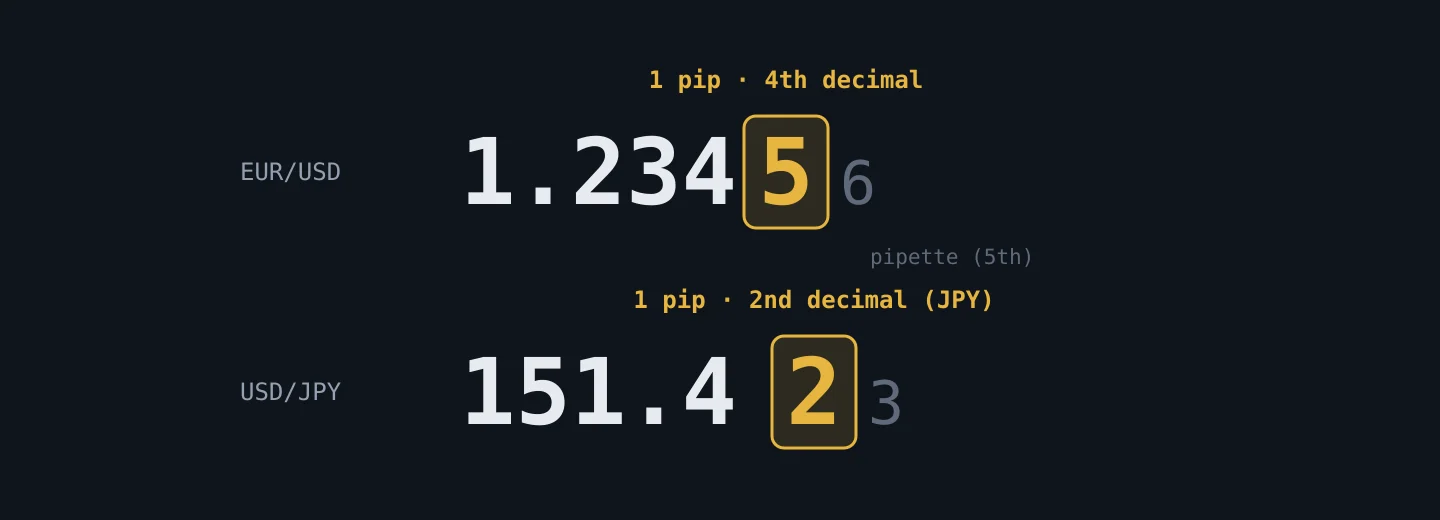
What exactly is a pip?
A pip is a one-digit move in the 4th decimal for most pairs: EUR/USD from 1.1200 to 1.1201 is one pip. JPY pairs are the exception — there a pip is the 2nd decimal (USD/JPY 109.50 → 109.51). Some brokers also quote a finer "pipette", but the pip is the standard unit.
How do you calculate the base pip value?
The base pip value is what one pip is worth in the quote currency (the second currency), and it scales with lot size:
- Standard lot (100,000 units): 10 quote units — e.g. EUR/USD = $10/pip
- Mini lot (10,000): 1 unit · Micro lot (1,000): 0.1 unit
For JPY pairs the quote is yen, so a standard lot is ¥1,000/pip.
How do you convert it to your account currency?
Convert the base value into your account currency:
Pip Value (account) = Base Pip Value (quote) ÷ (Quote→Account rate)
Worked example (illustrative): EUR/GBP, 1 standard lot, USD account.
- Base pip value = £10 (GBP is the quote currency)
- GBP/USD = 1.2500
- Pip Value = £10 ÷ 1.2500 = $8.00 per pip
If your account currency already IS the quote currency (e.g. USD/CAD with a CAD account), no conversion is needed.
What's the biggest beginner mistake?
Assuming a pip is always $10 per standard lot. That only holds when USD is the quote currency AND your account is in USD. For JPY pairs, or when the quote differs from your account currency, you must convert — otherwise your risk and position sizing are wrong. The same exposure math also informs carry-trade decisions, where ForexCommand's CTS (Carry Trade Score) helps.