What is drawdown in trading?
Drawdown represents the peak-to-trough decline in a trading account over a specific period, measuring the percentage loss from its highest equity point to its lowest before a new…

Drawdown represents the peak-to-trough decline in a trading account over a specific period, measuring the percentage loss from its highest equity point to its lowest before a new peak is achieved. It quantifies the temporary unrealized or realized loss experienced by a portfolio, highlighting periods of negative performance and the capital at risk.
What exactly is drawdown and how is it calculated?
Drawdown is a crucial measure of risk and volatility in your trading account. It tells you how much your account's equity has fallen from its highest point before it reached a new high. It's often expressed as a percentage, indicating the maximum percentage loss your account experienced.
To calculate it, you simply take your account's peak equity and subtract the subsequent lowest equity (the trough). Equity, not balance: the two are the same only when you have nothing open. Divide this difference by the peak equity, then multiply by 100 to get a percentage. For instance, if your account hit $10,000, then fell to $8,000 before recovering, your drawdown was 20%.
Why does recovering from a large loss require an even bigger gain?
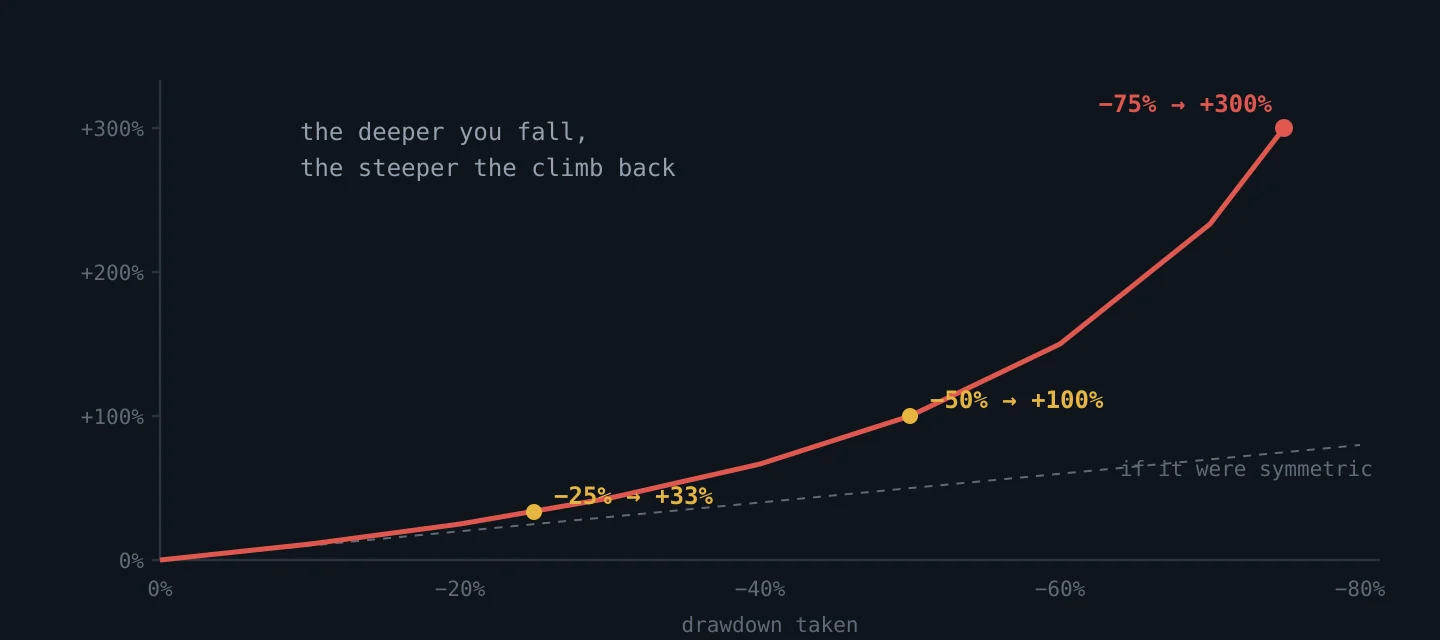
This is a critical concept for every beginner trader. When your account experiences a loss, subsequent gains are calculated on a smaller capital base. This means that to recover the same dollar amount lost, you need to achieve a higher percentage gain.
Let's illustrate with an example using illustrative numbers:
- Imagine your account balance is $10,000.
- If you incur a 20% loss, your account drops by $2,000, leaving you with $8,000.
- To recover that $2,000 loss from your new balance of $8,000, you now need a gain of $2,000 / $8,000 = 25%.
- The situation worsens significantly with larger losses. A 50% loss on $10,000 means a $5,000 drop, leaving you with $5,000. To recover that $5,000 from your remaining $5,000, you need a staggering 100% gain!
As you can see, the percentage gain required to break even becomes disproportionately larger as your initial loss increases.
| Loss | Gain needed to break even |
|---|---|
| 10% | 11.1% |
| 20% | 25% |
| 30% | 42.9% |
| 40% | 66.7% |
| 50% | 100% |
| 60% | 150% |
| 70% | 233.3% |
What's the most common beginner mistake regarding drawdown?
The biggest mistake beginners make is risking too much capital per trade, often driven by the desire for quick profits or an attempt to quickly recover previous losses. After experiencing a drawdown, new traders might be tempted to increase their position sizes or take on higher-risk trades to "get back to even" faster.
This aggressive approach usually backfires. By risking more, they expose themselves to even larger potential drawdowns, creating a vicious cycle that can quickly deplete their entire account. It's a psychological trap that prioritizes ego over sound risk management.
How can you keep drawdown under control?
The best defence is a hard stop-loss on every trade and refusing to over-leverage, so no single loss — or losing streak — can carve deep into your capital. Reading broader market conditions with a tool like the Market Readiness Score (MRS) can also temper your appetite for risk before you size up.