
Where should you place your stop-loss?
Your stop-loss should be strategically placed at a logical price point where your initial trading premise is invalidated, typically just beyond a key technical support or…

Your stop-loss should be strategically placed at a logical price point where your initial trading premise is invalidated, typically just beyond a key technical support or resistance level, while always considering your predetermined risk percentage per trade and allowing for market volatility.
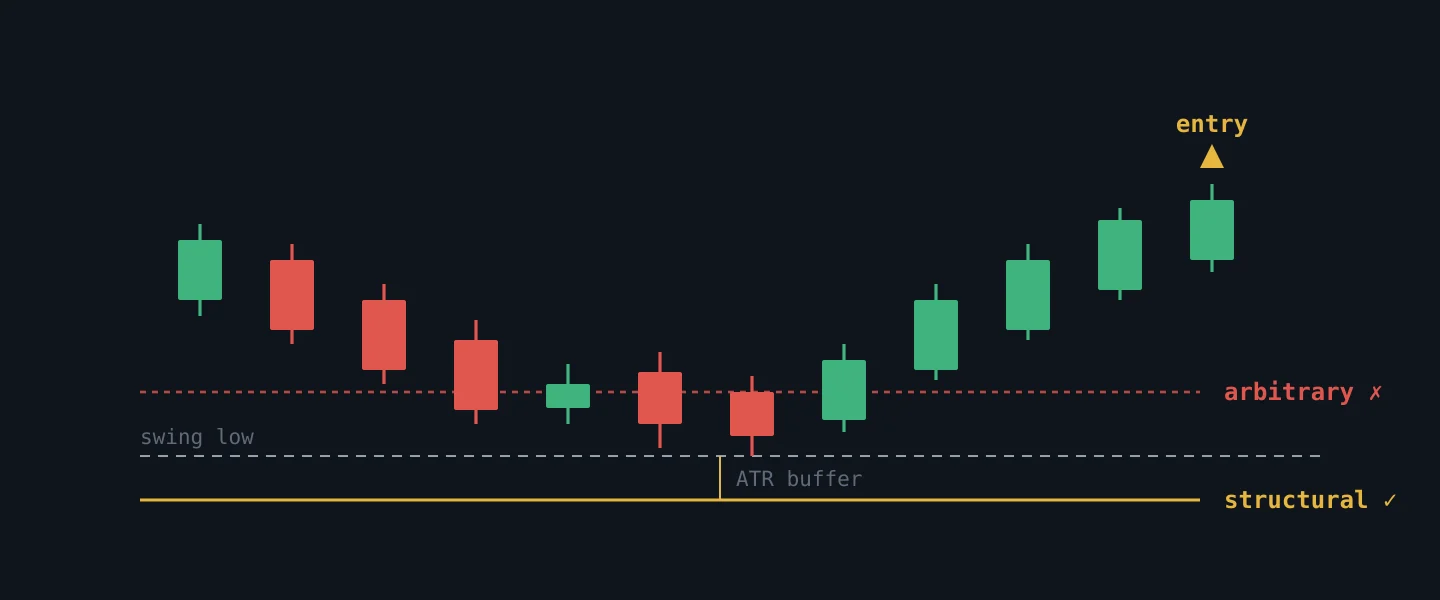
How do you find a logical stop-loss level?
The most effective stop-loss placement is not arbitrary; it's based on market structure and where your trade idea objectively becomes incorrect. Once the trade is running, moving that stop systematically and only in your favour is a different tool with its own rules: a trailing stop. For a long trade, this usually means placing your stop just below a significant swing low, support level, or below a key trendline break. Conversely, for a short trade, it would be just above a swing high, resistance level, or above a broken trendline.
This approach ensures you exit the trade only when the market definitively moves against your initial analysis, rather than being "stopped out" by normal market noise. Always factor in a small buffer beyond these levels to account for market volatility and potential false breakouts. A high ForexCommand MRS (Market Readiness Score) might indicate clearer technical levels, making stop placement more precise, while a lower MRS could suggest higher volatility, requiring a slightly wider buffer.
How do you calculate your exact stop-loss distance?
Once you've identified a logical price point, you need to calculate the precise distance in pips and, crucially, size your position accordingly based on your risk tolerance. Your capital protection depends on risking only a small, fixed percentage of your account per trade, typically 1-2%.
Illustrative Example:
Suppose you have a $10,000 trading account and decide to risk 1% per trade. This means you are willing to lose $100 per trade ($10,000 * 0.01). If your technical analysis dictates a stop-loss level that is 25 pips away from your entry price:
1. Determine pip value: For a EUR/USD trade, a micro lot (1,000 units) is generally $0.10 per pip. A mini lot (10,000 units) is $1 per pip.
2. Calculate allowable total pip risk: Your maximum risk is $100.
3. Position size calculation: Divide your maximum risk by your stop-loss in pips and the pip value per micro lot to find the micro lots: ($100 Risk) / (25 pips * $0.10/pip/micro lot) = $100 / $2.50 = 40 micro lots.
* This means you would trade 4 mini lots or 40 micro lots. This precise sizing ensures that if your stop is hit, you lose exactly $100. Remember, these numbers are illustrative and do not constitute a trading recommendation.
What are the most common stop-loss mistakes to avoid?
Beginner traders often fall into several common traps when placing stop-loss orders. The most prevalent mistake is setting stops too tightly, perhaps just "on" a support or resistance level without any buffer. This makes you highly susceptible to being stopped out by minor market fluctuations or spread widening, even if the overall market direction eventually favors your trade.
Another common pitfall is moving your stop-loss, either widening it when price approaches (known as "begging the market") or moving it to break-even too soon. Widening a stop-loss increases your potential loss beyond your initial risk tolerance, which is poor risk management. Moving to break-even prematurely can also lead to missed opportunities if the market retraces slightly before continuing in your favor. Always allow your trade to breathe, and only adjust stops when there's a clear, logical reason based on new market information, not emotion.