
How do you calculate your position size?
To calculate your position size, first determine your maximum acceptable monetary risk per trade (e.g., 1-2% of your account). Then, divide this…

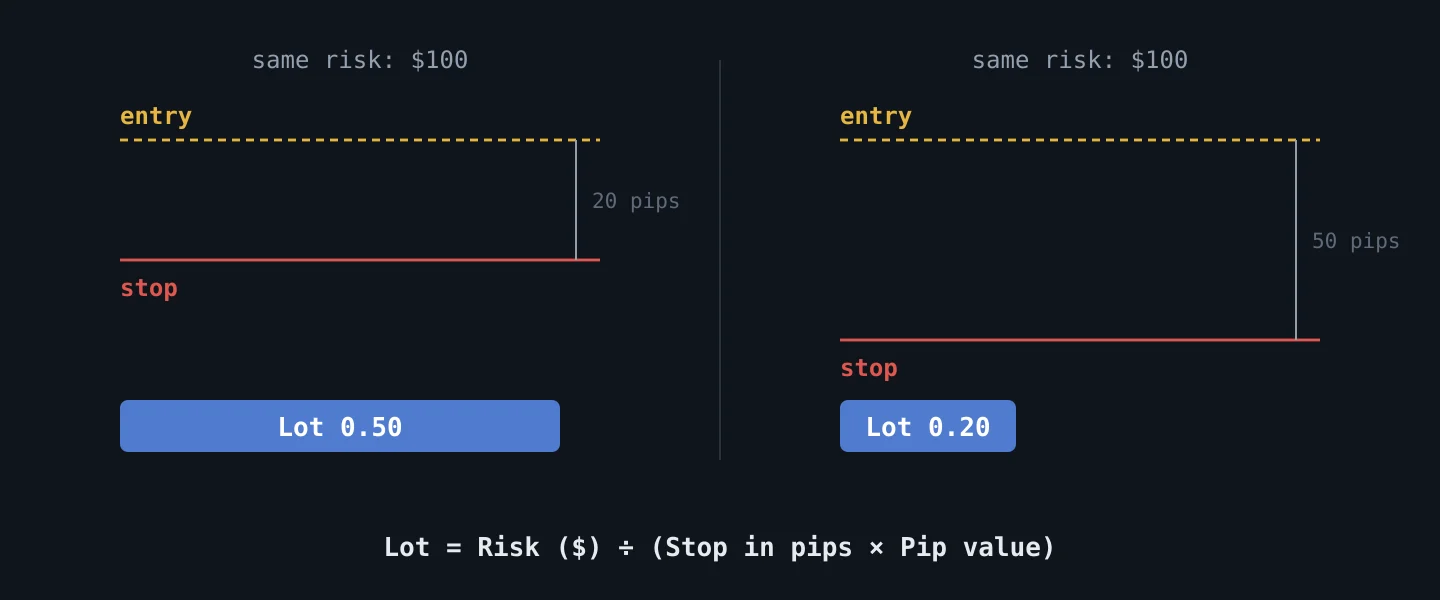
To size a position, divide the money you're willing to risk on the trade (say 1% of your account) by your stop-loss distance in pips times the pip value per lot. The result is the number of lots that caps your loss at your risk limit — no matter where your stop sits.
What is position sizing, and why does it matter?
Position sizing is deciding how many lots to trade so a losing trade costs a fixed, pre-planned amount. It's the core of risk management: size it right and no single loss can seriously dent your account, even when the trade goes fully against you. Trade the same lot every time and your real risk swings wildly with each stop distance.
How do you set your risk per trade?
Your risk per trade is a small, fixed slice of your balance — commonly 1–2%. On a $10,000 account, risking 1% caps your loss at $100 for that trade. Keep it consistent: a high ForexCommand MRS (Market Readiness Score) may flag a stronger setup, but your base risk percentage shouldn't drift.
How do you calculate the actual position size?
With your risk in money and your stop distance known, apply:
Position Size (lots) = Account Risk / (Stop-Loss in Pips × Pip Value per Lot)
Worked example (illustrative, not a prediction):
- Account $10,000 · Risk 1% = $100 · Stop-loss 25 pips
- EUR/USD: 1 standard lot = 100,000 units, 1 pip ≈ $10 per lot
- Position Size = $100 / (25 × $10) = $100 / $250 = 0.4 lots
So you'd trade 0.4 lots (4 mini lots) to risk exactly $100.
What's the most common beginner mistake?
Trading a fixed lot size — say always 0.1 lots — regardless of the stop. That breaks the link between stop and risk: a wider stop risks far more than intended, a tighter one far less. Fix the risk amount instead, and let the lot size flex with each trade's stop distance.