
What is the risk-reward ratio?
The risk-reward (R:R) ratio is a crucial metric comparing your potential profit to your potential loss on any given trade. Expressed as X:1, where '1' represents your defined risk…

The risk-reward (R:R) ratio is a crucial metric comparing your potential profit to your potential loss on any given trade. Expressed as X:1, where '1' represents your defined risk (1R), it helps you assess a trade's viability and manage risk effectively, aiming for trades where potential gains significantly outweigh potential losses.
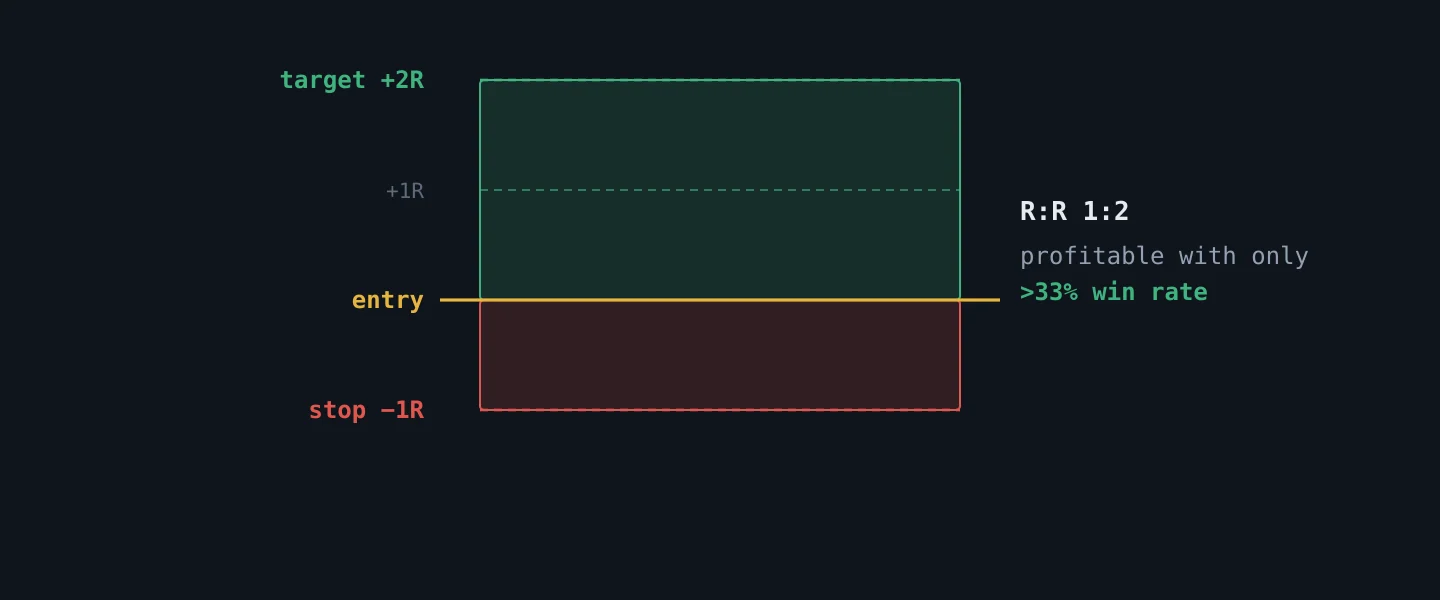
How do you calculate your risk-reward ratio and R-multiple?
The risk-reward ratio is a simple comparison: (Potential Profit) / (Potential Loss). Before entering a trade, you determine where your stop-loss (maximum acceptable loss) and take-profit (target gain) levels will be.
Your potential loss is the distance from your entry to your stop-loss. This defined loss is known as "1R" (one unit of risk). Your potential profit is the distance from your entry to your take-profit. If your potential profit is, say, three times your potential loss, you have a 3:1 risk-reward ratio, or simply "3R."
Why is understanding R:R vital for beginner traders?
Mastering R:R allows you to stay profitable even without winning every trade. For instance, with a consistent 2:1 R:R, you only need to win about 35% of your trades to break even (1 win (2R) + 2 losses (-2R) = 0). This principle forms the bedrock of robust risk management.
It promotes disciplined trading by forcing you to define your exit points before entering. It also ensures proper position sizing, as your position size is calculated based on your 1R value and your stop-loss distance, not just arbitrary amounts. Evaluating a trade's R:R, perhaps alongside insights from a strong CTS indicating a stable trend, helps validate its potential.
Can you show a practical example of using the risk-reward ratio?
(These numbers are illustrative.) Let's say you have a $10,000 trading account and decide to risk 1% per trade. Your maximum risk (1R) is $100. You spot a buy opportunity on GBP/USD.
- Entry Price: 1.2500
- Stop-Loss: 1.2480 (20 pips below entry)
- Take-Profit: 1.2560 (60 pips above entry)
Your potential loss is 20 pips. Since 1R is $100, each pip for your position is worth $5 ($100 / 20 pips). For GBP/USD, a standard lot typically has a pip value of $10. So, to have a pip value of $5, you would trade 0.5 standard lots. Your potential profit is 60 pips, which is 3 times your 20-pip risk. Therefore, this trade has a 3:1 R:R ratio, or a 3R potential gain ($300).
What is a common risk-reward mistake beginners make?
The most frequent mistake is entering trades without first clearly defining both their stop-loss and take-profit, or failing to adhere to them. This often leads to taking trades with poor R:R (e.g., 0.5:1) where potential losses are greater than potential gains, making long-term profitability extremely difficult.
Another error is moving stop-losses further away during a trade, effectively increasing your 1R risk without adjusting position size or profit target. Always pre-define your risk (1R) and reward, then stick to it. Your MRS might suggest market conditions unsuitable for very tight stops, prompting a re-evaluation of your R:R before commitment.