
What is leverage in forex?
Leverage in forex allows traders to control a much larger position in the market with a relatively small amount of their own capital, essentially borrowing funds from their…

Leverage in forex allows traders to control a much larger position in the market with a relatively small amount of their own capital, essentially borrowing funds from their broker. It amplifies both potential profits and losses, making careful risk management absolutely critical for beginners to avoid significant account depletion.
How does leverage work in forex trading?
Forex brokers offer leverage to enable traders to participate in the market with less capital upfront. It works by multiplying your trading power: for every dollar you invest, the broker essentially "loans" you additional capital to increase your trade size. This means you can open positions worth far more than your account balance.
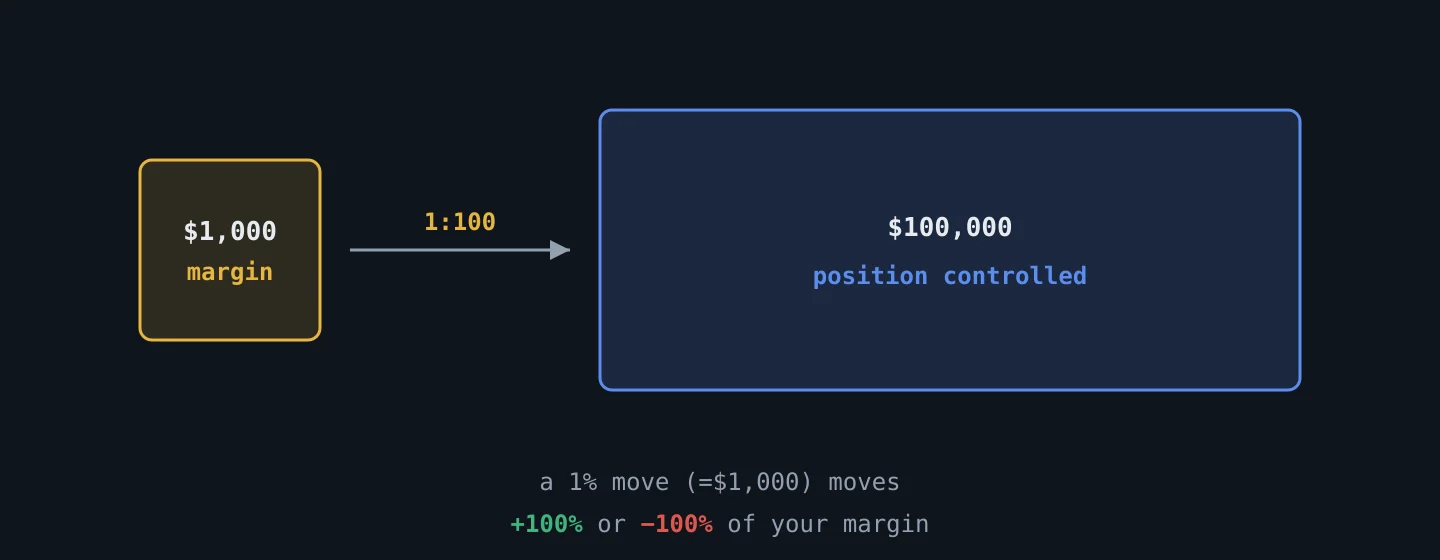
For example, with 1:100 leverage, a $1,000 account could control a position worth $100,000. While this can dramatically increase potential profits from small market movements, it also equally magnifies potential losses.
What is the difference between leverage and margin?
Leverage and margin are closely related but distinct concepts. Leverage is the ratio that determines how much trading power you get for your capital (e.g., 1:50, 1:200). It's the multiplier.
Margin, on the other hand, is the actual amount of your own capital required by the broker to open and maintain a leveraged position. It acts as a good faith deposit, ensuring you can cover potential losses. If you use 1:100 leverage, your margin requirement is 1% of the total trade value. Your available capital not used as margin is called "free margin," which can be used for new trades or to absorb existing trade losses.
What is a practical example of leverage in action?
Let's illustrate with an example: Suppose you have a trading account with $1,000 and your broker offers 1:100 leverage. If you decide to trade one mini lot of EUR/USD (10,000 units), the nominal value of this position is $10,000 (assuming the EUR/USD exchange rate is near 1.00).
To open this $10,000 position with 1:100 leverage, your margin requirement would be $10,000 / 100 = $100. This $100 is temporarily held by your broker as margin. You still have $900 of "free margin" in your account. A gain or loss of 10 pips on this mini lot would equate to approximately $10, showing how small capital can manage significant market exposure. Remember, these numbers are illustrative and not a guarantee of future performance.
How much leverage can you actually get?
This is the part most explanations leave out: in almost every regulated market, the 1:100 and 1:200 ratios used as examples above are not available to a retail trader. Regulators capped them precisely because leverage is what turns a normal losing streak into a wiped-out account.
| Jurisdiction | Cap on majors | Detail |
|---|---|---|
| European Union (ESMA) | 30:1 | 20:1 on non-majors and gold. |
| United Kingdom (FCA) | 30:1 | In force since August 2019. |
| Australia (ASIC) | 30:1 | Since March 2021. |
| United States (CFTC/NFA) | 50:1 | 20:1 on the rest — expressed in the rules as a security deposit of 2% and 5% of notional. |
So if a broker offers you 1:500, that offer is almost certainly coming from an entity registered outside those jurisdictions. That is not automatically fraud, but it does mean the investor protections behind those caps — including negative balance protection in the EU and UK — may not apply to your account. Check where the entity you are signing with is registered, not just the brand name on the website.
And there is a more useful way to read all of this. The cap is a ceiling, not a target: the leverage your broker allows has almost nothing to do with the leverage you should use. With a 1% risk rule and a sensible stop, most traders never come close to even a 30:1 ceiling. Leverage only becomes the binding constraint when position sizing has already gone wrong.
What common mistake do beginners make with leverage?
The most common mistake beginners make is overleveraging their accounts. Enticed by the ability to control large positions, many new traders use maximum available leverage without understanding the magnified risk. This leads to oversized positions relative to their account equity, making them highly vulnerable to small market fluctuations.
Even a minor adverse market move can result in significant losses, quickly depleting their account or leading to a margin call where the broker requests more funds or automatically closes positions. Prudent traders understand that leverage requires strict risk management, including proper position sizing and stop-loss orders. Evaluating market conditions and potential volatility, perhaps informed by a ForexCommand MRS (Market Readiness Score), can guide a more conservative approach to leverage and position sizing.