What is forex and how does it work?
It isn’t a market the way a stock exchange is: no building, no central order book, and your counterparty is usually your own broker. Nearly every odd thing you meet early on follows from that.
Forex is the market where one currency is exchanged for another. What nobody tells you on day one is the second part: it isn't a market in the sense a stock exchange is. There's no building, no central order book, and when you trade, your counterparty is usually your own broker. Almost every odd thing you'll run into follows from that.
What exactly is being bought and sold?
Never one currency on its own: always two at once, in what's called a pair.
When you see `EUR/USD 1.0850`, the first currency is the base and the second the quote — our guide to currency pairs explains it. Buying EUR/USD means buying euros and paying in dollars; selling it means the reverse.
That has a consequence which takes a while to sink in: there's no such thing as simply "buying" in forex. Every trade is a relative opinion — you aren't betting the euro rises, you're betting it rises against the dollar. The euro can strengthen and your trade can still lose if the dollar strengthens more. It's why comparing the strength of each currency is a different exercise from staring at a single chart.
Where does it happen, if there's no exchange?
Nowhere in particular, and that isn't a figure of speech.
Shares have an address. Buy one on the New York Stock Exchange and your order joins a single queue that everybody else is also standing in, and the trade is recorded where anyone can see it. Forex has no such venue. What exists is a network of banks, brokers and platforms quoting prices to each other, each with its own flow. That's what over the counter means: bilateral dealing, outside an organised exchange.
One of the biggest practical differences with equities comes straight from that: there is no order book you can look at. It isn't being hidden from you — there simply isn't a single one holding every order. There are partial books: the interbank platforms, each broker's own, and currency futures, which do trade on an exchange and do have a real book.
Who is on the other side of your trade?
Almost always your broker, not another retail trader.
On an exchange your order is matched with someone who wanted the opposite. In retail forex there's no common book where that happens: your broker takes the other side and then nets it against its other clients and its own inventory. There is no "other side" in the singular.
And a second detail worth knowing early: most retail traders don't buy currency, they buy a derivative on it. A CFD (contract for difference) tracks the pair's movement without you ever owning anything. That's why going short is as easy as going long, and why what you hold with your broker is a contract, not a pile of euros sitting somewhere.
Why is it open 24 hours?
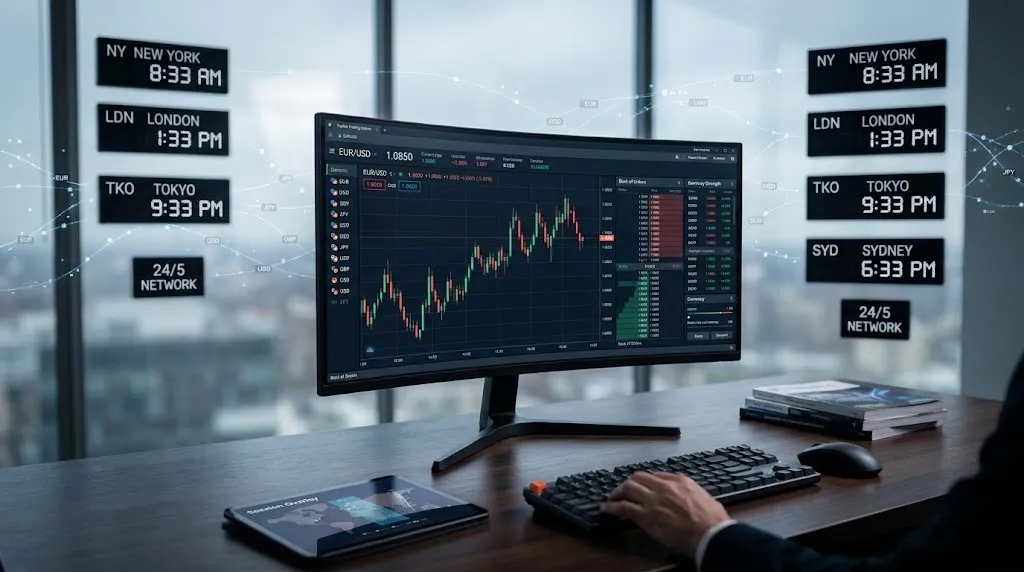
Because it's a network of financial centres, not a building with opening times. When Tokyo closes, London is already trading; when London winds down, New York has been going for hours. The market doesn't sleep on weekdays because some desk is always awake.
That doesn't make every hour equal. Liquidity concentrates into specific windows, and the sessions mark when the market is alive and when it barely moves. It does close at the weekend, and that close carries its own risk.
How do you make or lose money?
Three pieces, all of them calculable:
- The pip is a pair's standard minimum move. What each pip is worth depends on your size: a micro lot of EUR/USD moves $0.10 per pip; a standard lot, $10.
- The spread is the gap between the price you can buy at and the price you can sell at. It's what entry costs you, and since your broker is the counterparty it's usually how they charge, instead of a separate commission.
- Leverage lets you control a position larger than your balance. It multiplies the result in both directions, which is exactly why regulated markets cap it.
Put the three together and you have your result: pips won or lost, times pip value at your size, minus what entry cost.
What follows from all this?
Nearly every strange question of the first few weeks has the same answer:
| What do you notice? | Why does it happen? |
|---|---|
| Every broker shows a slightly different price | There's no single price: each builds its own from its liquidity providers |
| You pay a spread instead of a commission | Your broker is the counterparty, not a neutral middleman |
| You can't see the market's real volume | No central book exists to record it |
| It runs Sunday to Friday without stopping | It's a network of centres, not a building |
| Your broker sometimes gains when you lose | Which is precisely why regulation matters |
That last row is the uncomfortable one, so it's worth saying early. Your broker being the counterparty doesn't make it an enemy — it nets positions and generally prefers steady spreads to betting against you — but it does mean a regulator's supervision is the first filter, not the last: it's what forces your money to be kept apart from theirs, and what gives you somewhere to complain.
The essentials in four lines
- You trade pairs, always relative: one currency against another.
- There's no exchange: it's a network of bilateral deals, which is why there's no central book or volume.
- Your counterparty is your broker, usually through a derivative.
- You win or lose on pips × size, minus the spread — and leverage amplifies both.
If you want the same thing in order, with exercises behind it, this is where the Academy starts: 60 modules, at your own pace and no account.