
Gold collapses 2.3% as US-Iran strikes send oil vertical and yields to 4.79%
A second wave of US strikes on Iran took WTI crude above $88.50 and the US 10-year to 4.79%, its highest since January 2025 — and gold fell 2.3% to a two-week low near $4,330 instead of catching a safe-haven bid.
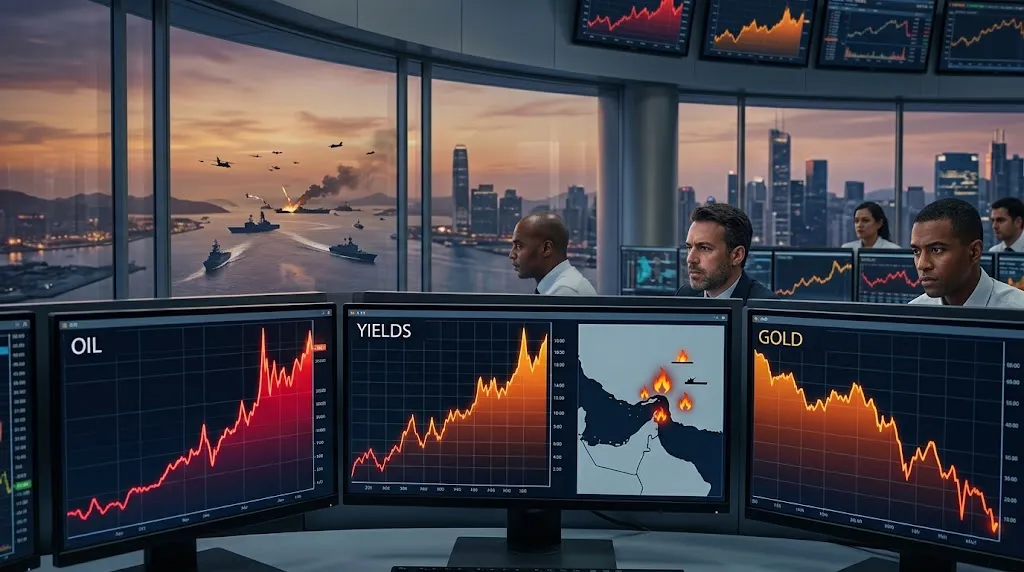
A second wave of US strikes on Iran took WTI crude above $88.50 and the US 10-year Treasury yield to 4.79%, its highest since January 2025 — and gold fell 2.3% to a two-week low near $4,330 rather than catching the bid a war at an oil chokepoint would normally give it.
Geopolitics & commodities
- The escalation arrived in stages, and the order matters. Reports of explosions at Chabahar and Bandar Abbas reached the wires in the New York afternoon; US Central Command then confirmed that American forces had begun striking Islamic Revolutionary Guard Corps targets inside Iran, and President Trump posted half an hour after that the US was striking Iranian targets near the Strait of Hormuz, in retaliation for what he called Iran's "failed attempt" to lay sea mines there. CENTCOM said the wave was complete late in the session. The Dow Jones Industrial Average fell to session lows on the confirmation, down around 450 points and 0.85%, and on a call with Fox News Trump described the day's hit as very big and said Iran would be "totally wiped out as a country" if it retaliated.
- Crude oil went vertical on those first reports. West Texas Intermediate had already extended its rebound for a second consecutive day, up 1.76% to around $86.95 by mid-morning, and sat near $87.50 through the afternoon; it then added more than a dollar in a handful of minutes to print a session high just above $88.50. Treasury Secretary Scott Bessent, who said on Monday that oil prices would come down, spent Tuesday at the G20 backing Japan's policy steps while crude ran.
- Gold collapsed more than 2.30% on Tuesday, breaking $4,400 in the first half of the European session and reaching a two-week low of $4,375 by midday; in early Asian hours on Wednesday it was below $4,350 and changing hands near $4,330, close to 8% under last week's peak near $4,700 — the ceiling our weekly wrap flagged as tested and unbeaten, and now far out of reach. Yesterday the story was that the metal did not rally on an exchange of strikes; today it fell hard on a bigger one, through the same channel that makes a hawkish Fed a problem for gold: oil feeds the inflation case, the inflation case feeds hike bets, and an asset that pays no interest loses on both.
- Treasury desks read the strikes as inflationary rather than as a reason to buy safety. The US 10-year yield traded near 4.79%, about four basis points higher and its highest since January 2025 in a fifth consecutive session of selling, and reached 4.80% later on. Nasdaq indices closed sharply lower.
Major currencies
- The dollar took the safe-haven side of the trade, the dollar index reversing all of Monday's losses and holding near a two-week high as hawkish Federal Reserve expectations and rising yields provided the tailwind. Every US release missed and none of it mattered: the Institute for Supply Management (ISM) manufacturing PMI fell to 54.6 in August from 55.6, under the 55.2 our calendar carried, with the employment index at 51.2 and new orders down to 53.7 from 56.7; job openings in the JOLTS survey came in at 7.27 million against the 7.33 million our calendar carried; and July construction spending fell 0.5% against a flat forecast.
- Euro-area flash inflation landed exactly where our calendar said it would: the harmonised index of consumer prices (CPI) rose 3.3% year-on-year in August from 2.9%, in line with forecast, with the monthly rate accelerating to 0.4% from 0.2%. The core rate went the other way, easing to 2.4% against the 2.5% we published. Commerzbank puts the headline jump down mainly to energy prices linked to the Middle East conflict, and both it and Nordea read the print as supporting another European Central Bank hike on 10 September. The euro still lost ground: EUR/USD fell 0.25% to 1.1590, capped by its 200-day simple moving average at 1.1633, and it extended losses against sterling as well.
- Japan's 10-year government bond yield hit 3% for the first time since 1996 and the yen weakened anyway, USD/JPY trading around 160.05 and up 0.19%, back above the 160.00 level desks flag as intervention risk. BoJ Governor Kazuo Ueda met Bessent on the G20 sidelines without giving details and declined to comment on daily moves, while markets price a 92% chance of a September hike. Bessent urged the BoJ to keep policy sound and avoid yen volatility.
- Sterling, the weakest major on our gauge yesterday, kept sliding: GBP/USD traded at 1.3540 on Tuesday and then extended its losses for a second successive session to around 1.3510 in Asian hours, with the safe-haven dollar bid doing the work.
- The New Zealand dollar, our strongest major yesterday, slipped 0.24% to around 0.5900 as hawkish Fed bets firmed. The RBNZ decides at 02:00 UTC and is expected to follow through with another 25 basis points, taking the official cash rate to 2.75%.
- The Canadian dollar retreated as the firmer dollar and diverging Fed and Bank of Canada expectations weighed on it, with TD Securities flagging asymmetric upside risk in USD/CAD as trade tensions escalate. Prime Minister Mark Carney said Canada never believed it had a deal during the talks, and that discussions can resume when US officials "stop doing memes". The BoC decides at 13:45 UTC and is expected to hold at 2.25%; Section 338 duties and Ottawa's retaliation take effect on 8 September, six days away.
- The Australian dollar fell as the conflict lifted the dollar, ahead of second-quarter national accounts at 01:30 UTC where GDP is forecast at 0.3% on the quarter and the 0.3 percentage point inventories drag we have now flagged three times gets its answer. The Mexican peso erased earlier gains to hold near 17.00, USD/MXN virtually unchanged at 16.99, as the strikes soured risk appetite.
Key events today
- AUD · GDP q/q: SCHEDULED — forecast 0.3% vs previous 0.3%
- NZD · Official Cash Rate: SCHEDULED — forecast 2.75% vs previous 2.50%
- USD · ADP Non-Farm Employment Change: SCHEDULED — forecast 47K vs previous 44K
- CAD · Overnight Rate: SCHEDULED — forecast 2.25% vs previous 2.25%
- USD · Beige Book: SCHEDULED
Market metrics
Our MRS dropped 16 points to 41 after four sessions pinned between 57 and 59, matching its 26 August reading — and none of the fall is volatility. The ATR, session, macro and positioning components are all unchanged; the entire move is the news component going from 18 to 2 out of 20. The sub-score keeps the lowest reading among imminent events, so a number falling means event risk rising — and when the reading was taken, Australia's second-quarter national accounts were thirty minutes away. It is computed on the Asian session's pairs, which is why the RBNZ and the Bank of Canada, both deciding later today, do not move it at all. The FSI eased to 68 (Greed) from 71 and the CTS holds at 79. Underneath them the euro is our strongest major and the dollar our weakest on an intraday basis — a basket reading against all the majors rather than a call on any single pair, and one that sits squarely against Tuesday's headline dollar rally. That weakest slot has now gone to six different currencies in six sessions.