How much does price move in one minute?
EUR/USD's median one-minute candle measures 1.30 pips, and 38.5% of minutes don't reach one. Measured across five pairs and 225,000 candles per pair: how much material does the market leave a scalper?
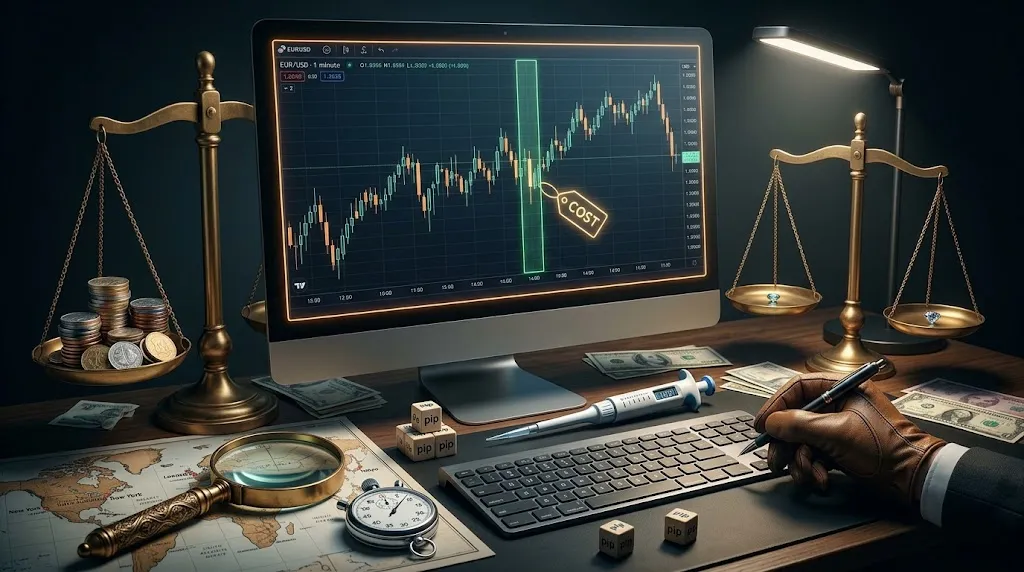
EUR/USD's median one-minute candle measures 1.30 pips, and 38.5% of minutes don't even reach one. Scalping doesn't fail for lack of technique: it fails because the slice of market it chases is the same size as the cost of getting in and out.
The question that decides whether scalping fits you
Almost everything written about scalping is about entry rules. The prior question is simpler, and nobody answers it with their own data: how big is the candle you intend to slice? If that candle measures barely more than your cost per trade, the style is decided before you open a chart.
We measured it with our own one-minute bars: January to September 2026, between 223,758 and 225,868 candles per pair, with Sundays excluded because in UTC they hold only the first two or three hours of the week.
What a minute is actually worth
The second column is the median range of a one-minute candle across the whole period. The third and fourth are the best and worst hour of the day. The fifth is the share of minutes that don't travel a full pip.
| Pair | Median candle | Best hour (14:00 UTC) | Worst hour (22:00 UTC) | Minutes of one pip or less |
|---|---|---|---|---|
| EUR/GBP | 0.60 pips | 1.0 pips | 0.3 pips | 80.5% |
| AUD/USD | 1.10 pips | 1.9 pips | 0.5 pips | 44.7% |
| EUR/USD | 1.30 pips | 2.1 pips | 0.5 pips | 38.5% |
| USD/JPY | 1.50 pips | 2.3 pips | 0.8 pips | 29.7% |
| GBP/USD | 1.60 pips | 2.7 pips | 0.7 pips | 26.3% |
Three readings.
First: the good hour is four times the bad one. On EUR/USD, 2.1 pips at 14:00 Coordinated Universal Time (UTC) against 0.5 at 22:00. Same chart, same technique, a quarter of the material to work with.
Second: EUR/GBP is the extreme case. Eight of every ten of its minutes don't move a pip. It is a quiet pair, and that quiet — a virtue in other styles — is here simply an absence of market.
Third, and this is the one that matters: assuming a one-pip round trip — an ordinary figure on a major during active hours — that cost eats more than half of EUR/USD's median candle.
So what does scalping demand?
Three things, and none of them is psychological. They are arithmetic.
Trading only in the good window. Not a preference: outside it, the median candle doesn't cover the cost. Our peak sits at 14:00 UTC, inside the London-New York overlap. If your question is about your calendar rather than your cost, the answer is in our guide to intraday trading hours.
Choosing the pair by range, not by familiarity. GBP/USD offers almost three times EUR/GBP's candle in the same hour.
A cost per trade you genuinely know. The spread is not a fixed number: it widens overnight, exactly when the candle was already smaller, so the margin narrows from both sides at once.
Who does it fit, and who does it not?
One warning worth keeping in view: between 67% and 97% of intraday traders lose money, and trading many times a day multiplies the share of the account that leaves as costs.
It fits someone who can sit down in a specific window with continuous attention, trades a high-range pair, and has a low, verified cost per trade. It fits badly anyone trading in scattered moments, anyone picking the pair out of habit, and above all anyone who doesn't know what each round trip costs them — because in this style the cost isn't an accounting detail, it's the opponent.
What this post doesn't give you
- We don't measure the spread. We store no bid and ask prices. The "one pip round trip" is an assumption you must replace with your broker's; at 1.5 pips the conclusions get worse, at 0.5 they improve.
- Eight months, not six years. Our one-minute bars start in January 2026. The rest of this series uses 5.7 years of hourly bars; here minute resolution is the point, and that is all we have of it.
- It's the candle, not the opportunity. A 1.30-pip median candle doesn't mean you can't capture 8 pips in a move; it means the ordinary minute doesn't offer them.
- It doesn't tell you which rule to use. Only how much material there is. If you want the rule, start with whether the perfect strategy exists at all.
Cost isn't a detail of scalping: it is the whole style
Every style pays the same cost per trade. What makes scalping different is that it pays it many times over a tiny move, so it is the only one where the cost can exceed the signal. Before asking whether your technique works, measure your candle and measure your cost. And if the cost eats the candle, this post hands you two levers, both measured, before you touch a single line of technique: the window — at 14:00 UTC the EUR/USD candle is worth four times what it is at 22:00 — and the pair — GBP/USD gives 1.60 pips where EUR/GBP gives 0.60. With those two chosen well, scalping stops being impossible and becomes merely hard, which is a very different place to stand.