What hours do you actually need to trade intraday?
Between midnight and eight in the morning New York time, the day has already travelled a median 61.7% of its range. Measured across ten pairs and 5.7 years: day trading does not ask you for hours, it asks for particular ones.
Between midnight and eight in the morning New York time, the day has already travelled a median 61.7% of its range. Day trading does not ask you for hours — it asks you for particular hours, and if you cannot be there for them, the style does not fit you no matter how much you like it.
The day does not spread its movement evenly
The question almost nobody asks before picking a style is not "how much can I make?" but "when do I have to be there?". In forex that answer is uncomfortably precise, because the market is open 24 hours and only really moves for a few of them.
We measured it with our own hourly candles: 5.7 years, from January 2021 to September 2026, ten pairs, and between 1,458 and 1,459 complete days per pair, with Sundays excluded because in UTC they hold only the first two or three hours of the week.
How much does a day move, and how much is left when you arrive?
The second column is the median range of the whole day. The third is the part of that range that had already printed between midnight and 08:00 New York time, the window that ends exactly when the session opens.
| Pair | Day's range | Already done between midnight and 08:00 (NY) |
|---|---|---|
| EUR/GBP | 38.5 pips | 69.2% |
| EUR/CHF | 44.4 pips | 65.5% |
| NZD/USD | 55.7 pips | 55.6% |
| USD/CHF | 58.3 pips | 61.8% |
| AUD/USD | 59.8 pips | 55.3% |
| EUR/USD | 67.3 pips | 61.7% |
| USD/CAD | 70.4 pips | 50.2% |
| GBP/USD | 86.3 pips | 63.6% |
| USD/JPY | 99.2 pips | 56.6% |
| EUR/JPY | 104.1 pips | 65.2% |
Two readings. The first: the median across pairs is 61.7%. If you sit down when New York opens, the day has already shown at least two thirds of what it is going to show.
The second is USD/CAD, the exception at 50.2% — half. It is the only pair whose two currencies share a time zone with New York, so its real day starts when yours does, if you live in the Americas.
So what schedule does it demand?
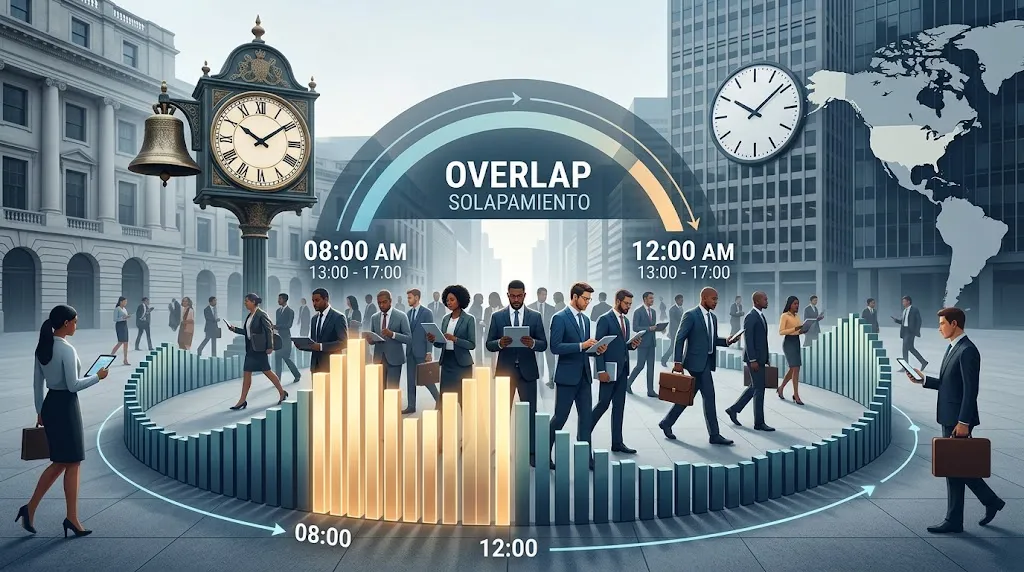
The 08:00 to 12:00 window in New York — the overlap with London — holds a median 58.4% of the day's range. That figure does not add to the previous one: they are two windows that overlap in price, not two slices of a pie. What they say together is that the day has a centre of gravity, and it sits in the New York morning, which is the European afternoon.
And there is a second question underneath this one: even if you can be there, does the candle you are chasing cover what it costs you to get in and out? We measured that at minute resolution in our study of the one-minute price range.
Translated into your calendar: day trading in forex is not "a few hours a day" of your choosing. It is these hours, and they are the same every day. If your working day does not include them, your options are to trade the pairs and the stretch you can reach — USD/JPY has a second peak at the Tokyo open, for instance — or to change style.
Who does it fit, and who does it not?
It is worth knowing what you are signing up for: between 67% and 97% of intraday traders lose money, and the cost of trading many times a day is a large part of that bill.
It fits someone who can reserve a fixed block in the right stretch, tolerates deciding fast, and closes the day flat. It fits badly anyone with only scattered moments: arriving at a day that has already covered two thirds of its range is not "showing up late to the party", it is trading a narrower range with the same spread and the same risk.
What this post does not give you
- It does not measure the real spread. We do not store bid and ask prices; the cost per trade is an assumption you have to supply from your own broker.
- The two percentages do not add up. The 61.7% and the 58.4% are the ranges of two windows compared against the range of the whole day, and those windows share price. Neither is "the slice of the pie" belonging to a given hour.
- The window excludes the Asian session. We measured from midnight to 08:00 New York time, so Tokyo's hours sit outside the 61.7%. The share of the day already travelled when New York opens is in fact larger; our number is the floor, not the ceiling.
- They are medians over 5.7 years, not a forecast. Any particular day can distribute itself completely differently.
- It does not say what to trade in those hours. It only says when the movement is. If you are after the rule that turns it into money, start with whether a perfect strategy exists at all.
The schedule is part of the strategy, not a detail
Choosing a style is mostly choosing when you will be available. Before asking whether day trading is profitable, check whether you can be at the screen in the stretch where the market does its work — because the London session and its overlap with New York will not move to suit your calendar. And if you cannot be there, the way out isn't to drop it: it's to move the style onto your hours. Start from the window you actually have, find the pair that moves in it — USD/JPY at the Tokyo open, USD/CAD through the American afternoon, the one pair whose day starts when yours does — and measure for a month whether that window leaves you enough material. That measurement is worth more than any strategy you could copy.