What are Treasury buybacks, and why did they sink the dollar?
The US Treasury bought back its own bonds, and the dollar fell to three-month lows without anyone touching the currency market. Here is the mechanism behind the Bessent put, and why it is not an intervention.
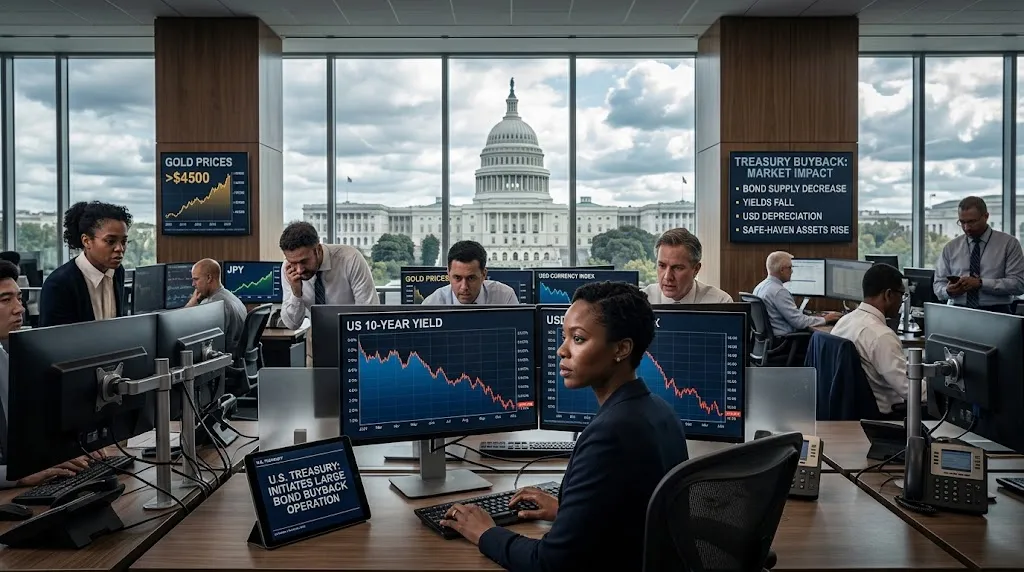
In August 2026 the US dollar fell to three-month lows, gold cleared a ceiling it had failed at for five straight sessions, and the Japanese yen caught a bid it had not earned. None of that came from the Federal Reserve, and none of it came from a currency intervention.
It came from the US Treasury buying back its own bonds.
Traders started calling it "Bessent's intervention", after Treasury Secretary Scott Bessent. The name is understandable and it is misleading — the Treasury never went near the currency market. Here is what a buyback actually is, why it repriced every dollar pair anyway, and how to tell it apart from the real thing.
What is a Treasury buyback?
A buyback is the government purchasing its own outstanding debt back from investors before it matures.
Ordinarily the Treasury is a seller. It issues bonds to fund spending, and the market absorbs them. A buyback runs that in reverse: the Treasury announces it will repurchase specific bonds, primary dealers offer the ones they hold, and the Treasury takes some portion of what is offered.
Mechanically it is routine — the US has run small buyback operations for liquidity management for years. What made August different was the size, the target, and the message.
- The size: the Treasury doubled its buyback cap.
- The target: long-dated bonds specifically, the part of the curve where yields had been rising hardest.
- The message: Bessent said the operation was partly signalling, and that "yields do not reflect underlying fundamentals".
That last line is the whole story. A liquidity operation does not need a justification about fair value. This one came with one.
Why does buying bonds move a currency?
The chain has four links, and each one is a market most traders already watch.
Buybacks change supply. Fewer long-dated bonds outstanding means less paper the market has to absorb. Bond prices rise.
Prices and yields move opposite. A bond that costs more pays out the same fixed coupon, so its yield falls. Long-term yields dropped on the announcement.
Currencies are priced against yields. Money parked in dollars earns the dollar's yield. When that yield falls, the dollar becomes less attractive to hold relative to everything else — the real-yield mechanism that sits underneath most currency moves.
Everything priced in dollars reprices too. Gold pays no interest, so its opportunity cost is whatever yield you gave up to hold it. Lower real yields make that cost smaller, which is exactly the reason a hawkish Fed crushes gold and the reason a dovish repricing does the opposite. Gold cleared $4,400, then $4,500, and kept going.
The yen is the clearest illustration of how indirect this is. Japan spent months worrying about a weak currency. Then Washington bought its own bonds and the yen strengthened — bought, as our roundup put it at the time, unwittingly by Washington. Nobody in Tokyo did anything.
This is not a currency intervention
Both moves push a currency around, so they get the same word. They are not the same operation, and the difference matters for how you trade them.
| Currency intervention | Treasury buyback | |
|---|---|---|
| Who acts? | Central bank or finance ministry | Treasury / debt management office |
| Market touched | Foreign exchange | Government bonds |
| What is bought? | The currency itself | The government's own debt |
| Stated goal | Move the exchange rate | Manage debt and yields |
| Effect on FX | Direct and immediate | Indirect, through yields |
| Typical duration | Minutes to hours | Days, and it can fade |
We had a textbook example of the real thing on 30 July 2026, when Japanese authorities were suspected of intervening. USD/JPY plunged below 160.00 and EUR/JPY fell 400 pips in minutes, down 2.54% on the day. That is what a direct FX intervention looks like: violent, targeted, over quickly.
The August buyback did not look like that at all. There was no sudden candle. The dollar drifted to three-month lows across sessions as the yield story sank in. If you want the mechanics of the direct version, we cover it in our explainer on currency intervention, and the case study of one that failed in USD/JPY near 162.
The "Bessent put"
Within days the market had a name for the implied promise: the Bessent put.
The reference is to a put option, which pays off when a market falls — so a "put" from an official is the belief that if things get bad enough, that official will step in. The phrase has a long history in markets, usually attached to a Fed Chair. Attaching it to a Treasury Secretary is new.
The belief was reasonable. Bessent said the buyback could exceed $4 billion and suggested more action if needed. Markets read that as a floor under bond prices and a ceiling on yields.
But the belief was tested almost immediately, and this is the part that keeps the story honest.
What it did not do
By the end of the same week, long-term yields had climbed back. The 10-year returned to around 4.704% and the 30-year to about 5.251%, erasing much of the drop the announcement had caused. The dollar recovered with them.
A buyback of a few billion dollars is small against a market of that size. It can change the mood for a few sessions. It cannot, on its own, hold a yield level that fundamentals are pushing the other way.
Analysts flagged the other risk too: an operation framed as a signal invites the question of what happens when the signal stops working. A Treasury that says yields are wrong has taken a position, and positions can be tested.
How do you read it as a trader?
Watch the bond market, not the currency headline. The dollar moved because yields moved. Yields are the leading edge; the currency is the follow-through. If yields reverse, expect the currency to.
Separate the announcement from the operation. The announcement moved markets. The actual take was $2 billion out of $20 billion offered — small. Effects driven mostly by signalling tend to decay unless something confirms them.
Do not price it as permanent. This one round-tripped inside a week. Treat a buyback as a repricing event with a short half-life, not a regime change.
Know which lever moved. A central bank changing rates is monetary policy, and policy persists. A debt-management operation is plumbing, and plumbing is easier to reverse. Both move your pairs; they do not deserve the same conviction.
The takeaway
Treasury buybacks are the government repurchasing its own bonds. That lowers long-term yields, and lower yields make a currency less attractive to hold — so the dollar falls and everything priced against it rises, without anyone touching the currency market at all.
Calling it an intervention is understandable shorthand, but the distinction is worth keeping. An intervention aims at an exchange rate. A buyback aims at a yield curve and hits the exchange rate on the way through. The first is a decision about your pair. The second is weather that happens to blow through it — and, as August showed, weather that can pass in a week.