What is Jackson Hole, and why does it move currencies?
The Economic Policy Symposium the Kansas City Fed has hosted in Wyoming since 1982 — how a farming conference became the stage where central banks trail policy shifts?, and what actually moves in forex when they do?
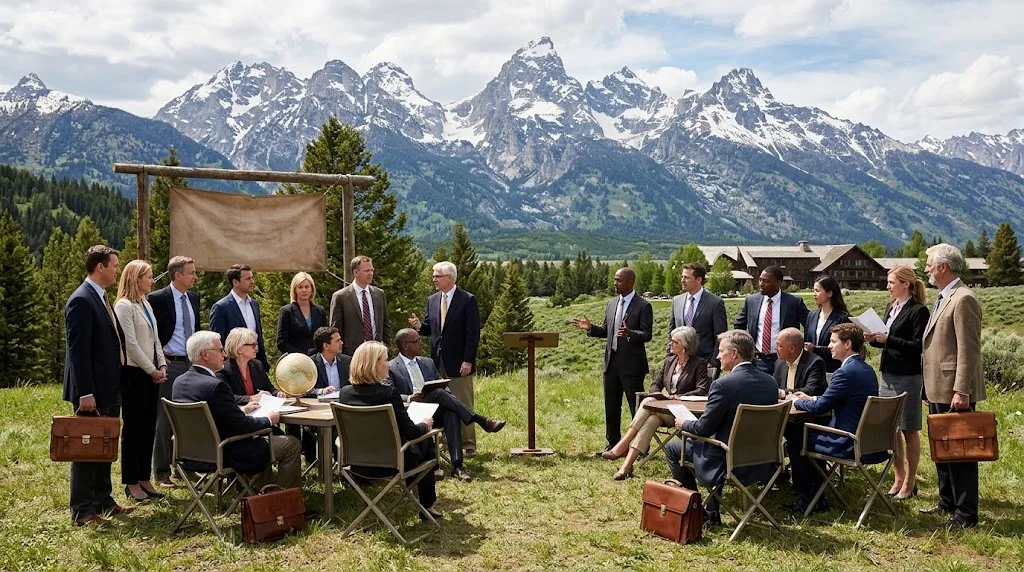
Every August a headline appears saying the dollar is waiting on Jackson Hole, and it is never explained. It sounds like a place, and it is one — but in a trading context it means a three-day meeting that has repeatedly changed the direction of interest rates before any official decision was taken.
Here is what it is?, why it matters?, and what to actually watch if you trade currencies?
What is Jackson Hole, actually?
Its full name is the Economic Policy Symposium, and it is hosted by the Federal Reserve Bank of Kansas City — one of the twelve regional banks that make up the Federal Reserve, the central bank of the United States.
It has run since 1978. Since 1982 it has been held at the Jackson Lake Lodge, in Grand Teton National Park, Wyoming — which is where the shorthand comes from. Nobody says "the Economic Policy Symposium". They say Jackson Hole, and everyone knows what is meant.
The guest list is what gives it weight: governors of central banks from around the world, finance officials, academic economists and financial press, in one building, for three days, in late August.
How did an agriculture conference become the Fed's biggest stage?
This is the part that explains why it is held in a national park rather than in Washington.
The first symposium, in 1978, was called World Agricultural Trade: The Potential for Growth, and it was held in Kansas City. The ones that followed ran in Vail and Denver, Colorado, and stayed on agricultural themes. It was a regional conference about farming.
In 1982 the Kansas City Fed's president, Roger Guffey, wanted to attract the Fed Chair, Paul Volcker. Volcker was a keen fly fisherman. So the organisers picked a venue with good fly fishing, and titled that year's symposium Monetary Policy Issues in the 1980s.
Volcker came. His successors kept coming, and so did central bankers from the rest of the world. A farming conference became the most closely watched of all central bank events because someone worked out what the guest of honour did on weekends.
Why do traders care?
A central bank rarely surprises the market with a decision. It prepares the ground first, and Jackson Hole is one of the places that preparation happens — a speech, not a vote, which means it can float an idea without committing to it.
Three occasions show the pattern:
| Year | What did the Chair signal? | What followed? |
|---|---|---|
| 2010 | Bernanke outlined bond buying to support growth | The programme known as QE2 was formally announced that November |
| 2020 | Powell announced a flexible form of average inflation targeting | The Fed would tolerate inflation moderately above 2% to make up for periods below it |
| 2022 | Powell said fighting inflation would bring "pain" to households and businesses | US stock indices closed at least 3% lower that day |
Note what those three have in common: no interest rate changed on any of those days. The decisions came later, or were about a framework rather than a rate. What moved was the market's expectation — and expectation is what prices a currency.
If you want the mechanism behind that, it is the same one covered in our explainer on monetary policy and in the difference between hawkish and dovish stances.
What actually moves, in forex terms?
Jackson Hole is a central bank policy forex event, not a data release. There is no number to beat, so the reaction is a repricing of expectations rather than a snap to a figure.
The chain usually runs in this order:
Expectations first. The market rewrites how many rate moves it expects and when. This is why the FOMC dot plot becomes relevant again straight afterwards — the speech reframes what the next set of projections should say.
Then yields. Government bond yields adjust to the new expected path.
Then the dollar. A currency is priced against the real return available in it, so the dollar follows the yields rather than the speech itself.
Then everything priced in dollars. Gold is the clearest case, because it pays no interest — which is exactly the reason a hawkish Fed crushes gold.
That ordering matters practically. The headline hits your screen before the repricing finishes, and trading the headline means trading the noisiest part of the move.
How do you read it as a trader?
Watch the reaction, not the speech. Text is ambiguous by design — a chair who wanted to be unambiguous would call a press conference. The bond market's verdict tells you how it was actually read.
Expect the whole week to be affected, not the speech hour. Positioning thins out ahead of it and liquidity stays poor afterwards while the interpretation settles.
Treat it as a scheduled volatility event. Among forex traders central banks are the one calendar item that reliably widens ranges, and Jackson Hole is the least predictable of them because there is no vote to anchor it. Our Market Readiness Score (MRS) exists to flag exactly this kind of condition — the point is not that conditions are bad, it is knowing they are unusual before you size a position.
One speech is not a policy change. The chair can float an idea the committee never adopts. Until it appears in a FOMC rate decision, it is a signal, not a fact.
Jackson Hole 2026: Warsh's debut
This section is about the current year and will date; the rest of this explainer does not.
The 2026 symposium is Kevin Warsh's first as Fed Chair, which makes it unusually hard to read: there is no track record of how this chair uses the venue.
The desks are framing it as a credibility event rather than a policy one. TD Securities expects the speech to lean on structural themes — productivity, growth driven by artificial intelligence, and regime change at the Federal Reserve — and argues the risk is volatility over credibility rather than a conventional policy signal. FXStreet frames the week as Warsh's debut alongside a US inflation test, against a soft dollar.
For context on why a new chair's credibility is itself a market variable, see our piece on the dollar and Fed independence.
The takeaway
Jackson Hole is a three-day academic conference in Wyoming that became the place where central banks think out loud. It moves currencies because it changes expectations, and expectations move exchange rates well before decisions do.
If you only remember one thing: it is a speech, not a decision — which is precisely why the reaction is worth more of your attention than the words.
For how this played out in the week running up to the 2026 symposium, see our weekly wrap on the dollar's rotation.