What was the Asian financial crisis?
A dollar bought 24.52 baht one day and 30.18 the next. What was the Asian financial crisis, and why did it not stop at Thailand?
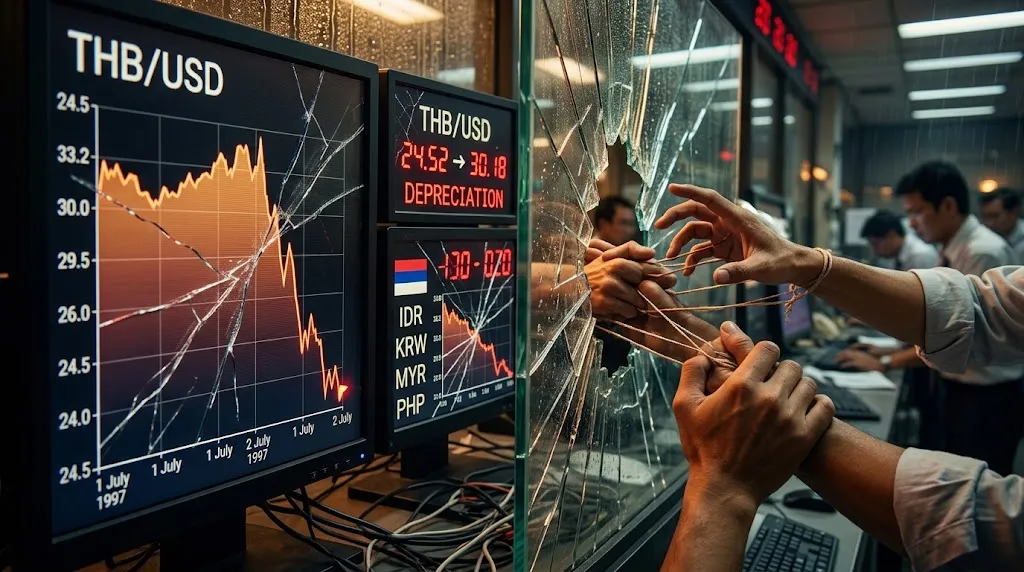
On 1 July 1997 a dollar bought 24.52 Thai baht. The next day it bought 30.18. Within six months it bought more than twice the original amount.
What was Thailand defending?
The baht was managed against a basket dominated by the dollar, and the Bank of Thailand spent reserves to hold it there. Foreign capital had poured into the country on the strength of that stability: if the currency could not move, borrowing cheaply in dollars looked close to free money.
That is the trap. A currency that cannot move invites exactly the borrowing that makes it impossible to defend.
What happened on 2 July 1997?
Thailand abandoned the managed rate and let the baht float. The figures are unusually blunt:
| Date | Baht per dollar | The dollar's gain |
|---|---|---|
| 1 Jul 1997 | 24.52 | — |
| 2 Jul 1997 | 30.18 | +23.1% |
| 31 Dec 1997 | 46.80 | +90.9% |
| 6 Jan 1998 | 53.00 | +116.1% |
A dollar debt taken on at 24.52 had to be repaid at 53.00. Nothing about the borrower changed; the exchange rate did all of it.
Why did it not stop at Thailand?
Because the market stopped pricing each country and started pricing the pattern. Investors who had been comfortable with one managed peg looked at every other managed peg in the region and asked the same question at the same time. Indonesia, South Korea, Malaysia and the Philippines followed within months.
That is correlation in its most expensive form: positions across several countries that look independent turn out to be one position in "emerging Asia" the moment confidence goes.
How is it different from the Frankenshock?
Both are a defended level failing, and the difference is who gave up. In Switzerland the central bank chose to stop paying, and the currency rose. In Thailand the reserves ran out and the currency collapsed.
Same lesson from opposite directions: the level lasted exactly as long as someone could afford to defend it. The first case tells you a defence can end by decision, the second that it can end by exhaustion.
What can a retail trader take from it?
- A stable quote is a statement about a defence, not about the economy behind it.
- The move is one-sided. A managed currency that breaks does not drift both ways first; it goes the way the defence was holding it back from.
- Diversifying inside one story is not diversifying. Four currencies, one premise.
- Intervention works with the fundamentals, not against them. Thailand was pushing uphill against capital flight, and reserves are finite in a way that market pressure is not.
Exchange rates are daily noon figures from FRED series DEXTHUS (Federal Reserve Bank of St. Louis). The float of 2 July 1997 and the regional sequence that followed are matters of public record.