What was Long-Term Capital Management?
A fund with two Nobel laureates lost almost everything in four months. What was Long-Term Capital Management, and who really paid for the rescue?
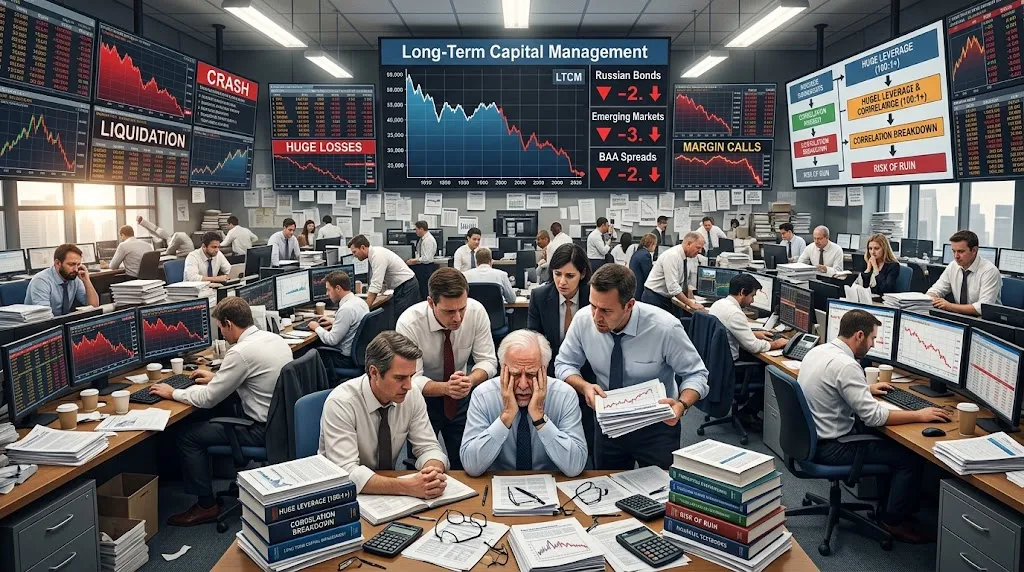
A fund with two Nobel laureates on its board lost almost everything in four months — and the rescue that followed was not paid for with public money.
What was LTCM actually betting on?
Long-Term Capital Management (LTCM) opened in 1994, run by John Meriwether, with Myron Scholes and Robert Merton — who shared the 1997 Nobel Prize in Economics — attached to the firm.
Its strategy was convergence arbitrage: find two assets that history says should trade at a stable distance from each other, buy the cheap one, sell the dear one, and wait for the gap to close. Each trade earned very little, because the mispricing it fed on was tiny by design.
Why did leverage turn a small edge into a large risk?
A tiny edge only becomes a business if you repeat it at size. LTCM borrowed heavily to do exactly that — the same arithmetic that makes retail leverage dangerous, several orders of magnitude larger.
Alan Greenspan, testifying to Congress on 1 October 1998, said the fund had returned $2¾ billion of capital to investors at the end of 1997 and then "reached further for return over time by employing more leverage and increasing its exposure to risk, a strategy that was destined to fail."
What actually broke in 1998?
The models assumed those spreads moved more or less independently of each other. After Russia defaulted that summer, they stopped: investors sold everything risky at once, and every spread widened together.
Moody's Baa corporate bonds yielded 1.67 percentage points more than the 10-year Treasury on 1 July 1998. By 16 October the gap was 2.77 points — it had widened by more than a full point in fifteen weeks.
That is correlation risk in its purest form: positions that look diversified turn out to be one bet when everybody reaches for the exit at the same moment.
Was it really a bailout?
This is the part most retellings get wrong. On 23 September 1998 a group of private creditors agreed to a capital infusion of about $3½ billion, in return for diluting the existing shareholders down to roughly one tenth of the firm.
Greenspan was explicit about who paid: "This agreement was not a government bailout, in that Federal Reserve funds were neither provided nor ever even suggested." The Federal Reserve Bank of New York convened the room because it judged that a forced liquidation would distort prices and damage firms with no connection to the fund. It did not write a cheque.
What can a retail trader take from it?
- A small edge plus large borrowing is not a small risk. The strategy was defensible on paper. What ruined it was the size at which it had to run to be worth running.
- Correlation is a fair-weather number. Spreads that behave independently for years can move together in a week — and that week is usually the one where the position is biggest.
- Surviving is a separate skill from being right. Many of those trades did eventually converge. The fund was not there to collect.
- The arithmetic has a name. Risk of ruin is what decides whether a sound strategy ever gets to pay out.
- The mirror image is worth reading. The Medallion Fund ran a tiny statistical edge too — and stayed deliberately small.
Quotations and figures come from Alan Greenspan's testimony before the House Committee on Banking and Financial Services, 1 October 1998 (Federal Reserve), and from FRED series BAA10Y (Federal Reserve Bank of St. Louis).