What was the Volcker shock?
Rates went from 10.94% to 19.10% and inflation fell from 14.6% to 2.5%. What was the Volcker shock, and why is it the benchmark for every hiking cycle?
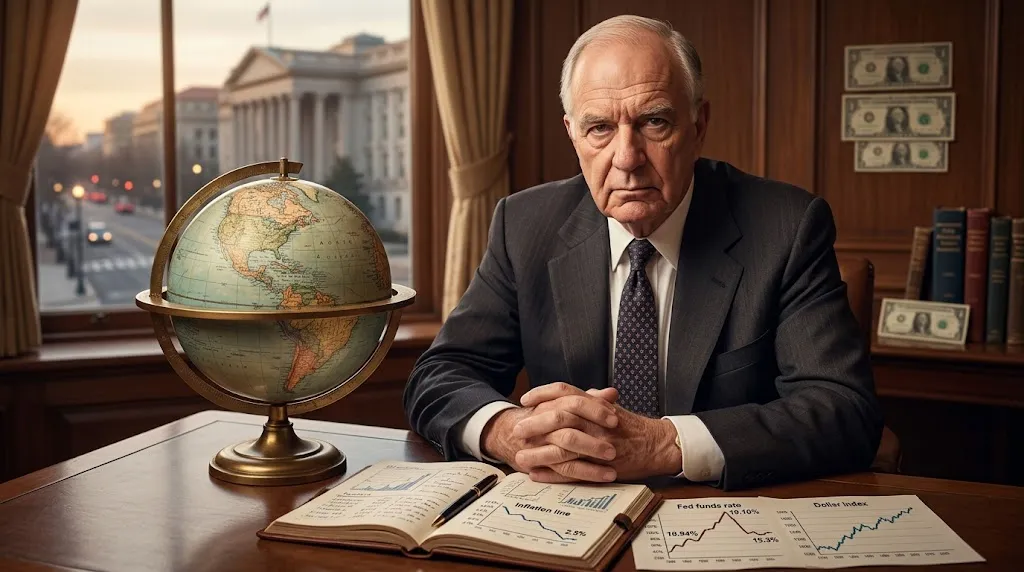
A central bank took its policy rate from 10.94% to 19.10%, accepted two recessions, and brought inflation down from 14.6% to 2.5%. The dollar rose about 51% along the way.
What was he handed?
Paul Volcker became Chairman of the Federal Reserve on 6 August 1979. That month the effective federal funds rate was 10.94% and consumer prices were running 11.8% above the year before. Inflation had been high for most of a decade and each attempt to tame it had been abandoned when the economy complained.
The credibility problem mattered more than the arithmetic. Nobody believed a tightening would be seen through, so nobody changed behaviour, so it never worked.
How high did rates actually go?
| Date | Fed funds rate | Inflation (year on year) |
|---|---|---|
| Aug 1979 | 10.94% | 11.8% |
| Mar 1980 | 17.19% | 14.6% |
| Jun 1981 | 19.10% | 9.7% |
| Jun 1983 | 8.98% | 2.5% |
The path was not a straight line. Rates fell sharply in mid-1980 as the economy contracted, then went higher than before — and it was that second climb, not the first, that settled the question of whether the Fed would flinch.
What did it do to the dollar?
It repriced it. Money goes where it is paid, and for several years the United States paid more than anywhere else. On the Fed's trade-weighted index the dollar rose from about 95 in January 1980 to roughly 144 by March 1985 — a gain of about 51%.
That is the mechanism behind every rate decision a trader watches today, and the reason the carry trade exists at all: the gap between two policy rates is a payment, and capital moves toward it.
Why is it the reference every hiking cycle gets measured against?
Because it is the case where a central bank took the unpopular side and held it. When headlines today describe policy as restrictive, the implicit comparison is to a period when the policy rate stood at nearly twice current inflation — which is a long way from where most cycles ever get.
What can a retail trader take from it?
- A rate cycle is a currency story before it is an economic one. The dollar index moved for years on this.
- The path is not the destination. Rates fell hard in 1980 before going higher. A pause is not a pivot, and the tape mistook one for the other at the time.
- Credibility is a tradeable variable. What changed was not the level of rates but the belief that they would stay.
- Nobody rings a bell. The tightening that worked looked, while it was happening, exactly like the ones that had been abandoned.
Rates are the monthly effective federal funds rate (FRED series FEDFUNDS); inflation is computed year on year from CPIAUCSL; the dollar is the Fed's trade-weighted index (TWEXMMTH). All from the Federal Reserve Bank of St. Louis.