What was the Frankenshock?
For six weeks EUR/CHF barely moved. What was the Frankenshock, and why did stop-losses fail to protect anyone on 15 January 2015?
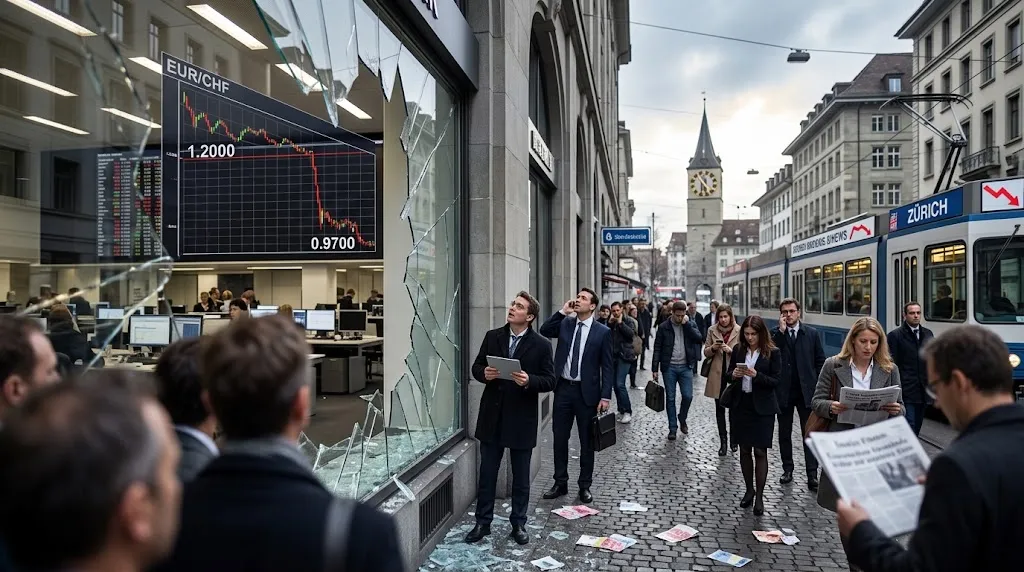
For six weeks EUR/CHF had not moved outside a two-tenths-of-a-cent band. Then a central bank stopped defending it, and the pair fell 13.8% in a day.
What was the floor, and why did it exist?
The Swiss franc is a haven: money moves into it when investors are frightened, which pushes it up regardless of what Switzerland's own economy is doing. That is the part covered in why CHF is called the 'swissie'.
In September 2011, with the euro crisis pushing the franc higher and Swiss exporters squeezed, the Swiss National Bank (SNB) set a minimum exchange rate: it would not let EUR/CHF trade below 1.20, and it would buy euros without limit to enforce that.
For more than three years it held. The daily fixings show how total the control was — between 1 December 2014 and 14 January 2015, EUR/CHF never left the 1.2008 to 1.2043 range.
What did the SNB announce?
On 15 January 2015 the bank published a release with a title that says everything: Swiss National Bank discontinues minimum exchange rate and lowers interest rate to −0.75%.
There was no warning and no transition. The floor was there on Wednesday and gone on Thursday.
How far did the franc actually move?
| Date | EUR/CHF | USD/CHF |
|---|---|---|
| 14 Jan 2015 | 1.2009 | 1.0172 |
| 15 Jan 2015 | 1.0357 | 0.8930 |
| 16 Jan 2015 | 0.9776 | 0.8488 |
EUR/CHF fell 13.8% on the day of the announcement and 18.6% over two sessions. Intraday the move was far larger than the closing figures show, because for a period there was almost no price at all.
Why did stop-losses not protect anyone?
Because a stop-loss is an instruction to sell at the market, not a promise of a price. When a floor is removed, the orders that would have taken the other side disappear at the same instant, and the next available price can be hundreds of pips away.
This is the same mechanism as the widening described in why the spread widens overnight, taken to its extreme: it is not a matter of an unlucky fill but of a market with nothing behind the bid. Several retail brokers ended the day with clients owing more than their account balance.
What can a retail trader take from it?
- A quiet market is not a safe market. Six weeks of near-zero range was the visible sign of a policy, not of calm — and policies end.
- Stops do not cap the loss they appear to cap. Where you place your stop-loss decides your plan; liquidity decides what you actually get.
- Leverage sets the size of the accident. The same 13.8% move is a bad day or a closed account depending only on leverage.
- A defended level is a one-sided bet on a committee. A floor held by a central bank lasts exactly as long as it wants to pay for it.
- The opposite case is on file. For an intervention that pushed with the trend instead of against it, read what was the Plaza Accord?
The announcement is the Swiss National Bank press release of 15 January 2015. Exchange rates are daily figures derived from FRED series DEXSZUS and DEXUSEU (Federal Reserve Bank of St. Louis).