What was the Plaza Accord?
Five governments published a short statement on a Sunday in 1985. What was the Plaza Accord, and why did the dollar lose half its value in two years?
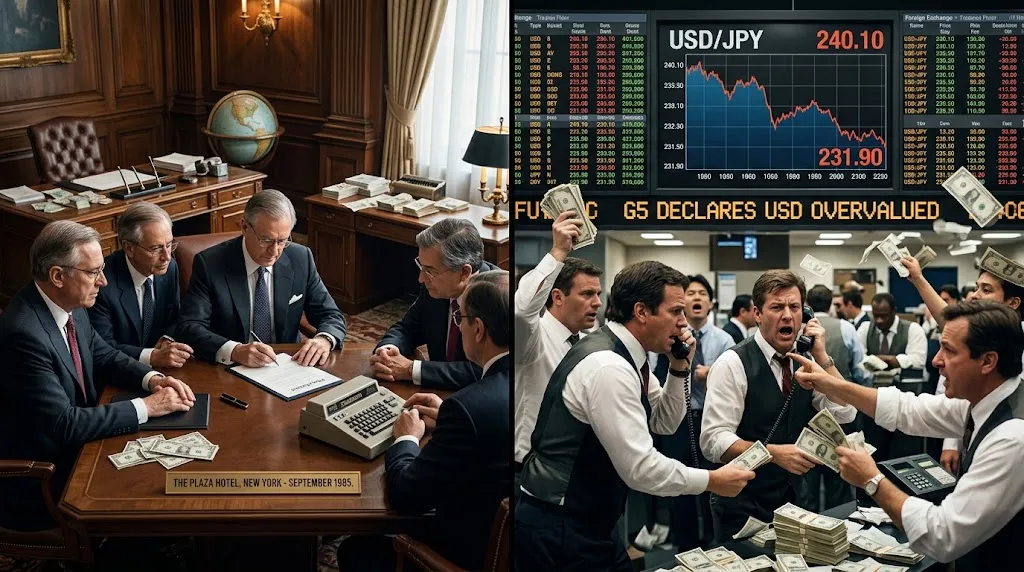
Five governments published a short statement on a Sunday in 1985, and the dollar fell 3.4% against the yen before Monday was over.
What did the five countries actually agree?
On 22 September 1985 the finance ministers and central bank governors of France, Germany, Japan, the United Kingdom and the United States — the Group of Five, or G5 — met at the Plaza Hotel in New York and issued a joint announcement.
The operative sentence is remarkably mild. They judged that "some further orderly appreciation of the main non-dollar currencies against the dollar is desirable" and said they stood "ready to cooperate more closely to encourage this when to do so would be helpful."
No amount was named. No mechanism was described. There was no deadline.
How fast did the dollar actually move?
Faster than the language suggests. The dollar had closed the Friday before at 240.10 yen. On the Monday after the announcement it closed at 231.90 — a fall of 3.4% in one session.
| Date | USD/JPY | Change from 20 Sep 1985 |
|---|---|---|
| 20 Sep 1985 (Friday before) | 240.10 | — |
| 23 Sep 1985 (Monday after) | 231.90 | −3.4% |
| 30 Sep 1985 | 216.50 | −9.8% |
| 19 Sep 1986 | 152.00 | −36.7% |
| 31 Dec 1987 | 121.25 | −49.5% |
Two years later the dollar had lost about half its value against the yen.
Why did a statement move a market that size?
Because the statement was not really the intervention — it was the announcement that intervention had become coordinated. Five central banks acting together are a different counterparty from one acting alone, and the market repriced against a seller it could not outlast.
That is the pattern in currency intervention generally: it works when it pushes in the direction the fundamentals were already leaning, and it fails when it tries to hold a line the market has decided to test.
Does this still matter to a trader today?
The Plaza Accord is the reason "coordinated intervention" is treated as a distinct category of risk rather than a detail. A single finance ministry buying its own currency is an event. Several of them agreeing to do it in the same week is a regime change, and it arrives as a press release, not as a chart pattern.
What can a retail trader take from it?
- Words are a tool, not a warm-up. The move started before a single order was placed, because the market priced the promise.
- Direction matters more than firepower. The dollar had already been widely judged overvalued. The accord pushed a door that was ajar.
- Weekend announcements land as gaps. A decision taken on a Sunday does not wait for you to be at your screen.
- The reverse case is on file. Where an intervention tries to hold a line rather than accelerate a trend, read what was the Frankenshock?
The text of the announcement is from the G8 Information Centre, University of Toronto. Exchange rates are daily noon figures from FRED series DEXJPUS (Federal Reserve Bank of St. Louis).