Are you really competing against high-frequency trading?
HFT competes against other machines over microseconds, not against you. What is it really, where do you feel it as retail, and why was your edge never speed?

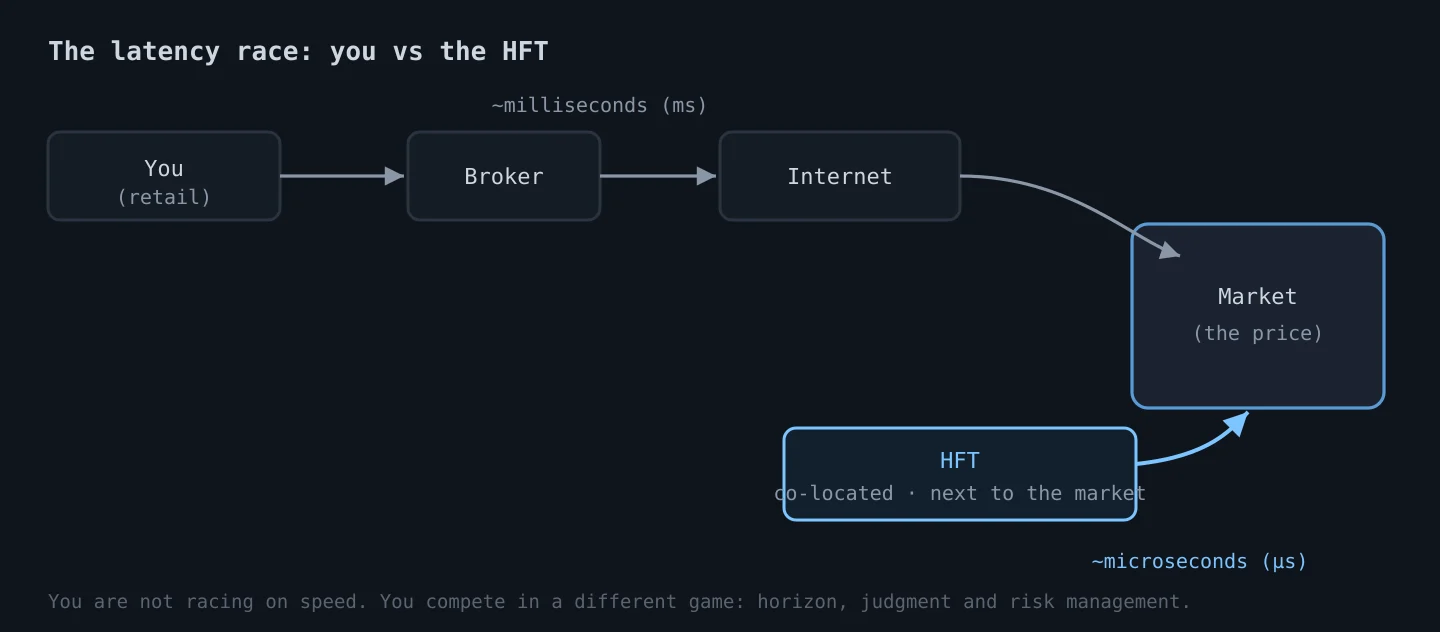
No. High-frequency trading (HFT) competes against other algorithms over microseconds, not against you. As a retail trader you're not in that race, and your edge was never speed.
What is HFT really?
It's algorithmic trading pushed to the extreme of speed: systems that fire thousands of orders in microseconds to arbitrage or provide liquidity. It's not magic or a named enemy; it's algorithmic trading optimized to win fractions of a millisecond against other machines. Its rival is another HFT, not your swing or intraday trading.
Where do you "feel" it as retail?
Not as a rival chasing you, but as market microstructure. It's part of why the spread widens overnight when liquidity drops, and of why price jumps all at once when news hits. That's not the machine coming for you: it's the market. Mistaking it for a personal enemy only feeds anxiety — the same error behind the belief that forex is a zero-sum duel against other traders.
So where is your edge?
In the time frame where speed doesn't decide. You don't beat HFT on the tick; you win by choosing when to trade: timing and volatility matter more than reaction, and reading whether conditions favor your trade before you enter is worth more than any microsecond.
And doesn't AI level me up to them?
No. AI is a copilot, not a pilot: it sharpens your analysis, it doesn't turn you into an HFT. And chasing that speed also carries a mental cost that isn't worth it. Your job isn't to be the fastest machine; it's to be the most consistent human.