The dollar fell all week, so why did the winner change every day?
Five sessions of dollar weakness produced five different winners: CAD, JPY, NZD, CHF and GBP. That rotation, not the slide itself, is what Warsh’s Jackson Hole debut will test next week.
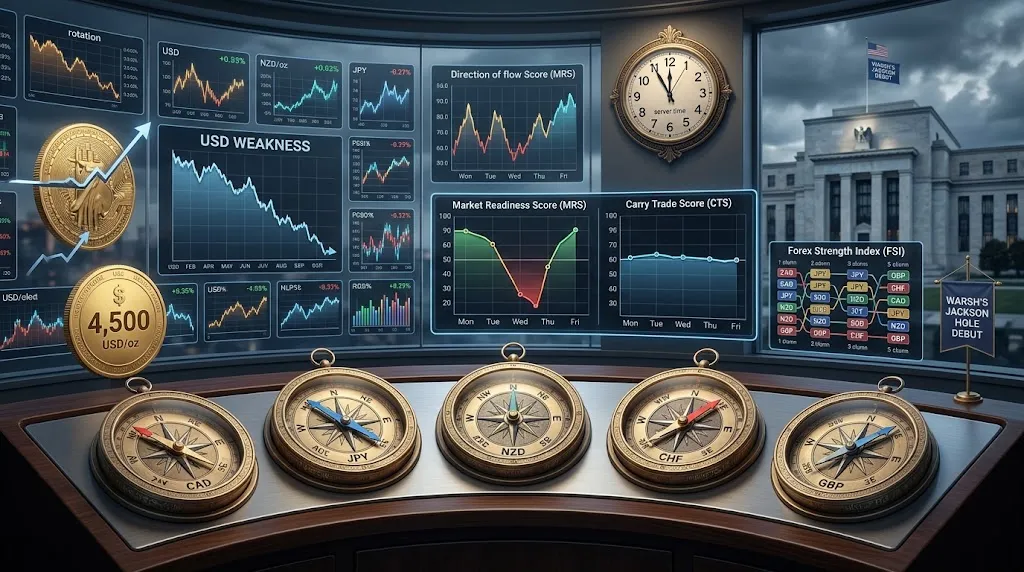
The US dollar lost ground on four of this week's five sessions. That part is easy to summarise. The part worth your attention is that it produced a different winner every single day.
Here is what our own gauges recorded, session by session:
| Session | Strongest | Weakest | MRS | CTS |
|---|---|---|---|---|
| Mon 17 | CAD | NZD | 66 | 80 |
| Tue 18 | JPY | CAD | 59 | 79 |
| Wed 19 | NZD | USD | 47 | 80 |
| Thu 20 | CHF | EUR | 49 | 79 |
| Fri 21 | GBP | CHF | 66 | 80 |
Five sessions, five different leaders. The Canadian dollar topped the table on Monday and sat at the bottom of it on Tuesday. The Swiss franc led on Thursday and trailed on Friday.
That is not what a trend looks like. A trending market produces a persistent winner — the currency that keeps absorbing the flow while everything else gives way. What this week produced was rotation: a weak dollar with no settled counterpart.
What pushed the dollar down?
Three separate forces, arriving in order.
It started with fading rate-hike expectations. Monday's session carried the dollar lower for a second day as the market pared back its bets on further Federal Reserve tightening, lifting the pound to a three-month high (Monday's roundup).
Softer US data extended it on Tuesday, and geopolitics added a second engine: Middle East tension pushed both oil and gold higher (Tuesday's roundup). Wednesday held the two forces in tension — geopolitical risk against fading rate expectations — with the kiwi taking the lead (Wednesday's roundup).
Then came the one that actually mattered. On Wednesday the US Treasury announced a buyback programme, and long-term yields fell in response. The dollar followed them down to three-month lows (Thursday's roundup). This is the mechanism worth understanding: buybacks change the supply of long-dated paper, yields adjust, and the currency reprices against a new real-yield backdrop. It is a plumbing story, not a policy story — which is precisely why it caught positioning off guard.
Gold cleared $4,500
Gold rode that yield move. It climbed more than 2% as the buyback plan pressured long-term yields, and by late Wednesday it had broken above $4,500. Thursday it slipped back under, then reclaimed the level.
The relationship is not mysterious: lower real yields reduce the cost of holding an asset that pays no interest, which is the reason a hawkish Fed crushes gold and the reason a dovish repricing does the opposite.
Two levels matter here and they are easy to confuse. $4,400 was the ceiling that had turned gold back for five sessions; $4,500 is where the move ended. Thursday's roundup clears the first in its headline and reports the second in its summary — both are correct.
Friday changed the tone
The dollar recovered as yields firmed. The Dollar Index ended the week near 98.80, having traded down into the 98.50s before turning back up — essentially flat against Thursday's close, according to FXStreet's weekly review. The pound led the majors and gold held its gains (Friday's roundup).
Notice what our Market Readiness Score (MRS) did across the same stretch: 66 on Monday, down to 47 by Wednesday, back to 66 on Friday. The middle of the week was the hostile part — conditions deteriorated exactly while the dollar was falling hardest. Meanwhile the Carry Trade Score (CTS) never moved outside 79–80. Carry conditions stayed steady all week; it was readiness that swung.
What stays open?
Nothing this week resolved the central question: is the dollar's decline a repricing of Fed policy, or a mechanical response to Treasury plumbing? That question now walks straight into next week's main event.
Warsh's Jackson Hole debut. FXStreet frames the coming week as Kevin Warsh's first Jackson Hole appearance as Fed Chair, alongside a US inflation test, against a soft dollar. TD Securities expects the speech to lean on structural themes — productivity, AI-driven growth, Federal Reserve regime change — and argues the risk is volatility over credibility rather than a conventional policy signal. That matters because credibility is the one variable that reprices every dollar pair at once.
Gold. TD Securities sees upside asymmetry into next week, noting that precious metals now trade in a higher range that could trigger another round of buying from trend-following funds. A range that holds long enough tends to pull in the systematic money.
Oil and the Iran risk. Commerzbank points to tension around the Strait of Hormuz and tight diesel inventories keeping Brent elevated. The same conflict shows up in European data: Commerzbank expects Germany's Ifo business climate index to slip from 86.6 to 86.0 on the war's drag.
The majors. Scotiabank reads a bullish structure in the Canadian dollar pointing toward the 1.35 handle, while TD Securities cautions the Bank of Canada will stay patient even if a tariff agreement lands. In Europe, Nomura and Brown Brothers Harriman both flag resilient August PMIs, manufacturing-led. Investing.com names NZD/USD, USD/JPY and AUD/USD as the pairs to watch.
How would we read it?
The honest summary of this week is that the dollar weakened without anyone winning the argument about why. When a currency falls and the beneficiary changes daily, the market is expressing doubt about the dollar rather than conviction about an alternative.
That is a rotation regime, and rotation regimes end in one of two ways: a catalyst arrives and one counterpart takes the lead, or the move fades and the dollar retraces. Jackson Hole is the obvious candidate for the catalyst.
If you trade next week, the thing to watch is not the dollar's direction. It is whether one currency finally holds the top of the table two days running. That is the tell that rotation has become a trend — and our Forex Strength Index (FSI) is built to surface exactly that shift. Until it happens, treat strength as temporary, because this week it always was.
Update — 28 August. Warsh gave that speech, and it answered the question above: the slide was a repricing of Fed policy, not Treasury plumbing. The rotation never produced a two-day leader — it ended because the dollar itself turned. The full week is in our wrap of 28 August.