USD/CHF: how much does it move, when, and what moves it?
The calmest of the five majors: a 53-pip median and 24% of days under 40. Its −0.83 against EUR/USD is the strongest inverse relationship in the series.
USD/CHF is the calmest of the five majors we measured: 53 pips of median daily range, with almost one session in four failing to reach 40. It also holds the strongest inverse relationship in the whole series with another pair, and that is why it is worth understanding even if you never trade it.
How the numbers were built. Hourly bars from January 2021 to September 2026. The headline figures use the last two years, 521 Monday-to-Friday days, with Sundays excluded because in UTC they hold only the first two or three hours of the week. Every hour below is UTC.
How much does USD/CHF move in a day?
| Kind of day | Range |
|---|---|
| Very quiet (10th percentile) | 31 pips |
| Quiet (25th percentile) | 41 pips |
| Typical (median) | 53 pips |
| Busy (75th percentile) | 70 pips |
| Very busy (90th percentile) | 98 pips |
The figure that defines it is the floor: 24% of days do not reach 40 pips, one in four. And only 9% clear 100. If your strategy needs price to cover distance, you will be waiting here.
| Pair | Median daily range | Days under 40 pips |
|---|---|---|
| USD/CHF | 53 pips | 24% |
| USD/CAD | 59 pips | 17% |
| EUR/USD | 64 pips | 15% |
| GBP/USD | 80 pips | 5% |
| USD/JPY | 112 pips | 4% |
⚠️ That table compares pips, not money. To turn range into currency there is the position size calculator, and if the unit is unfamiliar, our guide to pips and their value.
What hours is it genuinely alive?
| Window (UTC) | Median range per hour |
|---|---|
| 22:00–05:00 · Asia | 6 to 8 pips |
| 06:00–08:00 · London opens | 9 to 13 pips |
| 09:00–11:00 · European morning | 10 to 11 pips |
| 12:00–16:00 · London–New York overlap | 11 to 16 pips |
| 17:00–21:00 · New York afternoon | 7 to 10 pips |
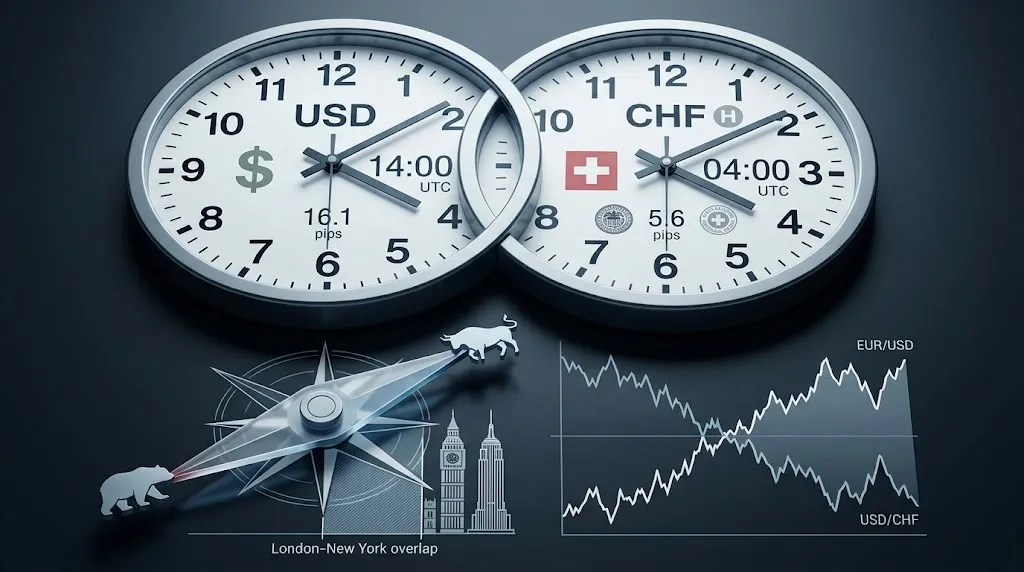
Peak at 14:00 UTC with 16.1 pips, trough at 04:00 with 5.6, and 60% of the daily range inside the London–New York overlap. In proportions it is almost identical to EUR/USD; what changes is the scale.
And one detail is worth a second look: this pair's flattest hour delivers 5.6 pips. In money terms that is close to noise, with the cost of getting in and out to pay on top. On USD/CHF, trading outside the overlap is not "less profitable" — usually it is simply not trading.
The map is in forex trading sessions and in session overlaps; live, on the session clock.
What moves USD/CHF?
- US data. In the hour non-farm payrolls are released its range is 2.23 times its range for that same hour on an ordinary day. The control is EUR/GBP, which carries no dollar and stays at 1.30. With a release coming, the news risk calculator turns that into size.
- The Federal Reserve (the Fed) against the Swiss National Bank, historically one of the most accommodative. A concrete episode of that divergence is in a hawkish Fed meets a dovish SNB.
- Fear. The franc is a haven: when markets take fright they buy it, and the pair falls. Which means part of its movement originates neither in Switzerland nor in the United States, but in whatever is happening somewhere else.
What does not move it, despite appearances?
None of that explains its defining trait, which is a relationship rather than a cause: it is the mirror of EUR/USD.
| What does it move with? | Correlation of daily returns |
|---|---|
| EUR/USD | −0.83 |
| USD/CAD | +0.55 |
That −0.83 is the strongest inverse relationship in the series; only AUD/USD and NZD/USD, at +0.89, move more tightly together. And it carries a practical consequence people miss: buying EUR/USD and buying USD/CHF together is not diversification, it is opening two positions that cancel each other while you pay the cost of both. The same mistake as trading EUR/USD and GBP/USD together, only inverted — it is explained in currency correlation, and the EUR/USD entry is this one's other half.
Is it a good pair to start on?
Yes, with one condition. Its calm is a genuine advantage while you are learning: mistakes cost fewer euros and there is time to think. But 24% of days under 40 pips punishes anyone who needs to trade every day, and that impatience is what usually breaks a new account.
Size with ATR (Average True Range) rather than the median. And on a calm pair the spread weighs proportionally more than anywhere else: always measure it against the range you expect, never in the abstract.
What these numbers do not tell you
- The median is not your day. It describes the centre of a distribution, not what happens tomorrow.
- No spread and no slippage are inside it, and on the calmest pair of the list that omission weighs most.
- The granularity is one hour, so a five-minute spike is invisible.
- It is a single feed — our broker's, normalised to UTC. Another would give similar numbers, not identical ones.
- This is not a forecast. It describes how the pair has behaved; the past shapes the expectation, never the outcome.