What is ATR (Average True Range)?
Average True Range measures how much a market typically moves — a volatility read that's one of the most practical tools for sizing positions and placing stops.

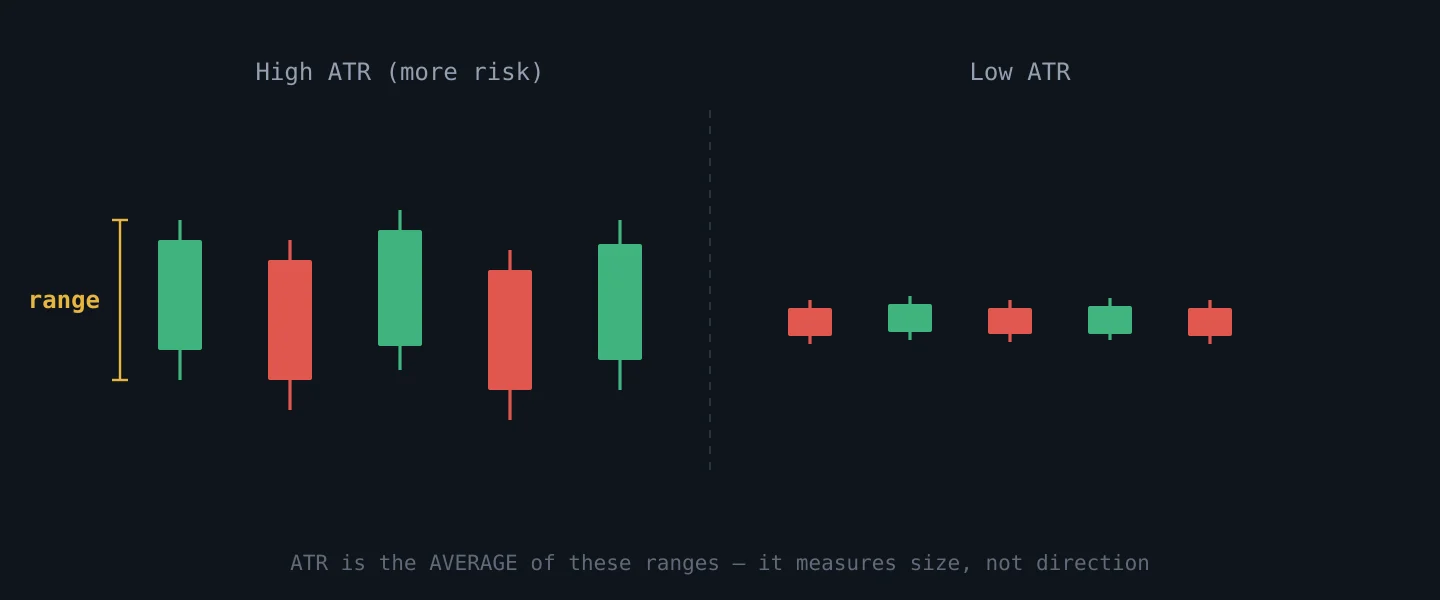
Average True Range (ATR) is a volatility indicator: it measures how much an instrument typically moves over a given period, in price terms. It doesn't tell you direction — only how big the swings are. That single number is one of the most practical tools a trader has for sizing positions and placing stops.
What does ATR actually measure?
ATR captures the "true range" of each bar — the largest of the high-to-low distance, or the gap from the previous close to the current high or low. Averaging that true range over a set number of periods (14 is the default) gives you the average distance price travels per bar. A rising ATR means volatility is expanding; a falling ATR means the market is calming down.
Why does it include gaps?
Ordinary high-minus-low ignores overnight gaps — which is exactly when big moves happen, after a weekend or a news release. By taking the previous close into account, true range captures that gap risk. This is why ATR is a more honest volatility read than raw candle size.
How do traders use it?
- Stop placement: setting a stop a multiple of ATR away from entry (say 1.5× ATR) keeps it outside normal noise, so routine wiggles don't take you out.
- Position sizing: if you risk a fixed amount per trade, a wider ATR means a wider stop means a smaller position — the core of the ATR position-sizing method.
- Target setting: projecting a realistic move as a multiple of ATR keeps profit targets grounded in how the instrument actually behaves.
What ATR won't do
ATR is not directional and not a buy/sell signal. A high ATR doesn't mean "go long" — it just means the market is moving fast, which cuts both ways. Used alone it's a context tool, not an entry trigger.
ATR in ForexCommand
ATR sits at the heart of the app's volatility read: the Market Readiness Score uses it to judge whether conditions are active enough to trade, and the ATR method drives smarter position sizing. When volatility expands, ATR is usually the first number to tell you.
The takeaway
Think of ATR as the market's speedometer. It won't point you toward a destination, but it tells you how fast you're going — exactly what you need to set a stop that survives the noise and a position size that matches the conditions.