OTC vs exchange: how is spot forex different from currency futures?
The same euro trades in two places: over the counter and on an exchange. Who is on the other side, who sets the price, and why does the futures quote not match spot?
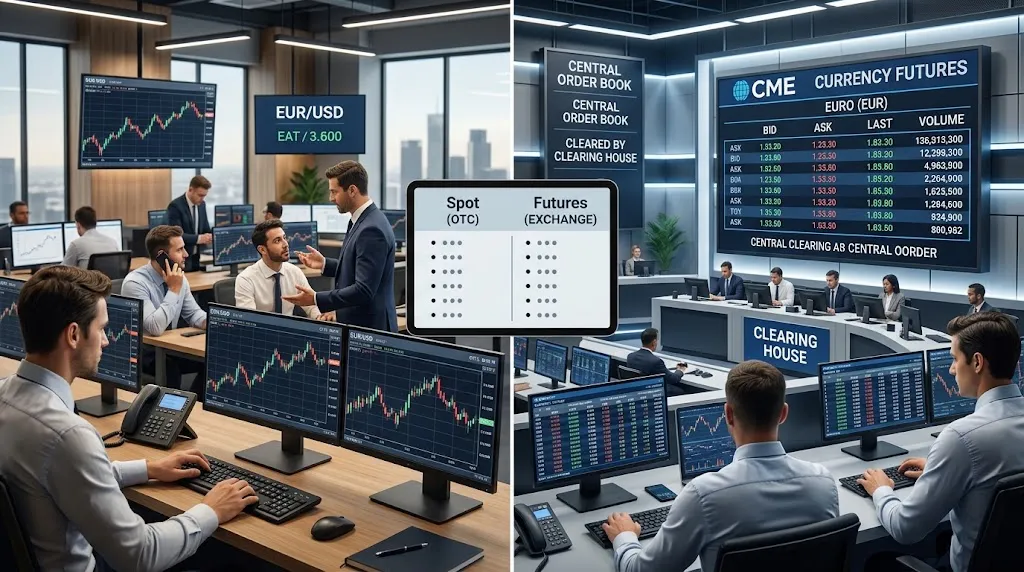
Spot forex trades over the counter (OTC): each deal is struck between two parties, with no central venue. Currency futures trade on an exchange, in standardised contracts, and every trade is cleared through a clearing house that stands between buyer and seller. It is the same euro in both places, but who you face, who sets the price and what you can see are different.
The basics of OTC trading are in our introduction to forex, and we have covered two of its consequences: the missing central order book, and the counterparty behind a retail broker's account. This article is about the comparison those leave open: the exchange-traded alternative.
The size of each side
The Triennial Survey of the BIS (Bank for International Settlements, the central banks' bank) put OTC FX trading at $9.5 trillion a day in April 2025, across all instruments, in the final figures published in December 2025. Spot, the segment closest to what a retail trader trades, was about $3 trillion a day, 31% of the total.
By our own estimate, first published in our piece on following the money, CME (Chicago Mercantile Exchange) currency futures trade a volume of around 3% of that spot figure. CME reports its volume in contracts, not dollars, so the conversion is our arithmetic. The exchange is the small side of the market. It is also the side you can see.
The two side by side
| Spot forex (OTC) | Currency futures (exchange) | |
|---|---|---|
| Where it trades | Between two parties, no central venue | On an exchange |
| Your counterparty | Your broker | The clearing house, reached through a futures broker |
| Contract terms | Whatever your broker offers | Standard size, delivery months, last trading day |
| Price | Each dealer quotes its own | One central order book |
| Volume you can see | Tick volume only | Traded volume, and positions in the COT report |
| Holding overnight | A daily swap | No swap: the rate gap is in the futures price |
The next three sections take the rows that surprise people most.
Your counterparty: a broker or a clearing house
Outside the US, at a retail broker selling contracts for difference (CFDs), the contract you sign is with the broker, whatever it does with the risk afterwards. That is the subject of your CFD broker is the counterparty, and it means that what stands behind your trade is that one firm. The US works differently: under the rules of the CFTC (Commodity Futures Trading Commission), the US derivatives regulator, in 17 CFR Part 5, a retail forex account is held with a retail foreign exchange dealer (RFED) or a futures commission merchant (FCM), and that firm is the counterparty.
A futures trade has a different structure. In its guide to how futures markets work, the CFTC explains that trades made on an exchange are cleared through a "clearing house," which "acts as the buyer to all sellers and the seller to all buyers". The contract is technically bought from or sold to the clearing house, not to the party on the other side of the execution. A retail trader still reaches it through a futures broker, an FCM.
To make that hold, the exchange or clearing house sets a margin, which the same CFTC guide calls "performance bonds" and puts typically between 2% and 10% of the contract's value. Every position is then marked to market daily: the day's loss comes out of your margin account, and if the account falls below the maintenance level, you post more, without waiting to close the trade. The margin a CFD broker asks for is a different arrangement, as margin vs leverage explains.
The futures price is not the spot price
Put a EUR/USD chart next to a euro futures chart and the numbers will not match. The gap is not an error. A future is a price for a later date, and a 2016 BIS paper on covered interest parity calls that rule "the closest thing to a physical law in international finance": the interest rate differential between two currencies "should equal the differential between the forward and spot exchange rates". A future is not a forward, but the same logic sets its price closely.
In spot forex you pay or receive that differential night by night, as the swap. In a future it is built into the price, and the gap closes as the contract approaches delivery: the CFTC says the purpose of the delivery provision "is to ensure convergence between the futures price and the cash market price".
Two caveats. That 2016 paper found the rule had not held since the 2007-08 financial crisis, so treat the rate gap as the main driver of the difference, not an exact formula. And most futures never reach delivery: the CFTC notes that most contracts, by volume, are closed out by offsetting before it.
What the exchange gives you, and what it does not
It gives you a central book, real traded volume and weekly positions in the COT report (Commitments of Traders), three things spot cannot offer, as our pieces on the order book and on the tick count your platform shows explain.
What it does not give you is the market your broker prices you in. The futures book is a real book for a volume about 3% the size of spot, not a window onto spot itself.
What this does not tell you
- Which is cheaper. We have not compared the all-in cost of a futures account with a spot or CFD account. It depends on the broker, as what a trade really costs shows for spot.
- Contract specifications. Sizes, delivery months and margins are set by each exchange and change over time. Check the exchange's own specifications before trading a contract.
- Much outside the US. The clearing and margin description comes from the CFTC, the US regulator. Other countries regulate futures under their own rules.
- Which one you should trade. This is a map of the two structures, not a recommendation.
The takeaway
Spot and futures are two ways of trading the same currencies. Spot gives you flexible sizes and a price from your broker; the exchange gives you a clearing house, a public book and published volume, with the interest rate gap built into the price. Knowing which one you are in tells you what you can check and what you have to trust.